
Payload CMS
Build code-first CMS backends with TypeScript schemas
Replaces Contentful, Sanity, Storyblok
Who it's for
Use Payload when a marketing site, documentation hub, or content-heavy app needs structured content APIs without usage-based vendor pricing.
Choose a managed CMS if your team does not want to operate the app, database, upgrades, and backups.
Use Payload for internal tools, product catalogs, media libraries, or admin workflows where content records need custom access rules and typed backend logic.
Skip it when the CMS should be completely separate from application code and owned entirely by non-technical editors.
The problem
Hosted CMS platforms can slow engineering teams down when schema changes, access rules, hooks, and deployment timing live outside the application codebase. Developers end up coordinating dashboard edits, API contracts, and vendor limits separately from the rest of the product. Payload CMS solves that by keeping collections, fields, hooks, authentication, and API behavior in TypeScript while still giving editors a web admin panel. Teams get a CMS that fits their release process, database choices, and hosting requirements instead of adapting their content model to a third-party content API.
How it works
Model collections, fields, validation, hooks, access control, and API behavior in code so CMS changes move through review with the rest of the application.
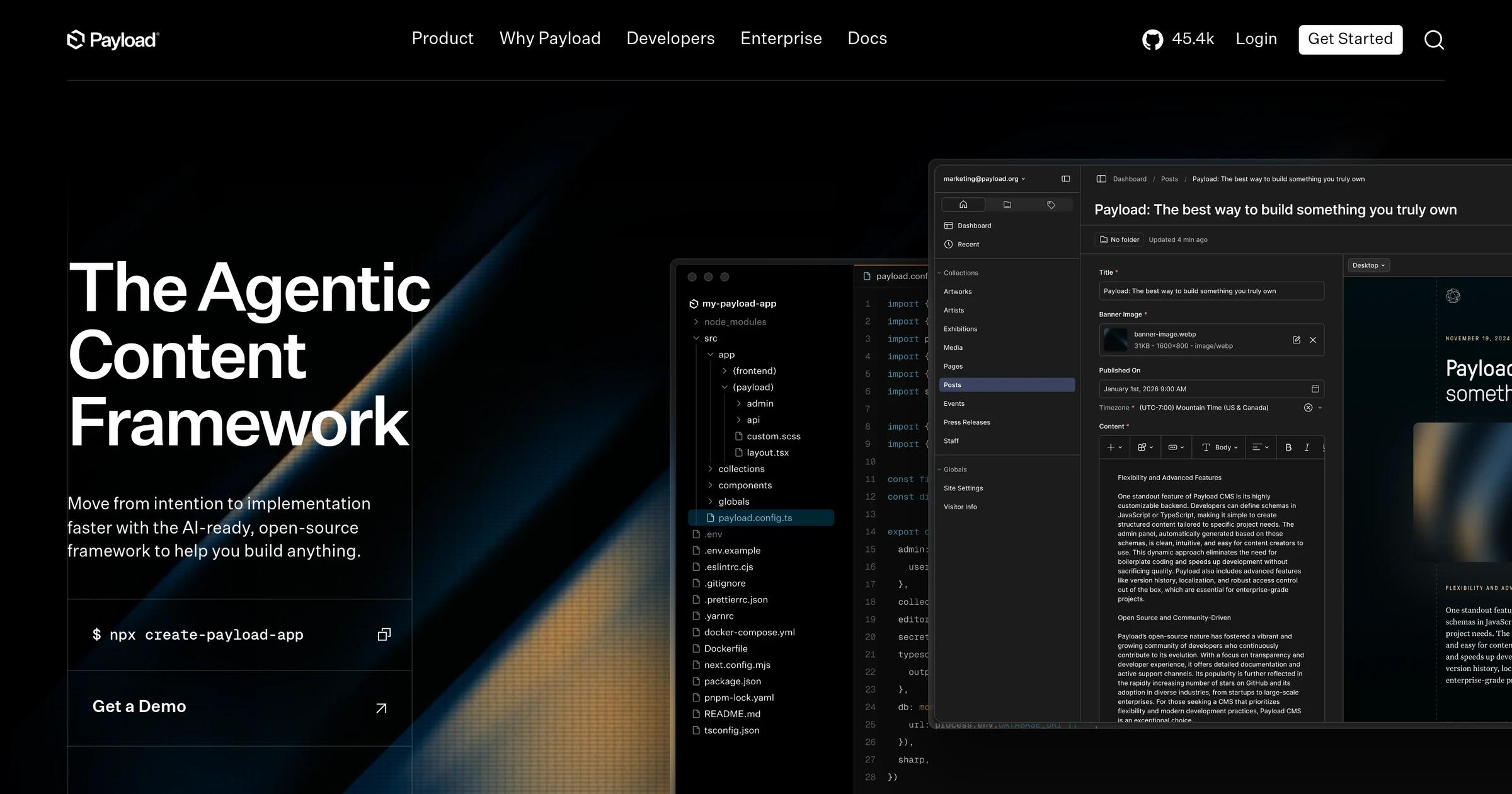
Give content teams a browser admin panel with drafts, uploads, localization, authentication, and publishing workflows without adopting a hosted content API.
Serve structured content through generated APIs while keeping database choice, deployment timing, and extension points under your control.
Features
- Define schemas in TypeScript
- Ship editor workflows
- Expose REST and GraphQL APIs
Recommended for this setup
Strengths
- Strong fit for Next.js teams: Payload works well when a team already builds in TypeScript and wants content schemas, backend logic, and application code in one release process.
- Full source and data control: Self-hosting lets teams choose infrastructure, database options, backup strategy, and compliance boundaries instead of depending on a proprietary content lake.
Trade-offs
- Requires engineering ownership: Payload is code-first, so non-technical teams may prefer a hosted CMS with a visual schema builder and managed operations.
Tech stack
FAQ
Yes. Payload CMS is MIT licensed, and the primary product code repository is payloadcms/payload on GitHub.
Payload CMS is best for TypeScript and Next.js teams that want code-defined content models, generated APIs, and self-hosted control.
Contentful is a managed SaaS content platform. Payload CMS is self-hosted and code-first, so teams trade vendor-managed operations for source, schema, and infrastructure control.