
InsForge
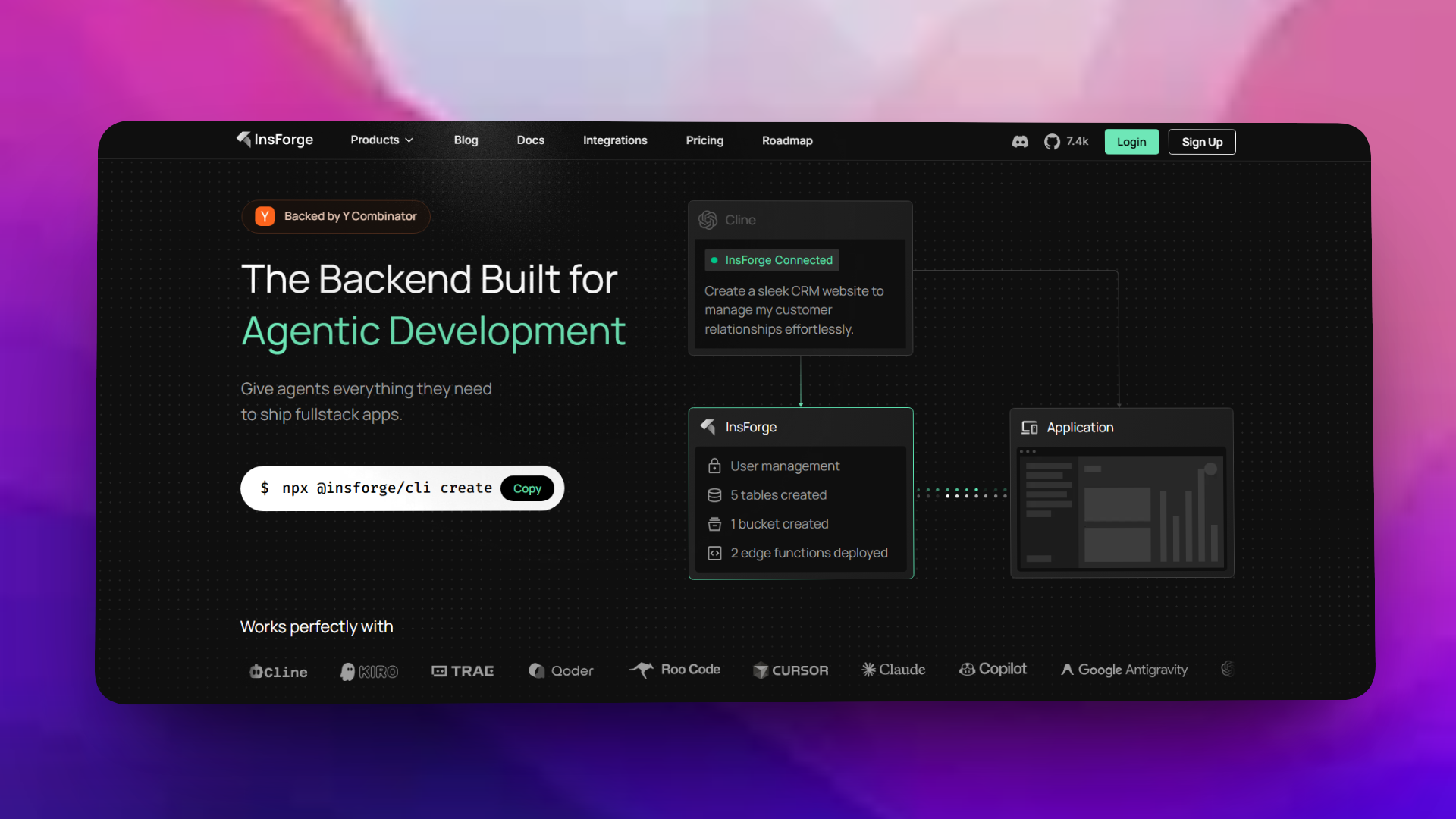
Backend-as-a-service platform built for AI coding agents
Replaces Supabase, Xano, Codeconductor Ai, Firebase
Who it's for
Use InsForge when agents need to configure backend services directly instead of only editing application files.
Skip if your workflow keeps all backend changes in human-reviewed infrastructure-as-code.
It fits experiments where database, auth, storage, and functions need to be created quickly while the agent keeps context.
Skip if you need a mature enterprise backend platform with a long compliance track record.
The problem
AI coding agents can write frontend code quickly, but they struggle when backend state, auth rules, storage buckets, migrations, deployed functions, and runtime logs live in separate systems. Without a backend control plane designed for agents, humans keep stepping in to configure infrastructure and explain state.
How it works
Exposes backend operations through an MCP server and, for cloud workflows, CLI plus Skills so coding agents can inspect and change backend state.
Covers authentication, database, storage, edge functions, model gateway, compute, and deployment rather than one isolated service.
Agents can read schemas, metadata, bucket contents, auth config, deployed functions, and logs before making changes.
Features
- Agent-facing backend interface
- Core backend primitives
- Runtime context for debugging
Recommended for this setup
Strengths
- Designed around agent workflows: InsForge treats AI coding agents as first-class backend operators, which is different from BaaS tools built only for human dashboards.
- Apache-2.0 repository: The Apache-2.0 license gives teams a permissive base for experimenting with agent-native backend infrastructure.
Trade-offs
- Young category with workflow risk: Agent-operated backend platforms are still emerging. Teams should gate production changes carefully and keep human review around auth, data, and deployment actions.
Tech stack
FAQ
InsForge is an open source backend platform that exposes database, auth, storage, compute, hosting, and AI gateway operations to coding agents.
Yes. The README describes an MCP server that lets compatible agents operate backend capabilities as tools.
It can cover backend primitives in an agent-focused way. Supabase is still the more established choice when the main need is a mature human-operated backend platform.