
Monica
Self-hosted personal relationship manager for friends and family.
Replaces Clay, Dex, Uphabit, Covve
Who it's for
Monica gives you one place to store everything you know about the people you care about: notes from conversations, birthdays, how you met, what their kids are named, and how they are doing. The records stay on your server when self-hosted.
You need professional contact enrichment, AI-driven networking insights, or integrations with business tools. Monica is not built for professional networking or career contact management.
Monica lets you record details about people that might be hard to retain naturally and surfaces reminders so you are not relying on memory for dates or follow-ups. The README explicitly names users with Asperger syndrome, Alzheimer's disease, and introverts as people who have found it valuable.
You need a lightweight mobile contacts app. Monica is a web application requiring self-hosting or a paid account; it is not a simple phone contacts replacement.
Running Monica on your own server means your relationship data stays entirely under your control. The AGPL-3.0 license makes the source auditable. The project commits to never tracking users and never running ads.
You prefer a managed service with no server maintenance. Monica's optional paid hosted plan at monicahq.com covers that need without requiring you to run your own server.
The problem
Most people track personal relationships through memory, scattered app notes, and reminders set when they happen to think of them. The problem is that memory is unreliable for the details that make relationships feel real: when someone's birthday is, what they told you last time you spoke, what their kids' names are, what struggles they are going through. Over time, the gap between what you know and what you remember widens. Paid personal CRM tools like Clay, Dex, UpHabit, and Covve fill part of this gap, but they are hosted services with subscription fees. For people who want private, structured records of the people they care about, with no subscription and no third-party data handling, those paid options are not the answer.
How it works
Track each contact's name, birthday, address, contact methods, and how you met them. Monica also lets you define relationships between contacts, so you can record that two friends know each other or that someone is a sibling of another contact in your vault.
Attach notes to any contact and log activities to build a running record of what you discussed, what happened, and when. Notes are date-stamped and tied to the contact, making it straightforward to recall what was said six months ago.
Set reminders on any contact for dates, follow-ups, or recurring events. Birthday reminders are automatic: Monica tracks them from the birthday field and surfaces them before the date, so you do not need to remember to check.
Monica includes a personal diary separate from contact records, with the ability to record how your day went. This sits alongside contact data so you can connect a good day with a conversation that made it that way, without mixing the two records.
Contacts are organized into vaults, letting you separate different groups (family, friends, colleagues) and optionally share a vault with another user. The interface is translated into 27 languages, covering international deployments.
Organize contacts with labels and define your own activity types so the records fit how you think about your relationships, not a preset structure imposed by the tool. Custom genders are also configurable.
Features
- Contact records with relationship mapping
- Notes and activity logs
- Reminders and birthday tracking
- Personal diary with day ratings
- Multiple vaults and 27 language support
- Labels and custom activity types
Recommended for this setup
Strengths
- Privacy by default with no tracking: Monica runs no ads, does not track users, and explicitly commits to never scanning user data. Self-hosting on your own infrastructure means your relationship records never leave your server. The README states this as a core design principle.
- Free self-hosting under AGPL-3.0: The AGPL-3.0 license means anyone can run Monica on their own server at no cost. Unlike paid tools like Clay and UpHabit, running Monica yourself has no subscription cost beyond the server itself.
- Covers personal details paid tools skip: Monica records pet names, how you met someone, custom activity types, a personal diary, and document uploads alongside contact records. These personal details are outside the scope of professional CRM tools, which focus on business relationships and networking.
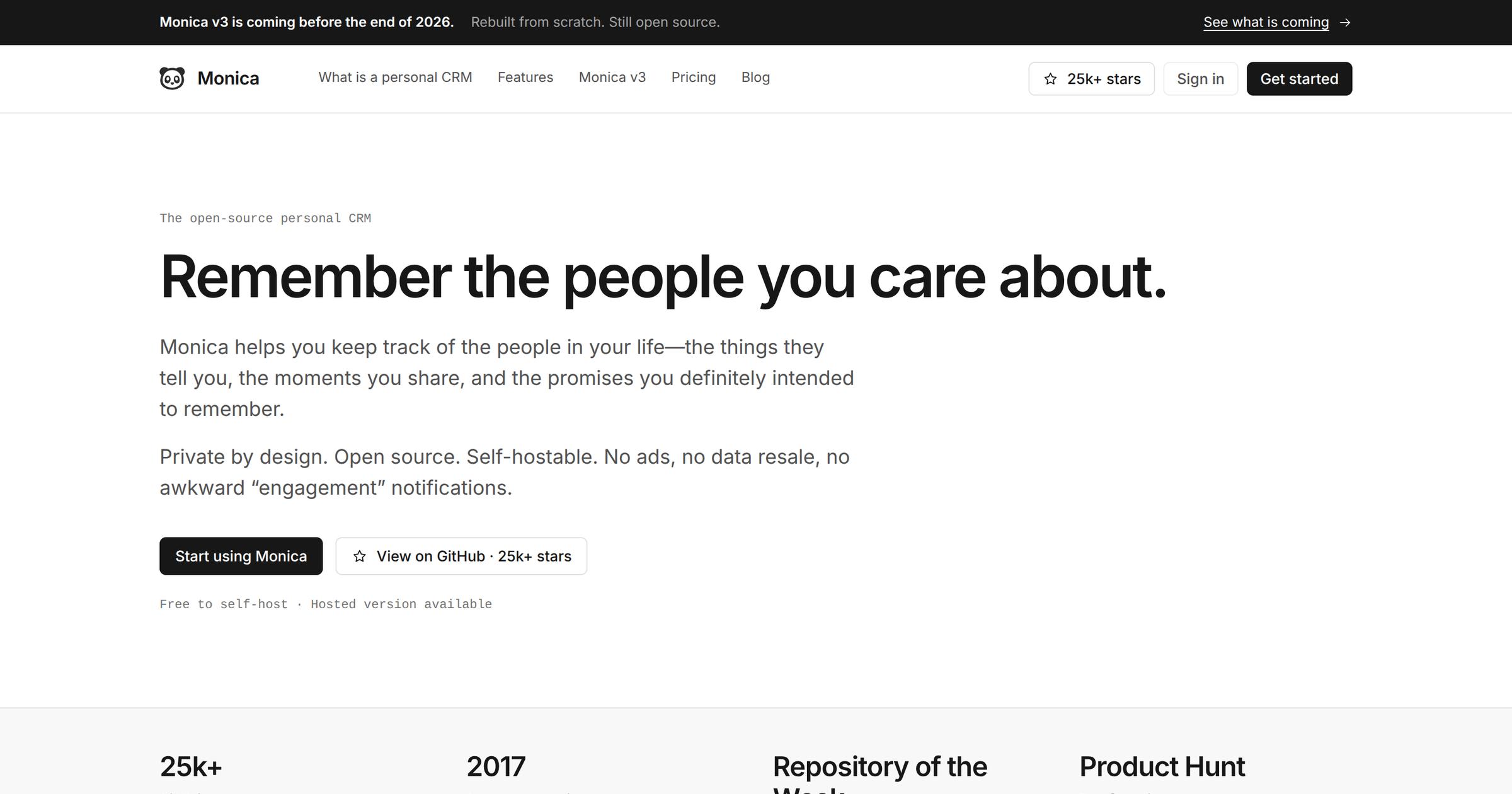
- Active project with 25,700 GitHub stars: The repo has 25,700 GitHub stars, was created in 2017, and was last updated in October 2026. The project is in active development with Monica v3, a full rewrite the maker says is due before the end of 2026 (monicahq.com), currently in beta on the main branch alongside the stable 4.x release.
Trade-offs
- Main branch is a beta rewrite: The main branch is Monica v3 in active development, a full rewrite the maker says is due before the end of 2026 (monicahq.com). The stable version is the 4.x branch. Users deploying from the main branch should expect rough edges; the 4.x branch is the production-ready path.
- 725 open issues as of November 2026: The issue tracker shows 725 open issues (excluding pull requests) as of November 2026. This is consistent with active use and feature requests, but also indicates known bugs and unimplemented features that have not yet been addressed.
- No built-in AI features, by design: Monica has no AI integrations: it does not guess, enrich contacts, or suggest follow-ups. The README describes it as operating purely on explicit instructions. Users who want AI-driven contact enrichment or automated networking insights should consider Clay or Dex instead.
Tech stack
FAQ
Self-hosting Monica is free under the AGPL-3.0 license; you run it on your own server at no cost. An optional paid hosted plan is available at monicahq.com for those who prefer not to manage their own infrastructure. The README does not indicate any feature restrictions between self-hosted and hosted.
Monica is a PRM (personal relationship manager), not a sales CRM. It is designed for tracking personal relationships with friends and family, not leads, pipelines, or business contacts. It records notes, activities, birthdays, diary entries, and personal details rather than deals or revenue metrics.
The 4.x branch is the stable release for self-hosting. The main branch is Monica v3, a full rewrite the maker says is due before the end of 2026 (monicahq.com); the README marks it as a beta. For a production self-hosted deployment, use the 4.x branch from https://github.com/monicahq/monica/tree/4.x.
AGPL-3.0 is an OSI-approved open source license. Running Monica on your own server for private use, including internal team or household use, is fully permitted at no cost. The restriction applies only if you run a modified version of Monica as a service for third parties: you must then distribute your modifications under the same license.
No. The README explicitly states Monica will never track users and will never be ad-supported. Self-hosting means your data stays on your own server. The project's design principles commit to transparency and to not doing anything with user data beyond what the user asks for.