
Automatisch
Self-hosted Zapier alternative for workflow automation
Replaces Zapier, Make, Microsoft Power Automate
Who it's for
Automatisch fits teams routing leads, syncing support data, and sending notifications where workflow data should stay under their own infrastructure controls.
Use Zapier if connector breadth and hosted convenience are more important than self-hosting.
Teams can move simple recurring integration tasks out of custom scripts and into a workflow UI. This helps non-developers maintain routine automations safely.
Skip it if your workflows require complex code, long-running jobs, or enterprise integration patterns better served by a workflow orchestrator.
The problem
Zapier-style automations become part of business operations quickly: lead routing, support triage, billing updates, notifications, and data sync. When those workflows live in a proprietary service, teams depend on external pricing, connector limits, and vendor availability for routine operations.\u000A\u000ASome organizations also cannot send operational data through a third-party automation vendor. They need a workflow tool they can host close to the systems being connected.
How it works
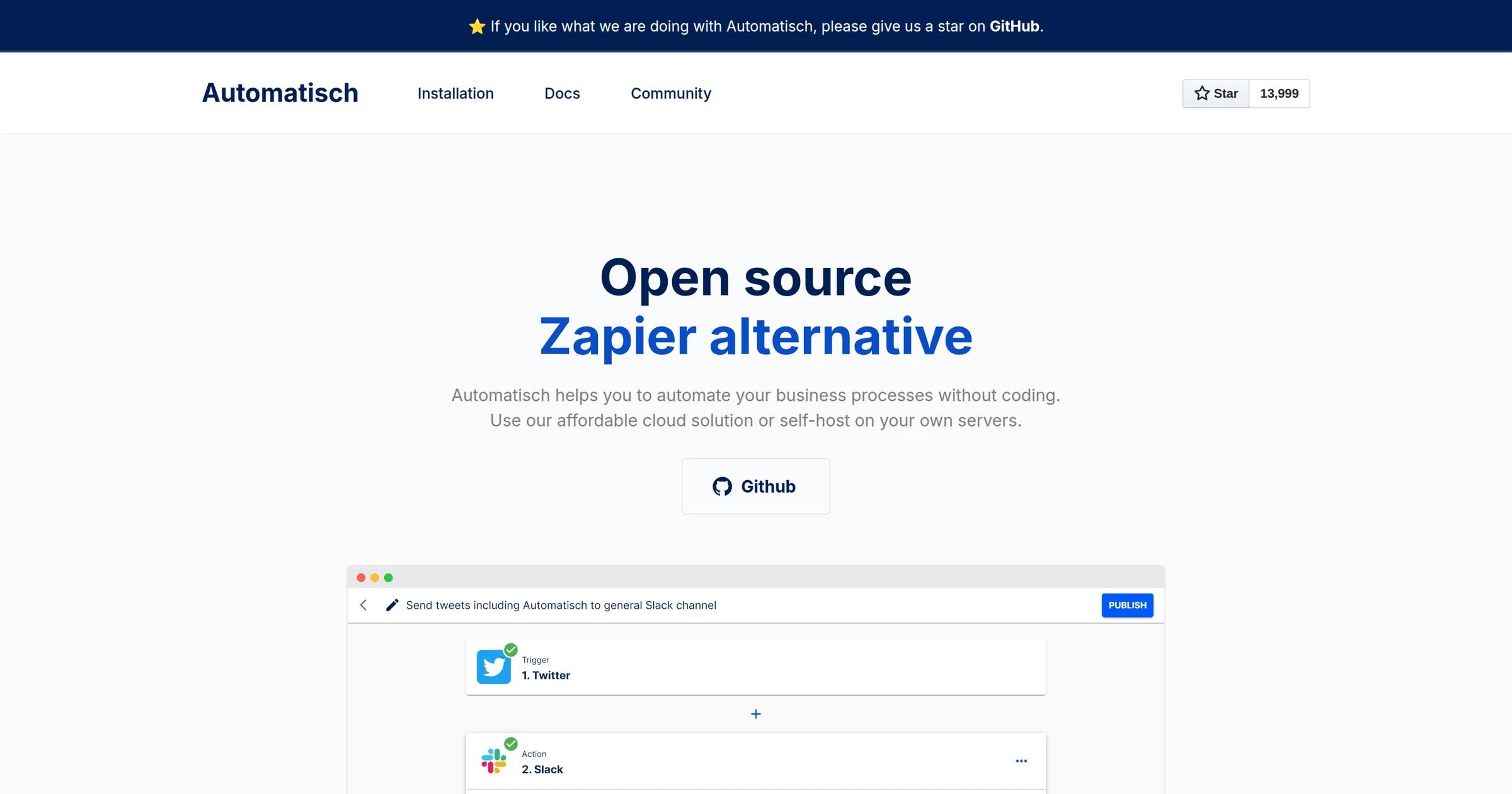
Automatisch lets users define triggers and actions between connected apps through a workflow UI. That supports routine business automation without building every integration from scratch.
Teams can run Automatisch on their own infrastructure, keeping workflow execution and connected-account data under their chosen controls.
Automatisch is designed around connecting common SaaS and internal tools. It fits lead handoffs, notifications, CRM updates, and lightweight data movement.
Features
- No-code workflow builder
- Self-hosted automation runtime
- App integration model
Recommended for this setup
Strengths
- Zapier-like workflow ownership: Automatisch gives teams a familiar automation pattern without making every workflow depend on a hosted automation vendor. That matters for privacy-sensitive operations.
- Useful bridge between no-code and engineering: Non-developers can create routine workflows, while technical teams can host and govern the runtime. This reduces pressure to build small integration services for every process.
Trade-offs
- Connector coverage may trail Zapier: Zapier and Make have much larger connector ecosystems. Automatisch is better for control, but teams should verify every required app integration before migration.
- AGPL core with enterprise files: Automatisch applies AGPL-3.0 to repository files except .ee. files, which are covered by an enterprise license. Teams modifying and offering it over a network should review AGPL obligations and enterprise feature boundaries.
Tech stack
FAQ
Yes. Automatisch is positioned as an open source Zapier alternative for building workflow automations. Its main advantage is the self-hosted deployment model.
Yes. Automatisch is designed to run on your own infrastructure. Self-hosting gives more control over workflow data and connected accounts.
Automatisch Community Edition code is AGPL-3.0 except .ee. files, which use an enterprise license. Review the AGPL and enterprise boundaries before commercial modification or hosted use.