
Zeroshot
Enforced QA workflow engine for coding agents, MIT licensed
Replaces Conductor
Who it's for
When your team runs Claude Code, Codex, and Copilot on different issues simultaneously, Zeroshot provides one process graph that applies the same QA standard to every run. Workers from any coding agent pass through the same reviewer chain before merging, so quality does not vary by which agent a developer used.
You have one agent, low PR volume, and informal review is adequate. Zeroshot adds a review and repair loop that is not justified for solo workflows where a single-pass agent run already delivers acceptable output.
Auth, payments, and database migrations can be routed through a blast-radius map and a dedicated security reviewer before standard acceptance and code review, using conditional branching in the graph. That reviewer runs with fresh context and cannot be bypassed by the worker's own assessment of the change.
Your security-sensitive paths already have independent automated checks (SAST, manual gates in CI) that the agent cannot merge around. Add Zeroshot where you need process enforcement at the agent level, before CI runs.
The auto-research template runs ten rounds by default: scouts propose directions, a researcher runs the experiment, an independent reviewer checks correctness and progress. Compact records and restorable candidates are kept at the workspace root. A geometry computation task ran ten iterations and achieved a 21x CPU speedup per the README.
Your research loop is exploratory and does not need independent correctness verification. The roughly five model calls per auto-research round add overhead that is not worth it for low-stakes experiments.
On 20 ProgramBench tasks, a small model in a Zeroshot review loop matched a larger model's score at a median 58% of its cost. The review and repair loop catches mistakes a single pass misses, so you can run a cheaper worker model and still reach the quality bar a larger model would deliver unassisted.
Your tasks are low-volume or low-stakes and a single-pass agent run with informal review already delivers acceptable quality. The reviewer and repair overhead is not justified when the cost of rework is lower than the cost of the extra model calls.
The problem
Coding agents now write and submit code faster than engineering teams can review it. When you run multiple agents in parallel, the review bottleneck shifts from the agent to the human: engineers are rubber-stamping dozens of open pull requests late at night or staying silent while agents push directly to staging. The deeper pain is that agents operating on prompts can decide for themselves whether their own work passes review. A skill can request a code review; the agent can also declare the result acceptable without one. Nothing in a prompt-based workflow prevents an agent from skipping the step when it judges the task complete. The result is unpredictable output quality: agents merge changes with passing tests written by the same agent that wrote the code, security-relevant changes bypass the blast-radius check that existed only in someone's head, and the team's actual QA process lives in individuals' skills files and chat history rather than in enforceable code.
How it works
Define your workflow as a directed graph: each node is a worker, reviewer, or delivery step with explicit retry limits and failure paths. No agent can skip a node or approve its own work. The graph runs identically on every task regardless of what the implementing agent's model says about the result.
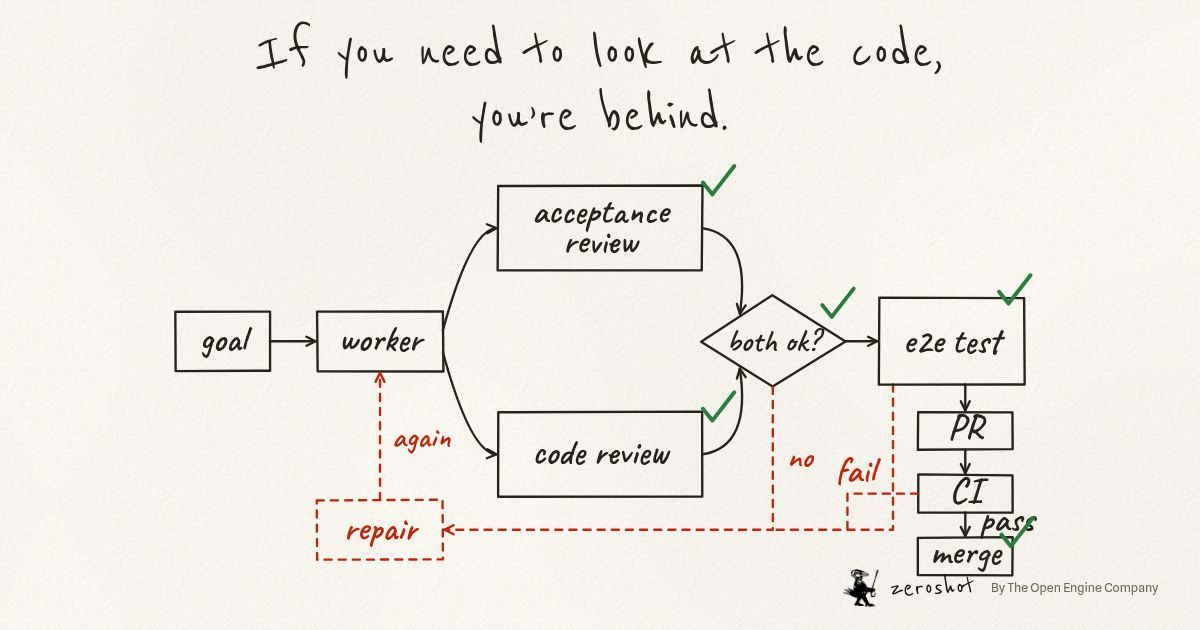
The built-in software-change template runs acceptance and code review in parallel, each reviewer starting with a fresh session on every pass. Rejected work returns to the original worker session with both reviews' feedback, then goes through both reviews again. Reviewers are isolated from the implementation context by design.
Each node can use a different coding agent (Claude Code, Codex, GitHub Copilot, or Pi) and model provider (Anthropic, OpenAI, OpenRouter, AWS Bedrock, or your own gateway). Bring your own API keys; the engine connects to the provider you name. Worker, acceptance, and code reviewers can run on different models in the same graph.
By default a software-change run opens a pull request and stops. Add --ship to proceed through CI and merge. The --delivery none flag keeps changes local for inspection. PR and ship runs address visible pull request review feedback by default. Delivery conflicts return through repair and review before merging.
The Docker target image bundles the native Rust engine plus Codex, Claude Code, Copilot, and Pi CLIs. Run it with a persistent volume to keep execution and durable state on infrastructure you control. The target exposes a browser UI and HTTP API at port 8080; stopping the UI server leaves active runs running.
The built-in auto-research graph runs up to ten iterations by default: three independent scouts propose directions, one researcher runs the experiment and prepares results, a fresh reviewer checks evidence and correctness. On 20 ProgramBench tasks, a small model in a review loop matched a larger model's score at a median 58% of the cost.
Features
- Graph-enforced QA process
- Independent parallel reviewers
- Agent and provider agnostic
- Configurable delivery targets
- Self-hosted Docker target
- Auto-research with independent verification
How to install
Install the CLI via npm, or deploy the Docker target for server-side execution.
npm install -g @the-open-engine-company/zeroshot
docker run --detach --restart unless-stopped --name zeroshot-target -p 127.0.0.1:8080:8080 -v zeroshot-data:/var/lib/zeroshot ghcr.io/the-open-engine/zeroshot-target:latest
zeroshot target add local --url http://127.0.0.1:8080 --direct
Recommended for this setup
Strengths
- QA is code, not a prompt: Other workflows rely on the implementing agent to decide whether its own review was sufficient. Zeroshot encodes your process in a graph the engine runs mechanically: the agent that wrote the code cannot approve its own pull request or skip the review step. That invariant holds regardless of the model or coding agent you connect.
- MIT license, no per-seat cost on the open-source path: The CLI and engine are MIT licensed. Run locally with any supported coding agent login, or deploy the Docker target image on your own infrastructure at no licensing cost. You bring API keys for the models you use; there is no per-seat or per-task fee on the self-hosted path. The hosted platform is a separate, optional upgrade.
- Multi-agent, multi-model in one graph: Each node in a Zeroshot graph can use a different coding agent and model. Worker on Opus, reviewer on Sonnet, delivery on Codex at a different provider, all in one run. That flexibility lets you balance cost and quality per step rather than accepting a single provider's defaults across the whole workflow.
- Active development and verified engineering adoption: 2,050 GitHub stars as of October 2026, starred by engineers at Google, Meta, Shopify, Uber, Booking.com, GitHub, Cloudflare, Atlassian, and JetBrains per the README. Last pushed October 27, 2026. The repo includes active CI, coverage tracking, and a Discord community.
Trade-offs
- Graph authoring requires upfront design work: The default software-change template works immediately, but building a custom graph for a specific QA scenario (blast-radius check, security review, conditional routing) requires writing and tuning node configuration and reviewer prompts. Teams expecting zero-setup should recalibrate; the power is in defining the process, and that takes time to get right.
- Node.js 18 or newer required for the CLI install: The npm installer requires Node.js 18 or newer to install the native binary. The binary runs standalone, but you still need a compatible Node version in PATH for the install step. Teams on older Node environments need to upgrade before installing.
- Hosted platform charges per parallel run: The CLI, engine, and Docker target are MIT-licensed and free. The managed Zeroshot Platform is free for one concurrent run and $100 per month per extra parallel run. Teams wanting many simultaneous managed runs pay per additional slot; the self-hosted path has no such limit but requires running your own infrastructure.
Tech stack
FAQ
Yes. The CLI and engine are MIT licensed and free to install via npm and run locally. The Docker target image is also free for self-hosted server execution. The managed Zeroshot Platform charges $100 per month per extra parallel run beyond the first; model API costs go directly to whichever provider you connect. The self-hosted path has no per-run or per-seat fee.
No. Zeroshot runs above your existing coding agents (Claude Code, Codex, GitHub Copilot, Pi) and puts them through the workflow you define. You keep the agents you already use; Zeroshot adds the enforced review and repair layer around them. Your existing agent can bootstrap the setup using the skill prompt included in the install.
Yes. Install with npm install -g @the-open-engine-company/zeroshot and run it in any project folder. Local runs reuse your existing coding agent login, including subscription-backed sessions. Add --push to publish results or --ship to proceed through CI and merge; omit both to keep changes local and inspect the output first.
Inspect the built-in graph with zeroshot template show software-change, then copy and edit the reviewer node's instructions for your project. The graph contract documents every supported node type, parallel step, retry limit, and failure path. Save the result as a named local profile to reuse across runs. Teams sharing configurations across engineers use organization profiles on the Zeroshot Platform.
Rejected work returns to the same worker session with both reviewers' feedback attached, then passes through both reviews again. The number of repair loops is bounded by the retry limit in the graph configuration. When the limit is exhausted without passing, the run reports failure. A run with a recoverable workspace can be restarted or resumed from where it stopped.