
Termic
Parallel AI coding agents in isolated git worktrees, no extra cost.
Replaces Conductor, Baton
Who it's for
Open four claude tabs, each in its own worktree, and work on separate features or bug fixes simultaneously. The broadcast command and work-done notifications reduce the overhead of monitoring multiple agent sessions.
You only ever run one agent at a time, or you prefer managing worktrees manually from the terminal with git worktree add.
Conductor stops working on 2026-11-20. Termic covers the same core workflow (parallel agents in worktrees, work-done detection, diff review) with an AGPL-3.0 license, local execution, and support for Codex, Antigravity, and custom CLI agents beyond Claude.
Your team depends on Conductor's cloud-hosted session storage or managed remote execution. Termic runs locally and does not replicate those features.
Enable the per-task macOS Seatbelt cage to let an agent run with --dangerously-skip-permissions without exposing ~/.ssh, ~/.aws, ~/.gnupg, or Keychains. The in-process network proxy limits outbound connections to per-CLI vendor APIs, GitHub, and package registries by default.
You are on Linux or Windows: the Seatbelt cage is macOS-only. Docker mode is the isolation alternative on those platforms.
Fire one prompt at claude, codex, and agy simultaneously using broadcast or agent races, each in its own worktree. Compare their diffs when they finish and adopt the winner, all from one app.
You only use one AI coding CLI. The parallel-agent value is specific to developers with subscriptions to more than one provider.
The problem
Running multiple AI coding agents in parallel against the same codebase creates three concrete problems: file conflicts when two agents edit the same path, billing surprises when a third-party orchestrator routes through the vendor SDK rather than the interactive CLI, and no reliable signal for when an agent actually finishes a turn. The billing problem is specific to the Anthropic ecosystem since June 2026, when Agent SDK usage moved to a separate credit pool from the interactive Claude CLI. Any orchestrator that calls the SDK silently bills against that pool, while a developer who opens claude in a terminal does not. The file-conflict problem is common to every multi-agent workflow: without worktree isolation, two agents writing to the same project produce merge conflicts and lost work.
How it works
Each task creates a git worktree under ~/termic/tasks/<project>/<name>/, so multiple agents work on separate on-disk copies of the same repository without file conflicts. You can run N agents against the same branch across tabs, attach to repo root for one-off questions, or duplicate a worktree to spin up a parallel attempt from the same commit.
Termic spawns the real claude, codex, agy, copilot, and grok binaries in PTYs. Because it launches the interactive CLI rather than the vendor SDK, inference rides on your existing Pro or Max subscription rather than the separate Agent SDK credit meter Anthropic introduced in June 2026. No per-token markup is added.
An optional per-task cage pairs macOS Seatbelt (filesystem default-deny) with an in-process HTTPS CONNECT proxy (hostname allowlist). ~/.ssh, ~/.aws, ~/.gnupg, and browser profiles are blocked by default. The proxy restricts outbound network to per-CLI vendor APIs plus GitHub and package registries; add your own hosts per project. No daemon to install.
Shift+Cmd+B sends one prompt to every agent in a task simultaneously. For races, each agent gets its own fresh worktree and you compare their diffs N-up when they finish, then adopt the winner. These features make multi-agent code review and architectural exploration practical without switching between terminal windows.
Spotlight mirrors one task's changes (committed, uncommitted, and untracked) into the main checkout as a detached HEAD in real time, so your editor, dev server, and browser see the agent's work without you switching branches. It never commits to your branch; disabling it cleanly restores the checkout.
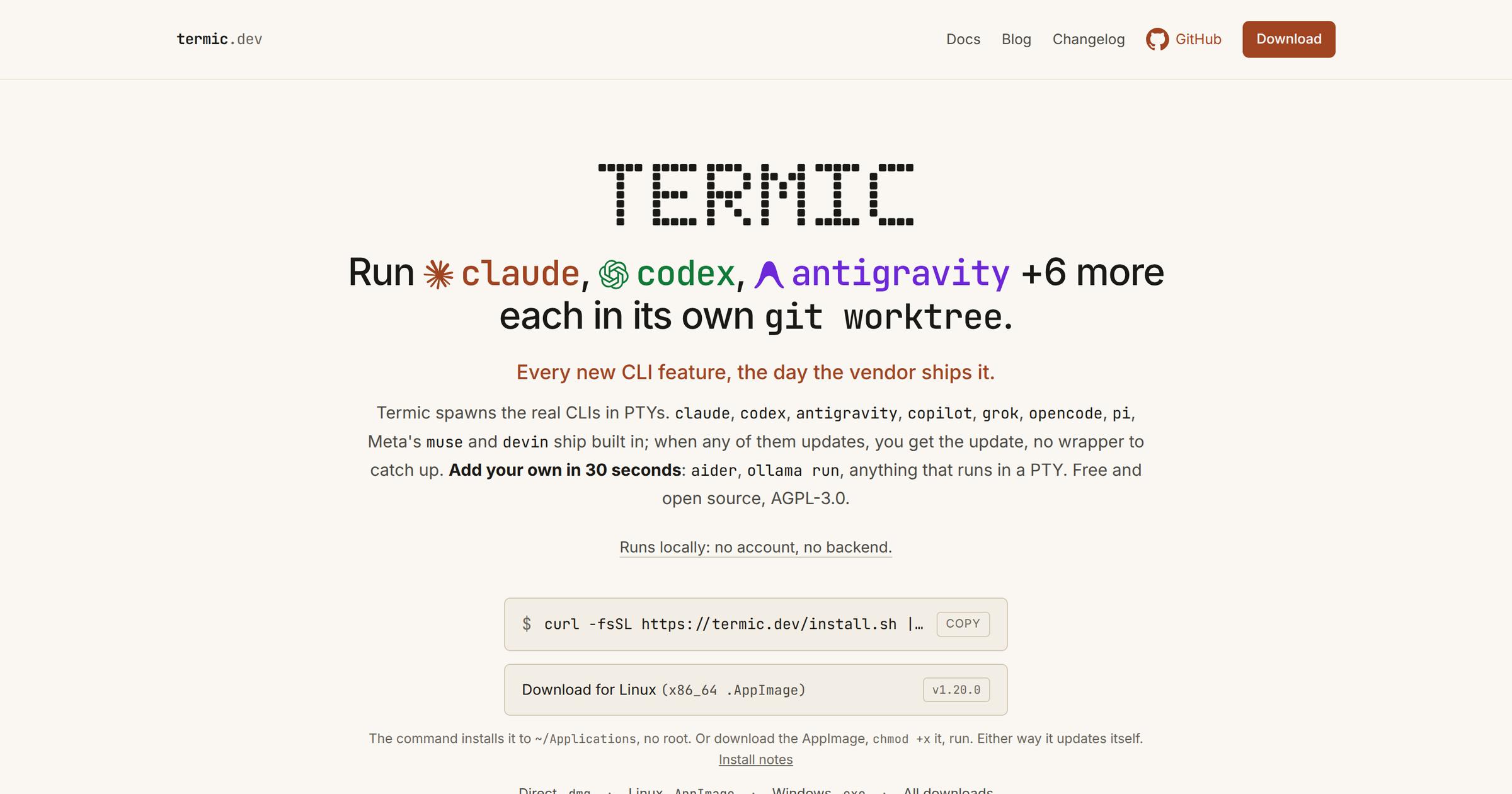
The agent registry in Settings is editable. Claude, Codex, Antigravity, Copilot, Grok, opencode, pi, Muse Code, and Devin ship as built-ins. Add aider, an ollama model, or any PTY-compatible tool in roughly 30 seconds by filling in the launch command.
Features
- Parallel worktrees per task
- Interactive CLI path, not SDK
- macOS Seatbelt sandbox per task
- Broadcast and agent races
- Spotlight: live worktree sync to main checkout
- Bring your own agent in 30 seconds
How to install
Install on macOS via Homebrew; on Linux, the install script downloads the signed AppImage.
# macOS
brew install --cask simion/termic/termic

# Linux
curl -fsSL https://termic.dev/install.sh | sh
Recommended for this setup
Strengths
- No SDK middleman means no extra billing: By spawning the interactive CLI rather than the Agent SDK, Termic stays on your existing Claude Pro or Max subscription. The June 2026 Anthropic credit change made SDK-based tools charge from a separate credit pool; Termic's interactive path is unaffected by that change and adds no per-token markup.
- Local-only, no account, AGPL-3.0: Termic runs entirely on your machine with no backend server and no account. Prompts go xterm to PTY to CLI to wherever the CLI sends them; Termic does not read or forward them. The AGPL-3.0 license means the source is auditable and any fork or derivative stays open, which prevents the tool from quietly going proprietary.
- Tauri 2 desktop build: ~10 MB: The app uses a Tauri 2 Rust backend and a WKWebView frontend, producing an ~10 MB bundle. Electron typically runs ~120 MB. For teams running many Termic instances or on constrained machines, the size difference is practical, not cosmetic.
- Reliable work-done notification: The work-done indicator combines per-CLI title classification (Claude spinner and similar patterns) with OSC 9;4 signals, gated by byte-quiet and content-hash checks, rather than an idle timer. Desktop notifications fire only when an agent actually finishes a turn, so you are not checking tabs constantly or missing a completed run.
Trade-offs
- macOS Seatbelt sandbox is macOS-only: The per-task filesystem and network cage relies on macOS Seatbelt, which does not exist on Linux or Windows. On those platforms the equivalent is Docker mode, which provides container-based isolation with a stronger filesystem boundary but does not restrict network egress the way the CONNECT proxy does on macOS. Linux users also lose the sandbox toggle on the task shield icon.
- Windows support is experimental: The Windows installer is not code-signed yet, so SmartScreen asks for confirmation on first launch. Windows support is documented as experimental and not yet used as a daily driver by the maintainer. The macOS Seatbelt sandbox does not exist on Windows; Docker mode is the available isolation path there.
- AGPL-3.0 share-alike applies to forks and hosted derivatives: Termic is free to run, modify, and use internally for any purpose, including commercial team use. The AGPL-3.0 share-alike clause requires that anyone who distributes a modified version, or runs a modified version as a hosted service accessible to others, must release those modifications under AGPL-3.0. Using Termic to run your own coding agents on your own machine is not affected by this clause.
Tech stack
FAQ
Termic spawns the interactive claude CLI, the same binary as running claude in a terminal. Anthropic's June 2026 Agent SDK credit change moved the SDK and claude -p onto a separate credit pool; the interactive CLI stays on regular Pro or Max usage limits. Termic adds no markup and routes no inference through its own backend.
Yes. Termic is AGPL-3.0, free to use, and free to build from source. The AGPL means any fork or derivative must also remain open source under AGPL-3.0. The source is on GitHub at github.com/simion/termic. The app itself costs nothing; you pay only for whatever CLI subscriptions you already use.
No. Termic is a local app with no backend. Prompts travel from the terminal emulator through a PTY to the CLI binary to wherever the CLI sends them; Termic does not read or forward them. A debug log in the system temp directory is available but off by default. Because the app is fully open source, you can read exactly what it does and build it yourself to verify.
The per-task sandbox combines macOS Seatbelt (default-deny filesystem) with an in-process HTTPS CONNECT proxy (hostname allowlist). It blocks the agent from reading ~/.ssh, ~/.aws, ~/.gnupg, Keychains, browser profiles, and personal folders. Network is restricted to per-CLI vendor APIs, GitHub, and package registries by default. Enable it for any task where you want to run with --dangerously-skip-permissions without full system exposure. The sandbox is pinned at task creation and cannot be changed on a live task.
Yes, with caveats. Linux ships as a signed x86_64 AppImage; the in-app updater works the same as on macOS. Windows 11 x64 ships as an experimental per-user installer that is not yet code-signed, so SmartScreen asks once on first launch. The macOS Seatbelt sandbox does not exist on Linux or Windows; Docker mode is the isolation alternative. The rest of the feature set, including worktrees, parallel tabs, diff view, and broadcast, works the same on all three platforms.