
Scoold
Self-hosted Q&A platform for internal team knowledge
Replaces Stack Overflow For Teams, Confluence
Who it's for
Scoold fits teams where technical answers currently disappear into Slack, tickets, or direct messages.
Your main need is polished public docs rather than internal Q&A.
The Q&A model helps support staff turn repeated customer or internal questions into reusable answers.
You need a full ticketing platform with SLAs and agent assignment.
The problem
Internal knowledge disappears when answers live in chat threads, direct messages, and old tickets. New teammates ask the same questions because the best explanations are not structured, searchable, or maintained. A team Q&A system needs to reward good answers, keep knowledge discoverable, and let people ask practical questions without forcing every answer into long-form documentation. That is a different workflow from a wiki or support inbox.
How it works
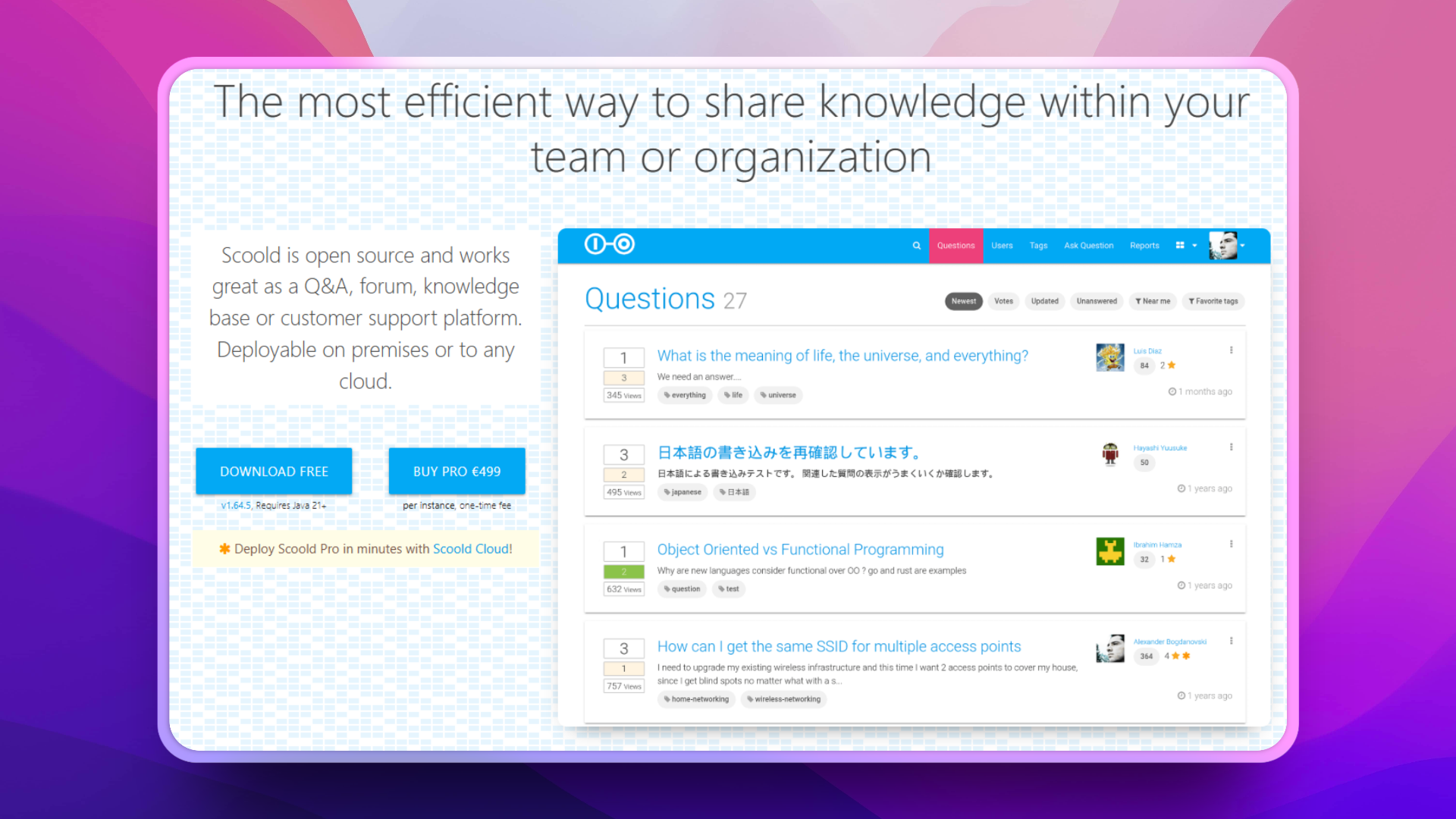
Scoold is a Q&A and knowledge sharing platform for teams, inspired by Stack Overflow.
Scoold can run self-hosted or hosted, giving teams a control path and a convenience path.
Scoold links API documentation and supports customization, which helps teams integrate Q&A content into internal workflows.
Features
- Stack Overflow-style Q&A
- Self-hosted or hosted options
- API and customization
Recommended for this setup
Strengths
- Better fit than chat for reusable answers: Scoold gives recurring questions a durable home, making technical and support knowledge easier to search than a messaging archive.
- Apache-2.0 license: Scoold is Apache-2.0 licensed, giving teams a permissive self-hosted basis for internal knowledge sharing.
Trade-offs
- Q&A is not a full documentation system: Scoold works best for question-driven knowledge. Teams still need maintained docs for canonical procedures, architecture records, and long-form onboarding.
Tech stack
FAQ
Yes. Scoold is a Q&A and knowledge sharing platform inspired by Stack Overflow.
Yes. Scoold can be self-hosted or used as a hosted service.
Not completely. Scoold is strongest for question-driven knowledge, while teams still need canonical docs for stable processes and long-form guides.