
Outline
Team wiki and knowledge base with realtime collaboration
Replaces Notion, Confluence, Slab, Nuclino, Coda, Gitbook, Slite
Who it's for
The markdown editor, code block support, and Slack integration suit developer wikis, architecture docs, and runbooks well. Full-text search means teammates find documents without knowing the exact title, which matters when a knowledge base grows beyond a few dozen pages.
Your engineering team already uses Notion for both documentation and project tracking and relies on Notion's database primitives. Moving to a dedicated wiki tool adds workflow overhead if the current setup works.
Outline's editor experience is closer to Notion's than Confluence's, which eases migration for teams leaving either product. The Slack integration preserves existing communication workflows. For teams that chose Confluence primarily because it was bundled in an Atlassian subscription, Outline is a lighter-weight replacement.
You need Confluence's deep Jira integration or Notion's relational database views. Outline covers the document and wiki layer but does not replicate structured data management.
Teams in regulated industries, government-adjacent organizations, or companies with strict data residency policies can run Outline entirely within their own infrastructure. All documents and files stay within the deployment environment, with no third-party cloud required on the self-hosted path.
Data residency is not a concern for your team and you prefer a managed SaaS product. The cloud-hosted version at getoutline.com removes all infrastructure management overhead.
Search, AI question answering, and realtime editing reduce the coordination overhead of distributed work. Public document sharing lets external contributors read specific documents without an account. RTL support and over 20 language translations cover teams across multiple regions.
Your team works synchronously in the same timezone and real-time communication covers most knowledge transfer. A full wiki may add overhead without payoff for very small or co-located teams.
The problem
Team knowledge scatters fast. Documentation piles up across scattered Google Docs, Confluence spaces nobody keeps current, and Slack threads that disappear the moment the conversation moves on. When a new hire joins, they spend their first week asking questions that a well-organized wiki would answer in seconds. The core challenge is not a shortage of writing tools: it is that the options are either too expensive to scale per seat, too complex to administer, or too slow and fragmented to search effectively. The teams most affected are growing engineering and product organizations. As headcount rises, the cost of commercial knowledge bases rises with it: seat-based pricing compounds with every hire. When documentation lives in the wrong tool, it becomes invisible. Teams default to repeating the same Slack question rather than maintaining a canonical source of truth, which means duplicated effort, slower onboarding, and knowledge that walks out the door with every departure.
How it works
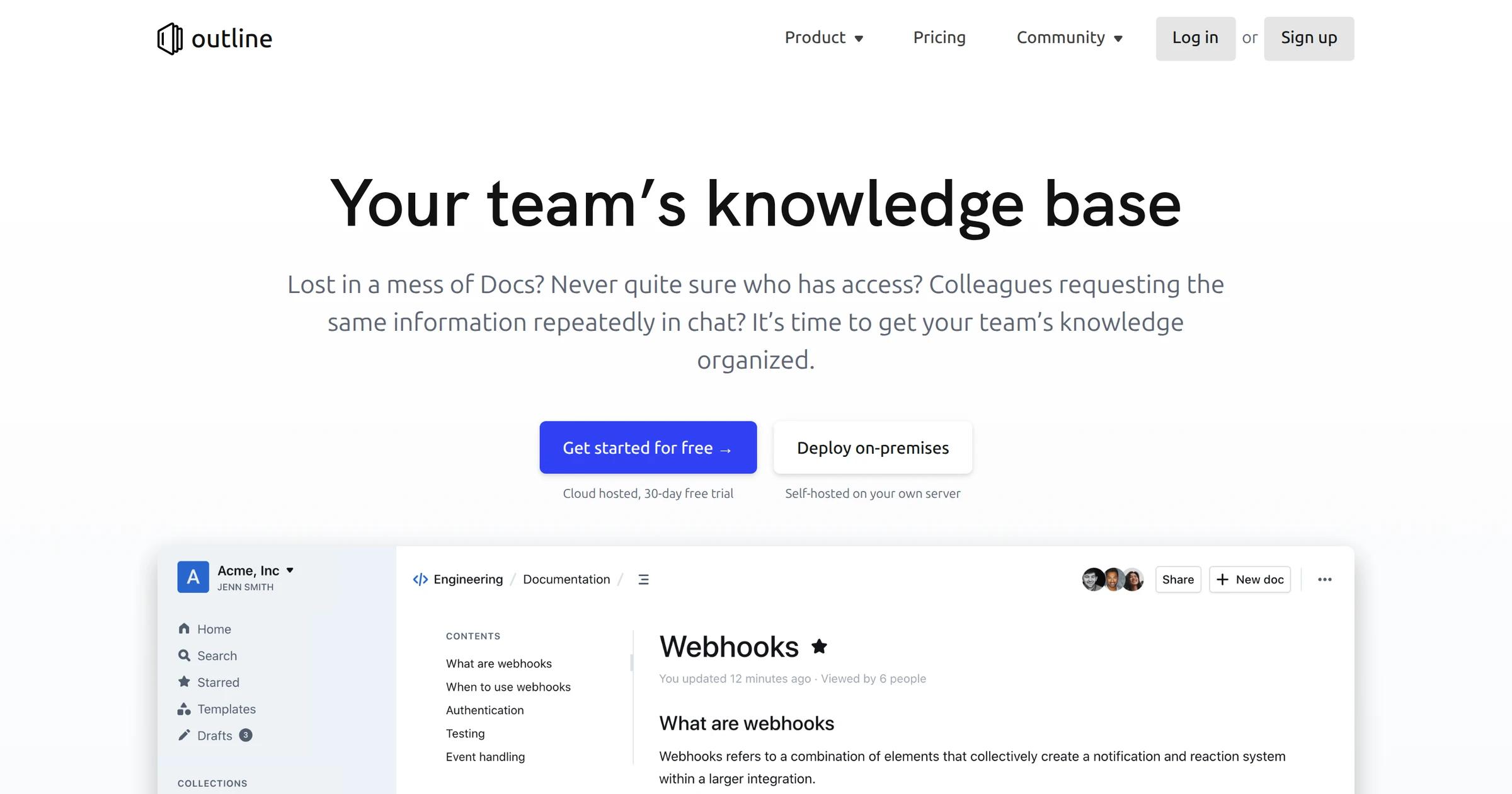
Multiple team members can edit the same document simultaneously, with cursor presence showing who is working where. Comments and threaded discussions keep feedback organized without branching into separate documents. The editor supports markdown shortcuts, slash commands, and interactive embeds from tools like Figma and Loom.
Every document is indexed and instantly searchable across the workspace. Beyond keyword search, an AI layer lets team members ask natural-language questions and receive direct answers drawn from the knowledge base, rather than a list of links to scan. The Slack integration extends this: teammates can query Outline documents without leaving chat.
Search, share, and ask questions about Outline documents directly from Slack. When documents are updated, Outline can post notifications to specified Slack channels. Other integrations include Figma for design embeds and Loom for video embeds. An open REST API supports use cases not covered by native integrations.
Documents can be scoped to specific user groups, shared with guest users on read-only access, or published publicly with a shareable link. Custom domains let teams serve their knowledge base at their own subdomain. White-labeling with brand colors and logos is supported on both the self-hosted and cloud paths.
Outline includes translations for over 20 languages, including French, Spanish, German, Korean, and Chinese, managed via the Crowdin translation platform. RTL text direction is supported without additional configuration, making Outline usable for teams working across multiple regions and languages.
Features
- Realtime multiplayer editing
- Full-text search with AI question answering
- Slack integration and 20+ tool connections
- Granular permissions and public sharing
- Multilingual support with RTL text direction
How to install
Self-hosting uses Docker; see the deployment documentation at docs.getoutline.com/s/hosting for full configuration with Postgres, Redis, and S3 storage.
docker pull outlinewiki/outlineRecommended for this setup
Strengths
- Decade of active development with 40,000+ GitHub stars: Outline has over 40,000 GitHub stars and has been maintained since 2016, with commits pushed regularly. A public changelog tracks feature releases and bug fixes transparently. The sustained development history and large contributor base reduce the adoption risk that comes with newer, less-proven knowledge tools.
- Self-hosted with no per-seat pricing: Once deployed, the self-hosted version has no user count limits and no per-seat licensing fees. The cost is the infrastructure the team already pays for. For growing teams, this makes the total cost of a team knowledge base predictable and independent of headcount.
- Source code is public and development is open: Outline's full source code is on GitHub and all development happens publicly. Teams can audit the codebase for security, build forks with internal customizations, and follow the public changelog to see exactly what changed and when. The project has been maintained for ten years without pivoting away from its core use case.
- AI search and Slack integration are built in, not add-ons: Most commercial wiki tools treat AI features and chat integrations as premium additions. In Outline, the AI question-answering layer and the Slack integration ship with the product in both the cloud and self-hosted deployments, at no additional cost on the self-hosted path.
Trade-offs
- Business Source License 1.1, not an open source license: The license document itself states that BSL 1.1 is not an open source license. Self-hosting for your own team is fully permitted at no cost with no user cap. The restriction is specific: you cannot operate Outline as a hosted service that lets third parties create their own teams and documents, competing with the vendor's cloud. The license converts to Apache 2.0 on 2030-07-13. Internal commercial use has no restrictions.
- Self-hosting requires multiple infrastructure components: A production Outline deployment needs Postgres, Redis, S3-compatible object storage, and an SMTP server for email notifications. This is a moderate setup effort: manageable for teams with a DevOps engineer or an existing container orchestration stack, but more involved than single-container tools with no external dependencies.
- Not a relational database workspace: Outline is a document and wiki tool, not a relational workspace. It does not replicate Notion's database views, formula columns, rollup fields, or template-driven project tracking. Teams migrating from Notion who depend on those primitives will need a separate tool for that layer of work.
Tech stack
FAQ
Self-hosting Outline is free: the license permits internal team use at no cost with no user count limits. The cloud-hosted version at getoutline.com offers a 30-day free trial; paid plans apply after that. For most teams with existing server infrastructure, the self-hosted path is the more cost-effective long-term option.
Outline is source-available under the Business Source License 1.1, which the license document itself states is not an open source license. The source code is publicly available on GitHub and self-hosting for internal use is fully permitted at no cost. The restriction is that you cannot use it to operate a competing hosted service for third parties. The license converts to Apache 2.0 on 2030-07-13.
A production Outline deployment requires a Postgres database, a Redis instance, S3-compatible object storage (such as AWS S3 or MinIO), and an SMTP server for email notifications and invites. Docker images are published under outlinewiki/outline on Docker Hub. The official hosting documentation at docs.getoutline.com covers full production configuration including environment variables and SMTP setup.
Outline replaces the document and wiki layer of both: editing, search, permissions, comments, and real-time collaboration. It does not replicate Notion's relational database views, formula columns, or template system. It also lacks Confluence's native Jira integration. Teams switching primarily for cost savings and self-hosting typically find the transition straightforward; teams dependent on Notion's database features will need a separate tool for that use case.
Yes. The Slack integration lets team members search Outline documents, share links, and ask questions from Slack without opening a browser tab. Outline can post notifications to Slack channels when documents are updated. The integration is available in both the self-hosted and cloud-hosted deployments at no additional cost.