
Podium
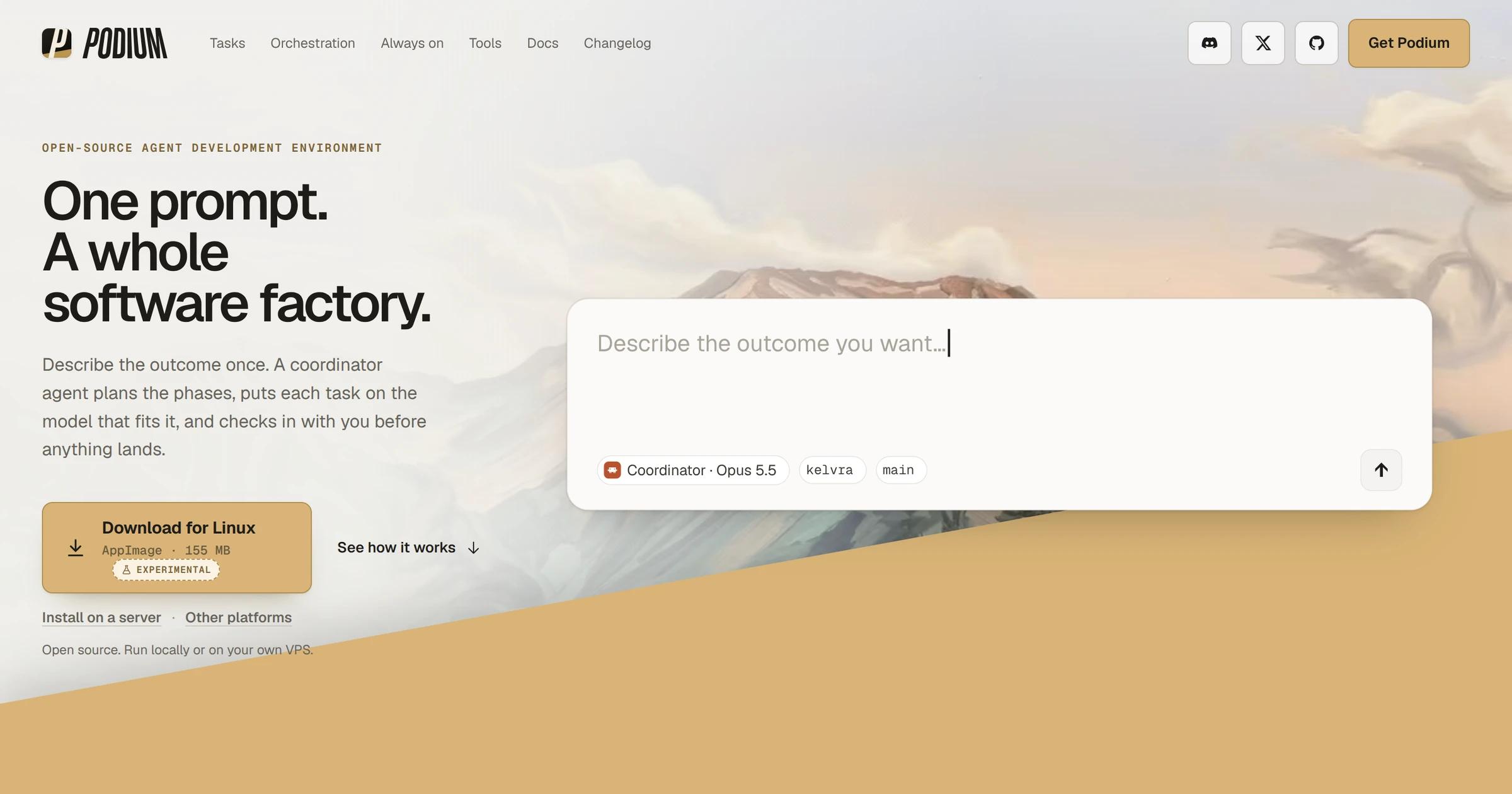
ADE for coordinating coding agents with shared tasks and check-ins
Replaces Conductor
Who it's for
You have a feature that needs research, architecture, implementation, and review. With Podium, one coordinator agent plans phases and delegates each to the best model: Sonnet for research, Opus for design, a build agent for implementation, and a reviewer before anything merges. You step in at the check-in points.
Skip if your task fits in a single session with one agent. Podium's value comes from multi-phase, multi-agent jobs. A one-shot code change does not need a task system.
Podium's check-in pattern is built for teams where a human must approve before changes land. Agents surface results with evidence: drafts, screenshots, sourced data. You review from the offer card and either approve or send back changes. The board shows every agent's status so oversight does not require watching each session.
Skip if your team runs fully automated pipelines with no human review step. Podium is designed around check-in gates; removing them leaves a plain task board with extra overhead.
Install the Podium server on a Linux VPS with one command. Agents keep running after your machine is off. Control and review the work from your phone, a browser, or the desktop app when you return. Best for longer-running tasks that would otherwise require leaving a laptop open.
Skip if you need agents to access resources only available on your local machine (local dev servers, local databases). The VPS server runs in its own environment and cannot reach your laptop's localhost.
The problem
Running more than one coding agent at once creates coordination overhead that cancels out the speed gains. Each agent needs context about what the others are doing, what it can and cannot touch, and what it is waiting on. Without a shared task system, you become the relay: copying findings between sessions, keeping track of which branch is safe to merge, and deciding when to interrupt an agent that is blocked. The harder problem appears when a task requires several rounds: research, then design, then implementation, then review. Passing results from one agent to the next manually is fragile. Findings get lost between sessions, an agent misses a dependency, or two agents overwrite the same file. The coordination cost grows faster than the number of agents.
How it works
Every task in Podium holds its goal, breakdown, dependencies, conversation history, and artifacts. Agents create and update that structure directly through Podium's CLI and MCP tools, so coordination has a persistent home outside any single session. A follow-up task waits on its prerequisite automatically; a session can end while the task and its recorded progress stay available to the next agent.
Any agent can act as the coordinator: Claude Code, Codex, Cursor, OpenCode, Grok, and Pi are all supported. The coordinator creates subtasks, links dependencies, delegates to the right agent for each phase, and collects results. You can switch coordinators mid-job or engage individual agents directly alongside the coordinator.
The team view shows every active agent, their tasks, what each is waiting on, and what has finished. Open any task to reach its conversation and join the work. Done tasks stay in place, one click from their history. The view makes it possible to follow a job with many agents without tracking it all in your head.
Before anything merges, the agent surfaces the result with evidence: a draft, a screenshot, pricing sourced and dated, or a code review. You approve from the card or request changes. This check-in pattern keeps you the decision-maker without requiring you to watch the work in real time.
Separate implementation tasks can run in separate git worktrees, so parallel agents do not step on each other's changes. Each task owns its branch and workspace. Agents sharing one workspace still need explicit file ownership, but the worktree system removes the main class of merge conflicts in parallel builds.
Podium runs on macOS (Apple Silicon and Intel), with experimental Linux AppImage and Windows installer builds. For server-side use, install the headless server on any Linux VPS with one command. Connect from the desktop app, any browser, or your phone's browser. Every Podium app connects to every Podium server.
Features
- Shared issue system for all agents
- Coordinator works across all your coding agents
- Parallel agent flight deck
- Agent check-ins and decision offers
- Git worktrees per task
- Desktop, server, and phone access
How to install
Install the headless Podium server on a Linux VPS with the official setup script.
curl -fsSL https://podium.do/install.sh | shRecommended for this setup
Strengths
- Apache-2.0 license with full self-hosting: Podium is Apache-2.0 licensed: free to run on your own machine or VPS, modify, and use commercially without restrictions. Unlike Conductor, there is no managed-service requirement and no account to create before your agents can work.
- Works with the coding agents you already use: Podium does not replace your coding agents. It adds a shared task system that Claude Code, Codex, Cursor, OpenCode, Grok, and Pi can all read and write. Your agents' own accounts, models, and limits stay in effect; Podium adds coordination on top.
- Persistent task state across sessions: Each issue holds its goal, brief, dependencies, and recorded progress. A session ending does not lose context: the next agent picks up where the last one left off. For jobs that span hours or multiple machines, this removes the manual context-passing that most multi-agent setups require.
- Phone and browser remote access: Because Podium can run on a Linux VPS, agents keep working after your laptop closes. You can follow and steer the work from your phone's browser or any desktop browser connected to your server. The macOS desktop app connects to any Podium server, local or remote.
Trade-offs
- Early-stage, pre-1.0 release: Podium is pre-1.0 and moving quickly. The README notes this directly and directs users to check release notes for what is in a packaged build. Breaking changes are likely between releases. The Windows and Linux desktop builds are explicitly marked experimental.
- Small user community: With 45 stars and 3 forks at the time of writing, Podium has a small user community. Third-party guides, forum answers, and community-sourced workarounds are limited. Issues and integration questions will mostly land in the Discord rather than a broad existing knowledge base.
- VPS deployment requires server setup: Running agents after your laptop closes requires a Linux VPS you manage. Setting up network access (Tailscale, Cloudflare Tunnel, or a reverse proxy) adds setup work for users without server administration experience. The macOS desktop app works standalone, but remote access is not zero-configuration.
Tech stack
FAQ
Podium supports Claude Code, Codex, Cursor, OpenCode, Grok, and Pi as of the current release. Cross-agent delegation and communication work across all of them. Your agents' own accounts, model selections, and usage limits still apply; Podium adds the shared task layer on top, not a replacement for the agents themselves.
No. Podium is Apache-2.0 licensed and runs entirely on your own machine or a VPS you own. The macOS desktop app works standalone. The server install is a single shell command. No account, subscription, or cloud service from the Podium team is required.
When an agent finishes a phase or reaches a decision point, it surfaces an offer: a card with the result and the evidence (a draft, screenshots, data with sources). You review from the card and either approve the next step or request changes. The agent does not proceed until you respond. This is configured through coordination prompts you give to the coordinator agent, not through a fixed workflow.
The Linux desktop build is an AppImage marked experimental. The Windows installer is also experimental (x64 only). The headless server for VPS use is production-ready on Linux x86_64 and ARM64. macOS on Apple Silicon and Intel is the primary supported desktop platform.
Separate terminals give each agent its own context with no way to pass findings between them. Podium adds a shared issue system that agents can read and write: tasks hold goals, dependencies, and recorded progress, so a follow-up agent picks up where the last one left off. The coordinator agent uses this structure to link phases and block work on prerequisites automatically.