
OpnForm
Self-hosted form builder with unlimited submissions, conditional logic
Replaces Typeform, Jotform, Tally, Fillout, Paperform, Cognito Forms, Gravity Forms, Formstack
Who it's for
OpnForm's conditional logic and answer piping let teams build multi-step onboarding flows that adapt to each user's answers. Webhook and Zapier integrations push completed submissions directly into CRM or project management tools without custom backend code.
Teams needing forms deeply embedded in a React or Vue application with fully custom-designed field components. OpnForm provides embeds and an API, but the form renderer is its own UI; custom-component form libraries are a better fit for that use case.
Self-hosted deployment keeps all form responses on the organization's own servers, with no third-party data processing. The EU cloud option provides data residency for teams that cannot self-host. Combined with 2FA and submission audit logs (enterprise edition), this covers common compliance requirements.
Teams operating under compliance regimes that require audited third-party certification such as SOC 2 Type II on the form provider. OpnForm's SOC 2 compliance is noted as underway, not yet completed at time of writing.
The REST API exposes form submission retrieval, creation, and management. The MCP server integration lets AI agents create form drafts via OAuth. Webhooks forward each submission to any HTTP endpoint in real time, covering the standard pattern of form-in, database or workflow out.
Developers building forms where complex client-side validation, offline support, or deeply custom field types are required. OpnForm's field set is broad but fixed; custom field types require forking the codebase.
Typeform's Basic plan limits responses to 100 per month at $39/month (typeform.com/pricing, November 2026). OpnForm's free cloud plan removes that cap, with no per-response charges at any volume. The form editor supports the same conversational multi-step layout Typeform offers, so migrating existing forms requires minimal redesign.
Teams that depend on Typeform's native HubSpot, Salesforce, or Intercom integrations. OpnForm offers Zapier and webhook coverage for these but does not provide direct native integrations with every CRM Typeform supports.
The problem
Most form tools cap submissions by plan tier. Typeform's Basic plan ($39/month) allows 100 responses per month; the Business plan at $129/month raises this to 10,000 (typeform.com/pricing, November 2026). Jotform's Bronze plan ($39/month) allows 1,000 monthly submissions; the Gold plan at $129/month allows 10,000 (jotform.com/pricing, November 2026). Both platforms lock features like conditional logic and file uploads behind higher pricing brackets. Teams building contact forms for a growing product, survey flows for user research, or onboarding sequences for new customers end up paying for plan upgrades the moment they gain traction. Data also sits on the vendor's servers, with no export path that keeps the full submission history portable. Teams subject to GDPR or internal data policies have limited options when their form data lives on US-based commercial platforms with no self-hosting path.
How it works
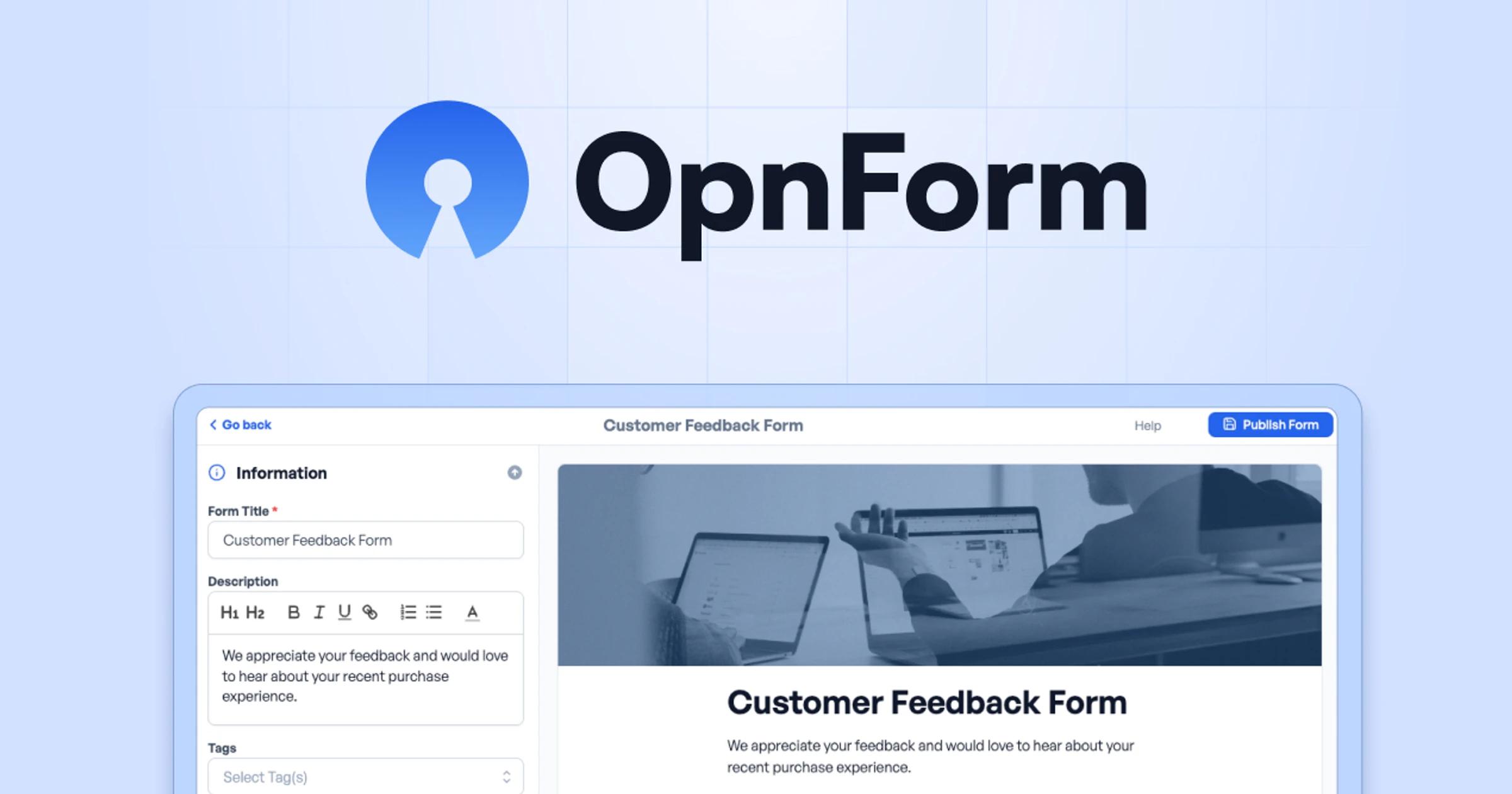
Design forms by dragging in fields including text, date, URL, file uploads, signatures, and payment blocks. Forms support single-page and multi-step layouts, with Typeform-style conversational flow or classic stacked designs. Themes, brand colors, and custom fonts are available on paid plans.
Show or hide fields based on prior answers, redirect to different pages on submit, and pipe earlier responses into later questions. Computed fields and hidden fields support pre-filling from URL parameters, letting forms adapt to each respondent without additional code.
Send form submissions directly to Slack and Discord channels, sync responses to Google Sheets, trigger Zapier workflows, and collect payments through Stripe. A REST API and webhook support connect OpnForm to any service not covered by the native integrations.
An AI mode helps draft form questions and structure from a text prompt. The MCP server lets AI agents create and preview private form drafts without requiring a login, with OAuth adding workspace-aware form management, submission search, and export for authenticated use cases.
Deploy on your own infrastructure using Docker and a Postgres database. Teams that need EU data residency for GDPR compliance can use OpnForm's EU-based cloud hosting option instead. Both paths deliver the same form builder without response limits.
Track view counts and completion rates per form through built-in analytics. PDF template fields allow mapping form responses to fillable PDF layouts for document generation. Submissions are searchable, exportable to spreadsheets, and display file attachments inline.
Features
- No-Code Form Builder with Drag-and-Drop Editor
- Conditional Logic and Answer Piping
- Native Integrations with Slack, Zapier, and Stripe
- AI-Assisted Form Creation and MCP Server
- Self-Hosted or EU-Hosted Deployment
- Form Analytics and PDF Template Mapping
How to install
Self-hosting uses Docker with a Postgres database; the full docker-compose configuration is in the official deployment guide.
docker pull jhumanj/opnform-apiRecommended for this setup
Strengths
- Unlimited Submissions on the Free Cloud Tier: Unlike Typeform and Jotform, OpnForm's free cloud plan does not cap the number of responses a form can receive. Teams collecting survey data, running lead generation campaigns, or gathering feedback do not face forced plan upgrades when submission volumes grow.
- AGPL-3.0 Core with Auditable Source Code: The core application is published under AGPL-3.0 on GitHub (3,985 stars, active development as of November 2026). The license grants full freedom to run, modify, and deploy the application for internal use. Source-offer obligations apply only to network deployments of modified versions offered to external users.
- EU Hosting and GDPR-Friendly Architecture: Organizations subject to GDPR or data residency requirements can use OpnForm's EU-based cloud option. Self-hosted deployments keep all submission data on the operator's own servers. The enterprise edition adds SSO, SAML, 2FA support, and form-level audit logs for compliance reporting.
- Active Development with Low Issue Count: The repository records consistent commit activity, with the last push on November 4, 2026. Only 16 open issues (pull requests excluded) indicates a well-maintained issue tracker relative to 3,985 stars and 580 forks. Security dependency audits run weekly through Dependabot across PHP, Node, and GitHub Actions.
Trade-offs
- Enterprise Features Require a Commercial License: SSO, SAML, white-labeling, priority support, and advanced audit log features are part of the OpnForm Enterprise edition, which requires a paid subscription for production use. Development and testing copies of the enterprise features are free. Organizations that need these features cannot access them under the AGPL-3.0 core alone.
- AGPL-3.0 Source-Offer Obligation for Modified Network Deployments: Running a modified version of OpnForm as a network service (for example, as a hosted form product offered to others) triggers the AGPL-3.0 source-offer requirement: modified source must be made available to users of that service. Teams running OpnForm internally for their own staff and customers are not affected by this obligation.
- Self-Hosting Requires Multiple Services: A production self-hosted deployment involves a PHP/Laravel API container, a Nuxt client, and a Postgres database composed together. Teams expecting a single-container install will need to follow the official deployment guide at docs.opnform.com/deployment rather than a one-line Docker command.
Tech stack
FAQ
Yes. The core application is AGPL-3.0 licensed, which allows self-hosting at no cost, including internal commercial and team use. Running the core on your own servers for your organization is unrestricted. The only obligation is a source-offer requirement if you run a modified version as a service others access over a network. Enterprise features under api/app/Enterprise/ require a commercial OpnForm Enterprise subscription for production use; development and testing copies are free.
The core form builder is AGPL-3.0: you can self-host, modify, and run it for your organization at no cost. The Enterprise edition covers advanced features such as SSO, SAML, white-labeling, priority support, and form audit logs. Those features live under api/app/Enterprise/ and require a paid OpnForm Enterprise subscription for production use; development and testing copies are free.
Yes. OpnForm integrates with Stripe for payment collection. A payment block can be added to any form to charge the respondent before or after submission. Stripe connection is configured in the integrations settings.
File upload fields are supported out of the box. Uploaded files are stored as references in the submission and are accessible via signed, time-limited download URLs. When a file field is prefilled in the form editor, a copy is made for each submission rather than sharing a single upload. Files can be exported with the submission data.
Yes. Forms can be embedded on any website using a standard script embed, shared via a direct link, added to Notion pages, or distributed with a QR code for offline collection. Custom domains are supported, letting the form URL match your brand. All embed types deliver the same unlimited-submission experience.