
Budibase
Low-code platform for building internal apps, self-hosted
Replaces Retool, Microsoft Power Apps, Bubble, Airtable
Who it's for
Use Budibase when teams need internal tools for approvals, portals, inventory, CRM back offices, or support workflows that connect to existing data sources.
Skip it if the team only needs a single static form or already has engineering capacity for custom internal apps.
Use Budibase when many small operational requests need one governed place for apps, automations, users, and connectors.
Skip it if procurement, vendor-managed uptime, and enterprise support matter more than self-hosting control.
The problem
Internal operations usually start with spreadsheets, admin scripts, shared inboxes, and one-off dashboards. That works until every approval, record update, and customer portal request needs an engineer to wire another CRUD screen or automation. Hosted low-code tools reduce that backlog, but they can place internal data, user management, and pricing inside a vendor account. Budibase addresses that operational gap by combining app building, agents, automations, and connectors in a tool teams can host themselves. It is useful when the goal is not just a nicer form builder, but a controlled way to turn internal processes into maintainable apps and workflows.
How it works
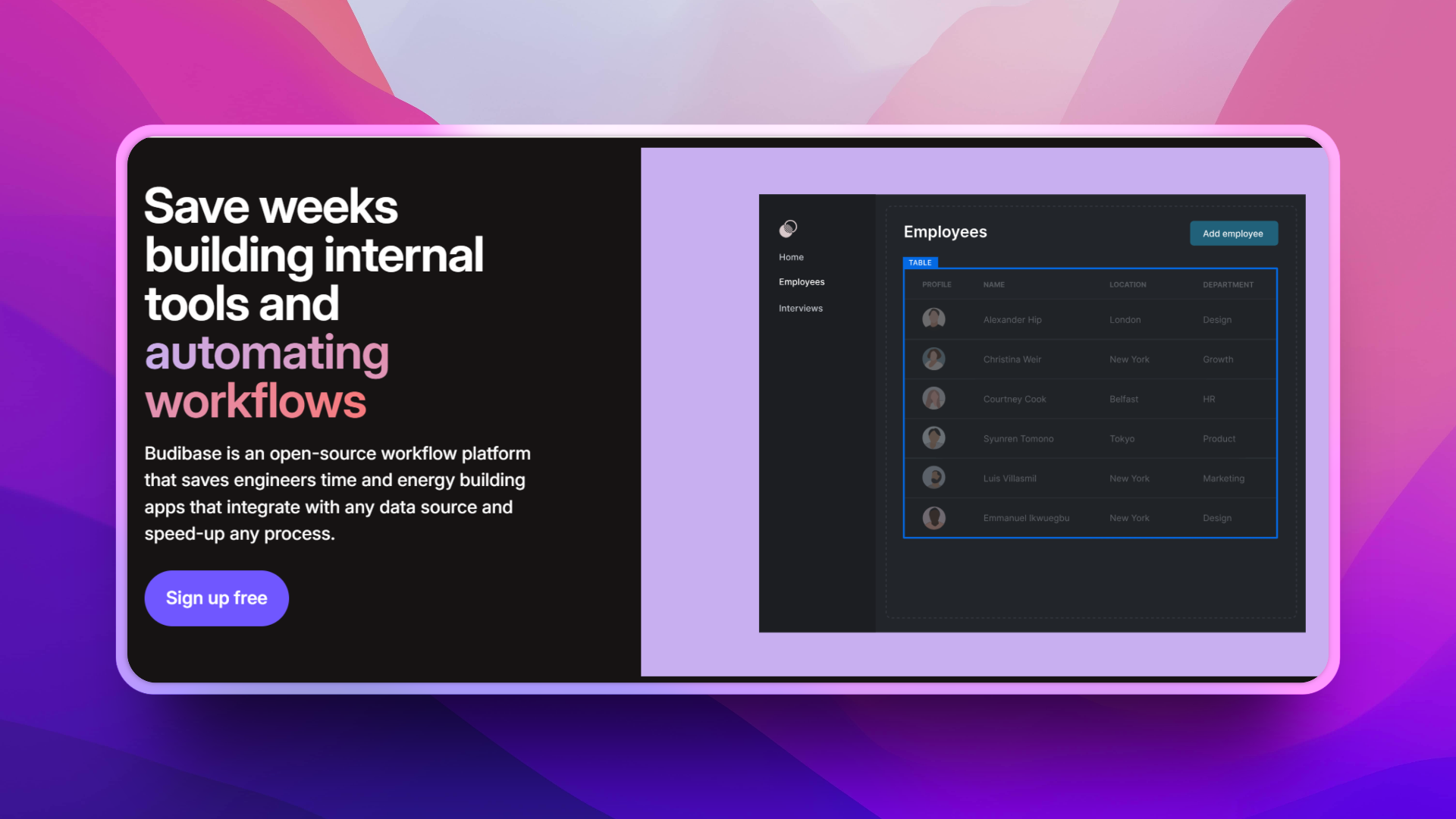
Build admin panels, forms, portals, and data GUIs around existing databases and APIs. Teams can replace one-off internal screens with reusable interfaces that non-engineers can operate.
Route approvals, update records, notify teams, and connect business systems from the same operations workspace. That reduces the handoff between an app builder and a separate workflow automation tool.
Budibase documents hosting through Docker, Docker Compose, Kubernetes, DigitalOcean, and Portainer. Teams with internal-data requirements can place the runtime closer to their own infrastructure.
Connect databases, REST APIs, AI models, and business tools so internal apps can act on live operational data instead of duplicated spreadsheet exports.
Features
- Internal app builder
- Agents and automations
- Self-hosting paths
- Connector-oriented workflow
Recommended for this setup
Strengths
- Covers apps and automation together: Budibase is stronger than a narrow CRUD builder when a process needs both a user-facing internal app and backend actions. That matters for approvals, service requests, onboarding flows, and support operations.
- Practical self-hosting choices: The official docs describe multiple self-hosted deployment methods, which gives teams a cleaner adoption path than tools that only run as hosted SaaS.
Trade-offs
- License and edition boundaries need review: The current OSA record does not expose a clean SPDX license. Teams should review Budibase license terms and edition limits before using it for redistributed products or competitive hosted services.
Tech stack
FAQ
Budibase can replace parts of Retool, Microsoft Power Apps, Airtable Interfaces, and Zapier-style internal automations. It is best viewed as an operations app platform, not as a full CRM or ERP by itself.
Yes. Budibase documents self-hosted deployment options including Docker, Docker Compose, Kubernetes, DigitalOcean, and Portainer, alongside Budibase Cloud.
Budibase is GPL-3.0 licensed. The GPL-3.0 allows self-hosting for any internal commercial purpose. If you redistribute a modified version to external users, that version must also carry the GPL-3.0 license.