
treg
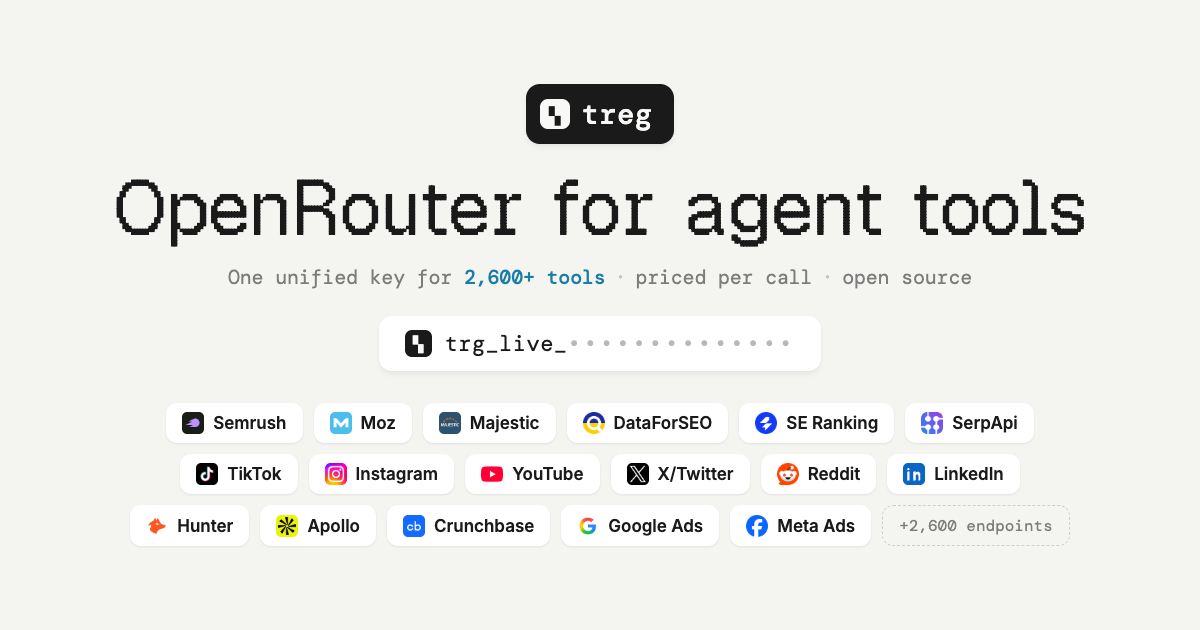
One token for 2,600+ agent tools across 47 providers
Replaces Composio, Toolhouse
Who it's for
An agent configured with treg can query keyword volume from Semrush, pull backlink data from Moz, run live SERP results from SerpApi, and check Search Console in a single run. All seven providers in the SEO toolbelt answer to one treg token, billed per call at fractions of the monthly seat price.
Your SEO workflow already has a data pipeline feeding a warehouse. treg's value is replacing missing subscriptions and per-provider signup overhead; if the data is already structured and queryable, a direct warehouse query is simpler.
treg exposes Hunter for email verification, Lusha for person enrichment, PDL for profile history, and Apollo for contact search under one token. An agent can run multiple enrichment providers on the same input and compare results without the team holding four separate seats.
Your enrichment volume is high enough that owning direct vendor seats is cheaper than per-call billing. Calculate the breakeven against each vendor's monthly cost before relying entirely on the catalog path.
Teams with multiple agents or developers register their provider keys once and every agent reaches them via the treg token, without distributing raw keys. Admin-configurable per-member access controls which tools each agent or teammate can call, and every call writes to an audit log.
Your team is one or two people with a single agent. Single-operator workflows do not need the team coordination overhead; a local .env is simpler until you have multiple agents or teammates needing shared access.
A SKILL.md recipe registered through treg upload becomes callable by any teammate's agent using just their treg token. The skill's API credentials live server-side; the skill author never has to redistribute keys when a teammate wants to run the same capability.
Your skills call only public APIs with no credentials. treg's skill registry is most valuable when the skill wraps a credentialed endpoint. For credential-free skills, a public GitHub skill directory is simpler.
The problem
The tools an AI coding agent needs for real work sit behind separate subscriptions: Semrush at $139/mo, Moz at $99/mo, Crunchbase at $99/mo, Apollo at $59/seat. Most of these exist because a human logs in regularly; buying them for a single automated agent run is economically irrational. Beyond cost, each provider requires its own signup flow, credential management, and key rotation. The credential problem compounds when a team shares agents. Every teammate needs the same set of API keys available in their environment, which means keys scattered across config files and machines, or stored in a secret manager most agents cannot query natively. One compromised machine exposes all those keys at once.
How it works
One treg token replaces credentials for every provider in the catalog. The proxy injects the correct API key server-side before relaying the request, so provider credentials never reach the agent's machine. Token revocation in one place cuts off access to all 47 providers simultaneously.
Every catalogued endpoint shows its price before the call, the success rate treg has measured, and average latency. Where multiple providers serve the same capability (nine vendors offer email lookup, for example), the catalog lists them side by side so the agent picks on evidence. The agent always chooses; treg does not silently pick a provider.
Semrush keyword data (normally $139/mo) costs $0.006 per call through the catalog. Moz backlinks ($99/mo) bill at $0.012 per call. Each team starts with $1.00 free credit. Teams that already hold a provider subscription connect their own key, and those calls route through unmetered with no treg markup.
Teammates register their own API keys, CLIs (stripe, gh, vercel), and SKILL.md recipe files once. Every agent in the org can then call them using just the treg token. Tool access is per-member configurable by admins, and every call writes an audit log entry.
treg ships as a Claude Code plugin installable with one slash command and exposes an MCP endpoint at treg.to/mcp/v2/ for the Claude.ai Connectors Directory. The plugin walks the agent through sign-in on first run, then registers the CLI and MCP tools automatically.
The registry server runs locally with uv run python -m treg using SQLite by default. Production deployment points at Postgres and sets a Fernet key for secrets at rest. No treg-owned infrastructure is required; self-hosters run the complete stack on any machine with Python.
Features
- Unified credential proxy
- 2,630-endpoint catalog with live pricing and success rates
- Pay-per-result billing at provider cost
- Team-scoped skill and secret registry
- Claude Code plugin and MCP surface
- Self-hosted with SQLite or Postgres
How to install
Install the CLI via the hosted setup script, or deploy the server locally using the Python server extra.
curl -fsSL https://treg.to/install.sh | sh
treg login
pip install "tools-registry[server]"
uv run python -m tregRecommended for this setup
Strengths
- No per-provider signup required: The catalog covers 47 providers. Using any of them requires only a treg account and a prepaid balance: no Hunter account, no Semrush trial, no Apollo seat. For agents that need data from several providers in a single run, this removes hours of account setup and ongoing credential-maintenance overhead.
- Bring your own key, pay nothing on top: Any provider key a team already pays for routes through treg unmetered. The team pays nothing additional, treg charges no markup on those calls, and credentials are still injected server-side so the key never sits on the agent's machine. Existing subscriptions become more useful, not redundant.
- Credentials never leave the server: The proxy relays requests faithfully to upstreams and injects credentials server-side. The agent holds only the treg token. Revoking that token immediately cuts off access to every provider. Losing a single agent's environment does not expose the underlying provider keys.
- Fully self-hostable open source stack: The registry server is open source and deployable on any machine with Python and a database. There is no treg-owned infrastructure required: a self-hosted instance can run its own catalog, credential store, and team management with no dependency on the hosted treg.to service.
Trade-offs
- Source-available license: SaaS use requires authorization: treg's LICENSE file is Apache-2.0 with Additional Terms that take precedence. Self-hosting for your own organization is expressly permitted, including commercial internal use. Offering treg as a hosted, managed, or embedded service to third parties, such as a SaaS product or managed registry sold to customers, requires the licensor's written authorization. This fair-code model resembles n8n's Sustainable Use License; strict OSI-only policies should review the terms first.
- Self-hosting requires careful Fernet key management: Stored credentials are encrypted with a Fernet key (TREG_SECRET_KEY). If that key is lost on redeployment, every stored credential becomes unrecoverable and must be re-registered. Production deployments need a persistent, backed-up key management strategy; the README explicitly flags this risk.
- Catalog calls fail hard when balance is empty: An empty prepaid balance returns HTTP 402, failing any agent call that depends on a catalog-tier endpoint. Teams relying on catalog endpoints for core workflows need either a funded balance with automatic top-ups, or their own provider keys registered as the primary path.
- Project is less than two months old: Created in July 2026, treg has 1,011 stars and 29 open issues. The core proxy and catalog are functional, but the project is under active development. API surfaces and configuration details may change. Production deployments should pin a tested version and monitor the changelog.
Tech stack
FAQ
Composio and Toolhouse are managed cloud services that connect agents to third-party APIs. treg is open source and self-hostable: you run the full registry on your own infrastructure with your own database and credential store. The billing model also differs: treg charges per call at provider cost with no markup, earning on volume pricing with vendors rather than on user margin. Teams needing data residency or wanting to avoid managed infrastructure have a path that Composio and Toolhouse do not offer.
Yes. Register a provider secret with treg secret add or run treg upload env from a project directory with a .env file. Those calls route through the proxy with your credential injected server-side and are completely unmetered. You pay the provider directly on your existing contract; treg charges nothing for calls that use your own key.
The registry server is free to self-host and run. You can run it locally with uv run python -m treg with no paid account needed. Catalog-tier calls, where treg holds the provider account and bills against your balance, require a funded prepaid account; every new team starts with $1.00 free credit.
The proxy returns HTTP 402 with balance_micro, estimated_cost_micro, and a topup_url in the response body. An agent can parse this structured response and act on it without reading prose. Teams can configure automatic top-ups to prevent mid-run failures on high-volume workflows.
Stored credentials are encrypted at rest using a Fernet key set in TREG_SECRET_KEY. The proxy injects credentials server-side before the request reaches the upstream provider. The agent's machine holds only the treg token, not the underlying API keys. Revoking the treg token immediately cuts off access to every provider. The README warns that losing the Fernet key makes stored credentials unrecoverable, so production deployments should back up the key separately from the database.