
hypit
Clone viral video formats with AI agents, batch 100+ variants
Replaces Viralclone Ai, Cloneviral
Who it's for
Clone any ad format, swap in your product, and ship 50 hook variants the same day. When the ad fatigues, rerun with a new hook without touching the body structure. The SVML workflow file is the reusable asset; the rendered video is the output.
You need a visual, no-code editor. Hypit workflows are written as SVML source and managed by a coding agent; teams without a developer or AI agent in the loop should use a managed platform instead.
Clone a proven TikTok, Reel, or Short format and swap the host, hook, product, or language while caption timing and edit structure stay fixed. Localization rewrites dialogue and reflows timing automatically across ten languages from one base workflow.
You need a browser-based collaborative review interface for individual clips before export. Hypit is command-line and agent-driven; frame-by-frame review requires a separate editing tool.
Hypit's agent compatibility and plugin architecture make it suitable for programmatic video generation at scale. Connect it to a data source, let the agent generate SVML for each record, and render hundreds of product or data-driven videos unattended.
Your pipeline output is images or text only. Hypit is focused on video composition and is not a general-purpose media-generation API.
The /hypit skill lets Claude Code, Codex, or other compatible agents plan and produce video as part of a broader task. An agent can research a topic, write the SVML, pull model-generated assets, and deliver a finished clip in a single session.
Your agent environment does not support the Node.js ecosystem or does not have shell access for rendering. The skill requires Node.js 22.15+ on the host machine.
The problem
Viral video replication at scale is manual and expensive. Platforms that generate content from a reference video typically produce scripts, thumbnails, or isolated clips, not a complete production. The face swap, B-roll selection, caption styling, effects timing, and shot transitions all still require manual work in a video editor or multiple separate tools. For teams producing paid social ads, TikTok Shop videos, or localized content, rebuilding a winning format from scratch every time erodes the ROI of the original. The deeper problem is batch economics. Swapping the host or product in a proven video format while keeping everything else the same is the core task in performance marketing, and there is no way to do it programmatically at scale without either a locked commercial platform with plan-based limits or a bespoke engineering project. Most creators choose the platform and accept the cost ceiling; engineering teams build one-off scripts that do not generalize to new formats.
How it works
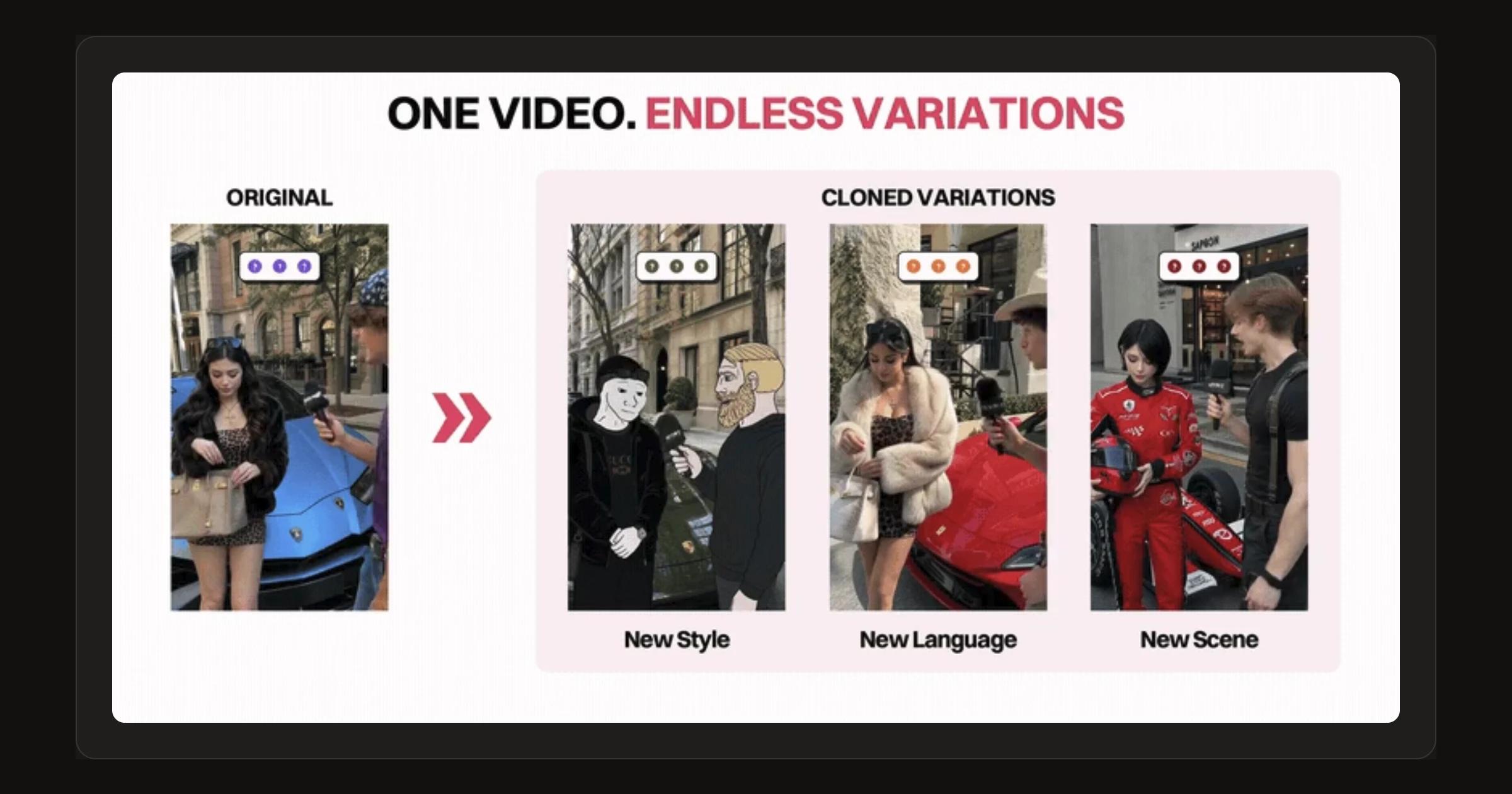
Drop in a reference video and the agent reconstructs the entire production as an SVML workflow covering footage timing, captions, B-roll placement, face swaps, and effects. Unlike tools that return a script or a thumbnail, Hypit outputs an editable, rerunnable composition covering every layer of the original. Change one line and re-render.
One workflow file runs 10, 50, or 100+ variant renders in a single command. Swap the host, product, language, hook, or aspect ratio while the proven structure stays intact. Concurrent rendering uses up to 64 headless Chromium processes, so large batches run in parallel rather than sequentially.
Hypit does not bundle a model API. You connect your own keys for generation services such as Seedance, GPT Image, or any service supported by HypiHub or Monid. A workflow that uses only motion graphics or code-rendered visuals runs with no generation API, so model costs for those elements are zero.
Compositions can compile captions, motion graphics, and front-end code visuals into a finished video entirely locally, without calling any generation model. This cuts AI API costs to zero for code-driven productions and keeps render times deterministic on the same input.
The /hypit skill is available to Claude Code, Codex, and compatible coding agents. The agent can plan, generate, and assemble a video from a text prompt or reference path, checking the environment and requesting model-service credentials before starting. No separate build pipeline is needed.
Video effects, captions, B-roll providers, and transitions are packaged as composable plugins. Fork and modify individual components, publish them under your own npm scope, or build new components without touching the core renderer. Community components follow a standard packaging contract.
Features
- Full video workflow cloning
- Batch variant generation
- BYOK model freedom
- Code-rendered video output
- Agent-native tooling
- Plugin-based component architecture
How to install
Self-host Hypit on any machine running Node.js 22.15+ and pnpm 10.33. Install the skill globally to make it available to your coding agents:
npx skills add hypit-ai/hypit -gOr clone and run from source:
git clone https://github.com/hypit-ai/hypit.git
cd hypit
pnpm install
Recommended for this setup
Strengths
- No seat pricing or per-render fees from Hypit: The open source core carries a $0 software cost. Model-service usage is billed directly by whichever service you choose, with no Hypit markup. Platforms like ViralClone.ai and CloneViral charge monthly subscriptions and enforce batch limits by plan tier; Hypit has neither.
- Entire video as editable source: Production output is SVML source, not a rendered file. Every shot, caption, and effect is adjustable before the next render. When a winning ad fatigues, open the file, change the hook, and re-run the batch without re-cloning the reference video.
- Works with any compatible AI agent: The /hypit skill integrates with Claude Code, Codex, and other compatible coding agents. Compared to platforms with closed, proprietary agent connections, Hypit is model-agnostic: switch the agent or the generation service without changing the workflow file.
- Self-hosted on your own infrastructure: Your video projects, API keys, and rendered outputs live on your own machine or server. There is no cloud account required to run Hypit, and no terms in the self-hosting tier restrict the content categories you produce for your own organization's use.
Trade-offs
- Fair-code license restricts multi-tenant hosting and redistribution: Hypit uses a custom license based on Apache-2.0 with additional conditions. Single-tenant self-hosting for your own organization is permitted, including client work. You may not operate a multi-tenant environment where multiple outside parties hold separate workspaces, and you may not resell or redistribute Hypit commercially without a separate license from Hypit.
- Infrastructure and model API costs are your responsibility: The $0 software cost does not include the cloud compute or model API credits you consume. A 100-variant short-form batch using generation models cost around $1 to $2 in the examples documented in the README. High-volume production requires budgeting for model service accounts and server capacity.
- Requires Node.js 22.15+ and specific toolchain versions: The install requires Node.js 22.15 or newer and pnpm 10.33. Teams on older Node LTS versions or different package managers need to upgrade their environment before using Hypit. On first use, the agent checks for the Hypit executable and helps prepare it if needed.
Tech stack
FAQ
The open source core is free to self-host and run on your own infrastructure. Hypit charges no seat fees and no per-render fees. You pay only for AI model services you choose to use, such as Seedance or GPT Image, and for the server compute you run. Model service costs in published examples ran around $1 to $2 per 100-variant batch.
Hypit uses a custom license based on Apache-2.0 with additional conditions. You may self-host and run it for your own organization's work, including client projects, in a single-tenant deployment. You may not operate a multi-tenant environment where outside parties hold separate workspaces, and you may not resell or redistribute it commercially without a separate license from Hypit.
Yes. Hypit is BYOK (bring your own key) by default. Connect your accounts for generation services such as Seedance, GPT Image, or any compatible service. You can also route calls through HypiHub or Monid. Workflows that rely on code-rendered visuals rather than generative models incur no model API costs at all.
The /hypit skill is available to Claude Code, Codex, and any agent that supports skills in a compatible agent environment. The agent handles environment setup, credential requests, and the full production workflow. The Hypit repository's agents documentation lists current integration details.
No. When you drop in a reference video, the agent writes the SVML source for you. Describe what you want in natural language and the agent plans, generates assets, and assembles the video. Editing SVML directly is optional for teams that want per-element control over individual production components.