
GoatCounter
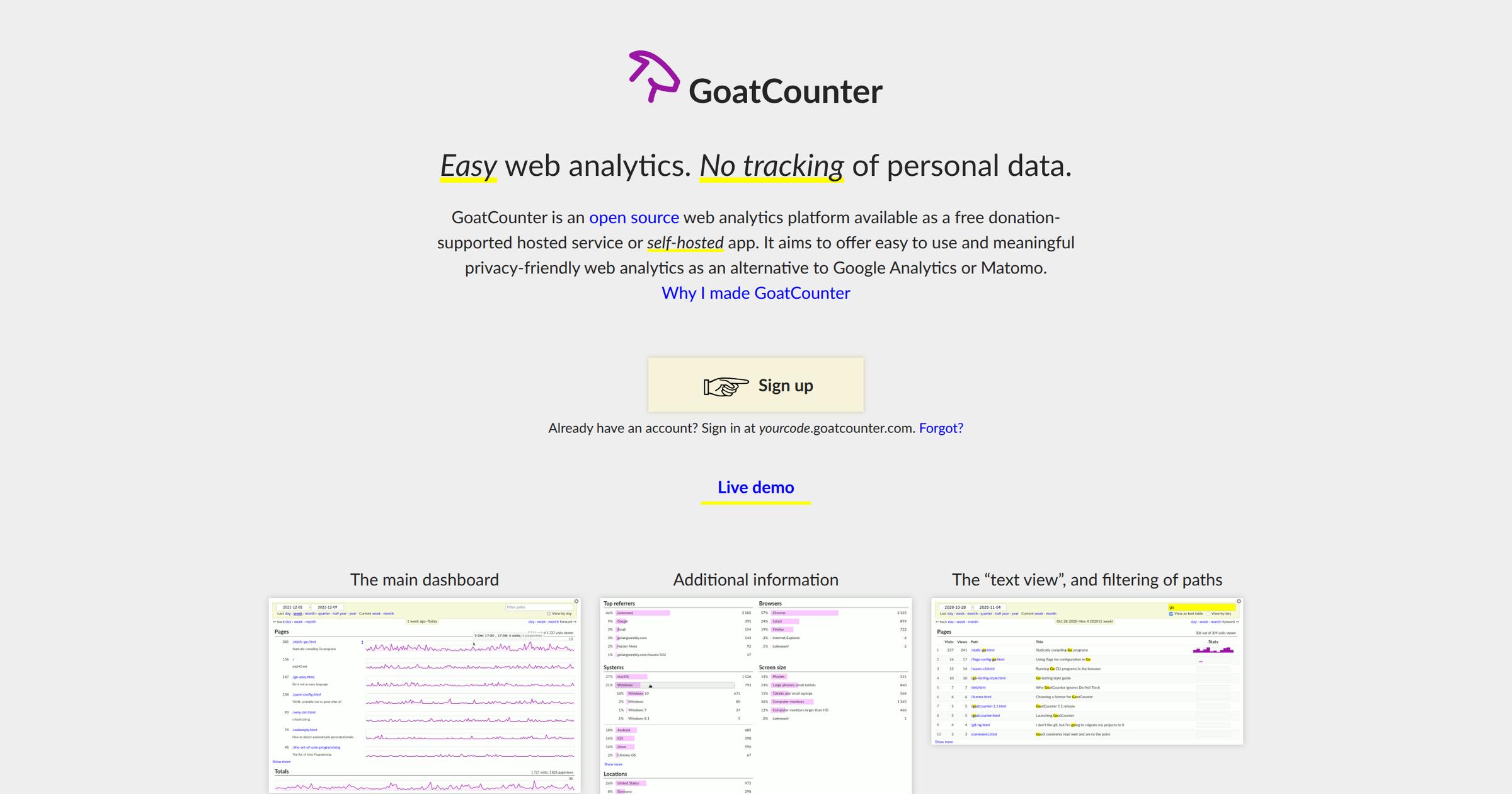
Web analytics without cookies, consent banners, or personal data.
Replaces Google Analytics, Plausible Analytics, Fathom Analytics, Simple Analytics, Matomo Cloud, Piwik Pro
Who it's for
GoatCounter is a natural fit for personal websites and portfolios that want basic traffic data: which posts are popular, where visitors come from, which countries send traffic. The free hosted service at goatcounter.com requires no server and takes under five minutes to set up with a single script tag.
Skip if you need conversion tracking, goal funnels, or any form of event attribution beyond pageview counting. GoatCounter is a pageview and referral tool; event analytics require a different approach.
Developers adding analytics to their own applications benefit from GoatCounter's REST API and backend middleware integration, which lets them record events server-side without any client-side JavaScript. Logfile import from nginx, Apache, Caddy, and CloudFront is also supported, enabling analytics without any code change to the application.
Skip if your application needs user-level tracking, session replay, or product analytics such as click maps or heatmaps. GoatCounter is designed around aggregated privacy-safe counts, not individual user journeys.
Small businesses that want traffic data without GDPR consent banners and ongoing cookie policy maintenance can use GoatCounter without collecting personal data, removing the need for a consent management tool. The free hosted service handles the infrastructure; the self-hosted path gives full data ownership.
Skip if your marketing team needs campaign attribution, multi-channel conversion tracking, or audience segmentation. GoatCounter does not support these workflows.
The problem
Most web analytics tools track users across sessions using cookies or persistent fingerprints, which triggers GDPR consent requirements and forces site owners to display consent banners on every page. For personal sites and small businesses, managing that compliance process is a significant ongoing pain: banner copy must be legally reviewed, consent preferences must be stored and honored, and data processing agreements must be in place with the analytics provider. Beneath the compliance burden is a usability gap. Tools like Google Analytics and Matomo offer deep segmentation, funnel analysis, and campaign attribution, but most small site owners use almost none of it. The gap between what the tool measures and what an owner actually reads means analytics become background noise rather than actionable information. Many site owners end up either disabling analytics or running them without looking at the data.
How it works
GoatCounter identifies unique visits using a daily rotating salt that generates a non-identifiable session hash. The hash cannot be linked back to a specific user across days, so visits are counted accurately without any cookie, local storage entry, or persistent identifier. Technical details are documented at goatcounter.com/help/sessions.
The standard integration adds approximately 3.5KB of JavaScript to your site via a single script tag. For sites where JavaScript is unavailable or undesirable, GoatCounter also supports a no-JavaScript image-based tracking pixel, backend middleware integration via REST API, and logfile import from nginx, Apache, Caddy, or CloudFront.
GoatCounter ships as a single Go binary with no runtime dependencies beyond SQLite (bundled) or PostgreSQL. Download the binary for your platform, run goatcounter serve, and the server starts on port 8080. No Node.js, Ruby, or Python runtime is required. Docker images are also published at arp242/goatcounter on DockerHub.
Site owners can configure which data GoatCounter collects and stores, including browser information, country, screen size, and referrals, each independently. The privacy policy and GDPR documentation are published at goatcounter.com/privacy and goatcounter.com/gdpr, and the source code is fully auditable on GitHub.
GoatCounter's built-in HTTP server supports TLS with automatic certificate generation via ACME (Let's Encrypt). Running in production requires no separate reverse proxy: start with goatcounter serve -listen=:443 -tls=tls,rdr,acme. This is distinct from most self-hosted analytics tools, which require a separate nginx or Caddy layer.
Features
- No-cookie unique visit counting
- ~3.5KB JavaScript or no-JavaScript tracking pixel
- Single statically-compiled binary with no runtime dependencies
- Fine-grained data collection control
- Built-in TLS with automatic ACME certificate management
How to install
Self-hosting GoatCounter uses Docker with a named volume for the SQLite database.
docker run -p 8080:8080 -v goatcounter-data:/home/goatcounter/goatcounter-data arp242/goatcounterRecommended for this setup
Strengths
- No GDPR consent banner required: Because GoatCounter does not process personal data or set cookies, it does not trigger GDPR's consent requirements for most deployments. Site owners running GoatCounter on EU visitors can typically skip the cookie banner entirely, reducing page friction and removing an ongoing compliance task. The documentation at goatcounter.com/gdpr covers the specific legal basis.
- Free for personal and small-to-medium business use: The hosted service at goatcounter.com is free for personal sites and small-to-medium businesses with reasonable traffic. Self-hosting is also free with no per-seat or per-pageview limits. Subscription-based alternatives like Plausible Analytics start at $9/month (up to 10k pageviews, plausible.io, read 2026-11-05) and Fathom Analytics at $15/month (up to 100k pageviews, usefathom.com/pricing, read 2026-11-05); GoatCounter covers the same core use cases at no cost.
- EUPL-1.2 (modified) open source with full self-hosting rights: GoatCounter is licensed under EUPL-1.2 (modified), which grants the right to self-host for any purpose, including internal commercial use, with no licensing fee. The only difference from standard EUPL-1.2 is a narrowed compatible-licences appendix. Copyleft applies only when you distribute a modified version: running your own private instance has no such requirement. The source code is fully auditable on GitHub at arp242/goatcounter.
- Accessible interface for assistive technology: Accessibility is a stated high-priority feature in GoatCounter's design. The dashboard is built to work with screen readers and other assistive technology, which is uncommon among analytics tools. This matters for teams where dashboard users include people relying on assistive technology to navigate data-heavy interfaces.
Trade-offs
- No funnel analysis, conversion goals, or A/B testing: GoatCounter tracks pageviews, referrals, browser data, location, and screen size, but does not support conversion goals, event funnels, A/B test tracking, or attribution modeling. Teams that need to measure product sign-ups, checkout completions, or campaign ROI will need a different tool. This is a deliberate scope constraint, not a roadmap gap.
- EUPL-1.2 (modified) copyleft applies when distributing modifications: Distributing a modified version of GoatCounter (for example, shipping it as a managed service to customers) requires releasing modifications under EUPL-1.2 (modified) or a compatible license. Running it privately for your own site or organization has no such restriction. Teams building a hosted analytics service on top of GoatCounter need to review the license terms before shipping.
- 47 open issues; primarily single-maintainer development: GoatCounter has 47 open issues and is primarily developed by one maintainer (arp242). Feature requests and bug fixes depend on a single contributor's availability. This is not unusual for a project with over 6,000 stars, but teams should factor maintainer availability into their evaluation for production-critical deployments.
Tech stack
FAQ
Yes, for most deployments. GoatCounter does not set cookies or store personal data, which means processing typically falls outside GDPR's consent requirements. The official documentation at goatcounter.com/gdpr covers the legal basis in detail and discusses edge cases. Site owners with complex legal situations should review it with their own counsel.
Yes. GoatCounter is licensed under EUPL-1.2 and can be self-hosted for any purpose, including commercial internal use, with no licensing fee. Download the statically-compiled binary for your platform from the GitHub releases page, run goatcounter serve, and the server starts on port 8080 with SQLite as the default database. Docker images are also available at arp242/goatcounter on DockerHub.
GoatCounter uses a slightly modified version of EUPL-1.2 (European Union Public Licence 1.2). The only difference from standard EUPL-1.2 is a narrowed compatible-licences appendix that removes GNU GPL, LGPL, and MPL from the compatibility list. The rights are identical: use, modify, distribute, and self-host in any circumstance, including for commercial internal use. The copyleft clause applies only when you distribute a modified version of the software to others: running GoatCounter privately for your own company or clients does not trigger it. Teams planning to resell a modified version as a managed service should review the license terms before shipping.
Yes. In addition to the standard ~3.5KB JavaScript integration, GoatCounter supports a no-JavaScript image-based tracking pixel for static sites or email tracking, backend middleware integration via its REST API for server-side recording, and logfile import from nginx, Apache, Caddy, and CloudFront. These options are documented at goatcounter.com/code and goatcounter.com/api.
GoatCounter uses a daily rotating salt to generate a session hash from the visitor's IP address, User-Agent, and timestamp. The salt changes every 24 hours, so the hash cannot be linked across days. This identifies unique visits within a session without storing any persistent identifier, without setting cookies, and without retaining the original IP address. Technical details are at goatcounter.com/help/sessions.