
DuckDB
Fast in-process SQL analytics database, no server needed
Replaces Motherduck, Snowflake, Google Bigquery
Who it's for
Use DuckDB to run SQL against CSV, Parquet, JSON, and data frames without provisioning a warehouse.
Skip if your organization requires centralized role management and always-on shared compute.
Use DuckDB inside an app when customers need fast analytical queries over local or app-owned data.
Skip if writes, transactions, and concurrent application users are the primary workload.
The problem
Analytical work often starts with files, notebooks, or application data long before it belongs in a managed warehouse. Moving every exploratory query into BigQuery, Snowflake, or Redshift adds cloud cost, data movement, and operational delay.
How it works
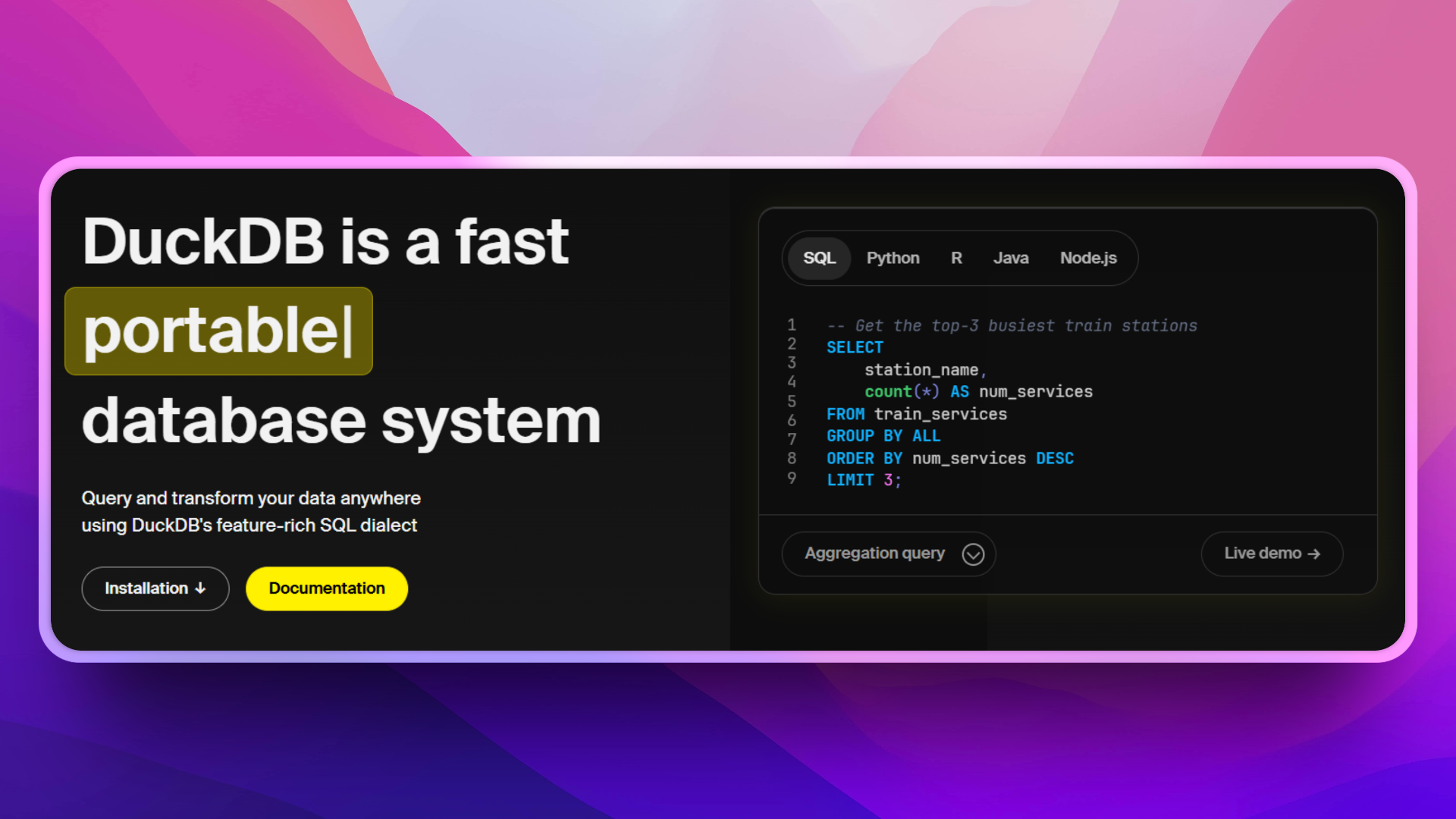
DuckDB runs inside the application process with no server to start. Analysts can query local files or data frames directly from Python, R, Java, Node.js, or the standalone CLI.
The README shows CSV and Parquet reads directly in the FROM clause. That makes ad hoc file analysis possible without loading data into a warehouse first.
DuckDB supports window functions, complex types, nested subqueries, and extensions designed for analytical workflows rather than transaction processing.
Features
- In-process OLAP engine
- SQL over common file formats
- Rich analytical SQL
How to install
pip install duckdbRecommended for this setup
Strengths
- No warehouse required for local analytics: DuckDB removes the service layer for small and medium analytical jobs, so teams can run SQL close to the files and code that already hold the data.
- Permissive MIT license: The MIT license allows commercial embedding, which is valuable for applications that need local analytics without shipping a separate database server.
Trade-offs
- Not a multi-user warehouse: DuckDB is built for in-process analytics, not high-concurrency shared warehouse workloads. Use Snowflake, BigQuery, ClickHouse, or another server system when many users need centralized compute and governance.
Tech stack
FAQ
No. DuckDB targets analytical OLAP queries, while PostgreSQL is a general relational database for transactional application workloads.
Yes. The README shows querying Parquet files directly from SQL by referencing the file path in the FROM clause.
Yes. DuckDB is MIT licensed, which permits commercial use and embedding.