Forgejo
Self-hosted Git forge for teams that want platform independence
Replaces Github, Gitlab
Who it's for
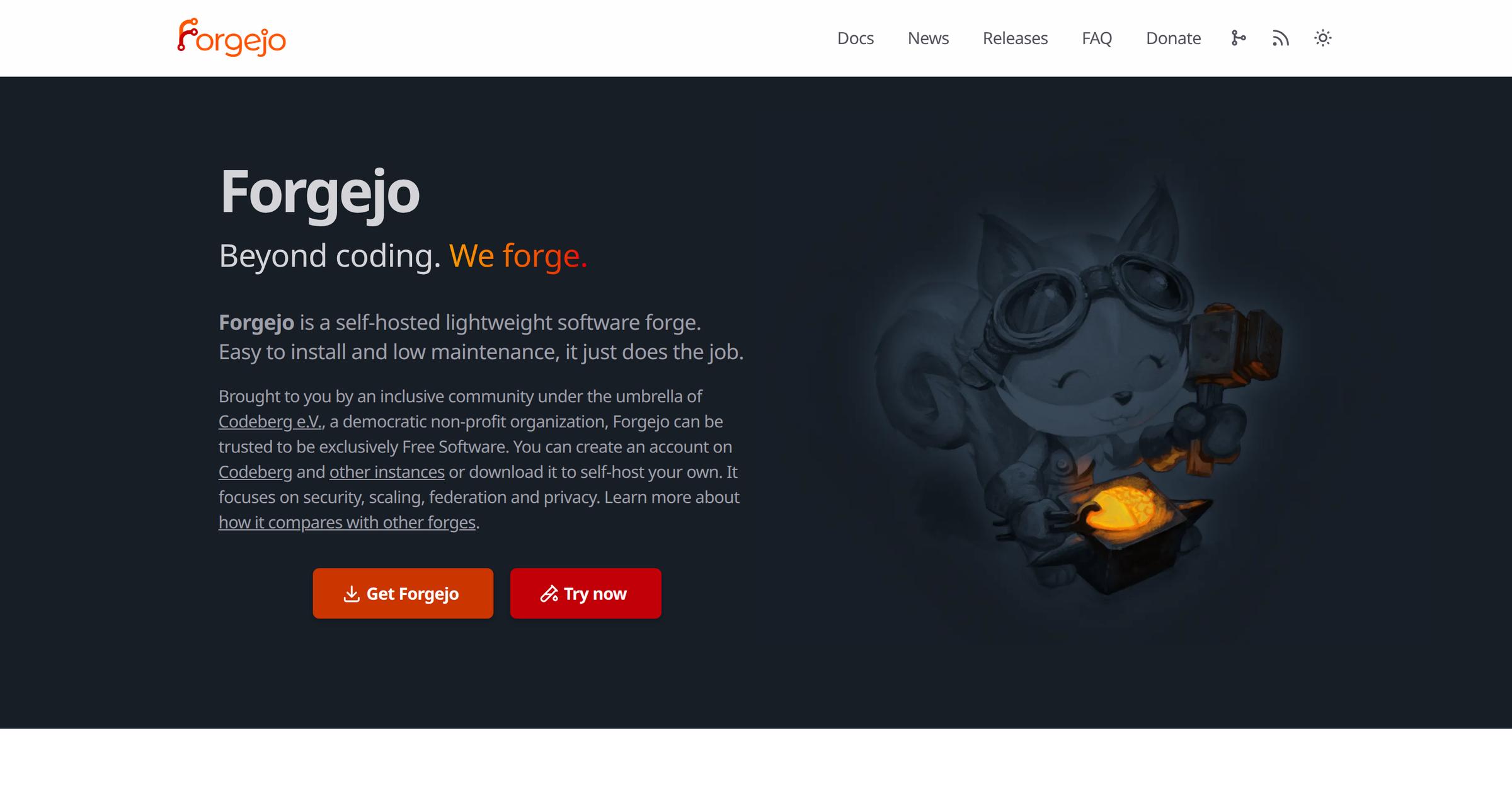
Forgejo provides a GitHub-like interface at self-hosted cost. Pull requests, issues, wikis, and package publishing are all built in. The website describes it as designed to offer a familiar environment to GitHub users, allowing a smooth transition to a platform the team owns.
If the team depends heavily on GitHub's third-party app marketplace, GitHub Copilot, or public discoverability for open source contributions, Forgejo does not replicate those. The GitHub network effect does not transfer to a private instance.
Forgejo is governed by a democratic non-profit community under Codeberg e.V., meaning the roadmap and terms are shaped by contributor input rather than a single company's commercial interests. A project with community governance may prefer hosting on a forge with matching governance values.
If discoverability matters to the project, with new contributors finding it via GitHub search, a private or small public Forgejo instance will have much less reach than GitHub.
Forgejo is designed to run on nearly every machine. The README calls this out explicitly, noting it runs on a Raspberry Pi or small cloud instance. The website states it requires an order of magnitude less resources than other forges, making it suitable for basic server setups.
If no one on the team is comfortable with basic server administration, setup and ongoing maintenance (backups, upgrades, SSL certificates) will require learning or outside help.
Forgejo shares a common codebase with Gitea, making the interface and feature set comparable. The main reasons to switch are Forgejo's GPL-3.0 license and community-governed roadmap under Codeberg e.V. Both tools are listed in this directory and serve similar use cases.
If the team is satisfied with Gitea's current governance and the MIT license, the migration offers limited practical benefit in day-to-day use.
The problem
Development teams on GitHub or GitLab ship code in an environment they do not own. Their commit history, issue threads, CI runs, and access control rules all live on servers run by a third party at prices the third party sets. When pricing structures change, migrating is expensive because the data format, URLs, and integrations are all tied to the platform. Self-hosting solves the ownership problem, but most self-hosted forge options have historically demanded either large server resources or significant administrator time to keep running. A team wanting more control could find themselves maintaining a heavier forge that requires substantial infrastructure before serving a single request. Forgejo addresses both pressures: it is light enough to run on modest hardware and designed to stay low-maintenance, so the team spends time on code rather than forge administration.
How it works
Full Git repository management with pull request workflows and collaborative code review. The website describes the interface as designed for GitHub users, with the goal of allowing a smooth transition to a platform the team owns.
Issues, wikis, and kanban boards are all built in alongside code hosting, so teams can coordinate work without connecting a separate project management tool. The README describes this as covering everything needed to coordinate with your team.
Built-in registry supports Docker, npm, and many other package managers per the README. Teams publish directly to their Forgejo instance and pull packages through standard tooling, keeping artifact hosting internal alongside the source.
Forgejo includes CI integration for automating builds and tests alongside code hosting. The README lists it alongside LDAP, OAuth, code search, and organization permissions as part of the capabilities available for teams with advanced workflow needs.
Connects to existing LDAP setups and OAuth identity providers. Organization and team permissions let administrators control repository access at a granular level, all listed in the README as part of Forgejo's advanced capabilities.
Forgejo is actively building cross-instance federation via ActivityPub. When complete, users on separate Forgejo instances will be able to follow repositories and interact across server boundaries, moving forge collaboration toward a decentralized model.
Features
- Git hosting with pull requests and code review
- Issues, wikis, and kanban boards
- Package registry for Docker, npm, and more
- Built-in CI integration
- LDAP, OAuth, and organization permissions
- ActivityPub federation across forge instances
Recommended for this setup
Strengths
- Runs on minimal hardware including a Raspberry Pi: Forgejo runs on a Raspberry Pi or a small cloud instance. The README explicitly calls this out as a design goal. For teams with modest infrastructure budgets, this removes the cost floor that makes self-hosting unattractive compared to paying for a hosted platform.
- Permanently Free Software under GPL-3.0: Forgejo is governed by Codeberg e.V., a democratic non-profit, with an explicit commitment to remaining Free and Open Source Software permanently. There is no open-core model and no enterprise tier withheld from the GPL release.
- GitHub-like interface with a smooth migration path: The interface is close enough to GitHub's that developers switching platforms rarely need onboarding. The website notes Forgejo is designed to offer a familiar environment to GitHub users, allowing a smooth transition to a platform you own.
- Community-governed roadmap via Codeberg e.V.: Governance is handled through a democratic community process under Codeberg e.V. Roadmap decisions reflect contributor and user input rather than a single company's commercial interests. This is the practical distinction from Gitea's current governance structure.
Trade-offs
- Active issue backlog with over 1,500 open items: The Codeberg repository shows over 1,500 open issues covering feature requests and bug reports across a wide surface area. Response time on non-critical bugs varies. Teams that need guaranteed support response times will need to arrange their own support.
- GPL-3.0 requires source disclosure when distributing modifications: GPL-3.0 means any modified version you distribute must carry the same license and include the source. Running a private internal Forgejo instance is unrestricted. Shipping a modified Forgejo as part of a product distributed to customers triggers the disclosure requirement.
- ActivityPub federation is still in development: Cross-instance federation is listed as a work in progress in the README. Teams selecting Forgejo specifically for its federated future should check current release notes to confirm the status before committing to that as a feature.
Tech stack
FAQ
Forgejo is a community fork of Gitea, created in 2022 to move the project under independent governance via Codeberg e.V. The codebase overlaps substantially, but Forgejo adopted GPL-3.0 at v9.0 while Forgejo versions before v9.0 used MIT. The two projects have diverged in governance and roadmap priorities. Gitea is also listed separately in this directory.
Yes. Forgejo covers the core GitHub workflow: Git hosting, pull requests, issues, CI integration, and a package registry. It runs on your own server with all data on infrastructure you control. The main trade-off is losing the GitHub network: public discoverability, the app marketplace, and third-party integrations built specifically for GitHub.
GPL-3.0 permits running Forgejo internally for any purpose, including commercial work. You can run it for your company's private development without any license fees. The GPL-3.0 source disclosure requirement applies only if you distribute a modified version of Forgejo itself; running it as an internal hosted tool does not trigger it.
Forgejo is designed to run on minimal hardware. The README explicitly notes it runs on a Raspberry Pi or a small cloud instance. The website states it requires an order of magnitude less resources than other forges, making it suitable for basic server setups without significant infrastructure investment.
Yes. The README lists CI integration as a built-in capability alongside LDAP, OAuth, code search, and organization permissions. Teams can run automated builds and tests within the same forge that hosts their code and issues. For specifics on supported runner types and workflow configuration, check the official documentation at forgejo.org/docs/latest.