
Zulip
Organized team chat with threaded conversations, self-hostable
Replaces Slack, Microsoft Teams, Google Chat, Discord
Who it's for
Zulip keeps architecture, incident, release, and support conversations separated by topic while still living in shared team streams.
Your team mainly uses chat for quick social coordination and does not want to enforce topic naming.
Maintainers can point contributors to focused topics and keep answers discoverable across time zones.
Your community depends heavily on voice rooms, live events, or broad consumer familiarity with Discord.
The problem
Fast chat tools work well for live coordination, but they turn messy when a team discusses several decisions in the same channel. Important answers get buried between status updates, newcomers have to read long scrollback, and remote teams repeat the same questions because no one can find the thread that settled the issue. The pain gets sharper for open source communities, research groups, and engineering teams with members across time zones. They need asynchronous discussion that stays organized by topic, not just a searchable stream of every message ever sent.
How it works
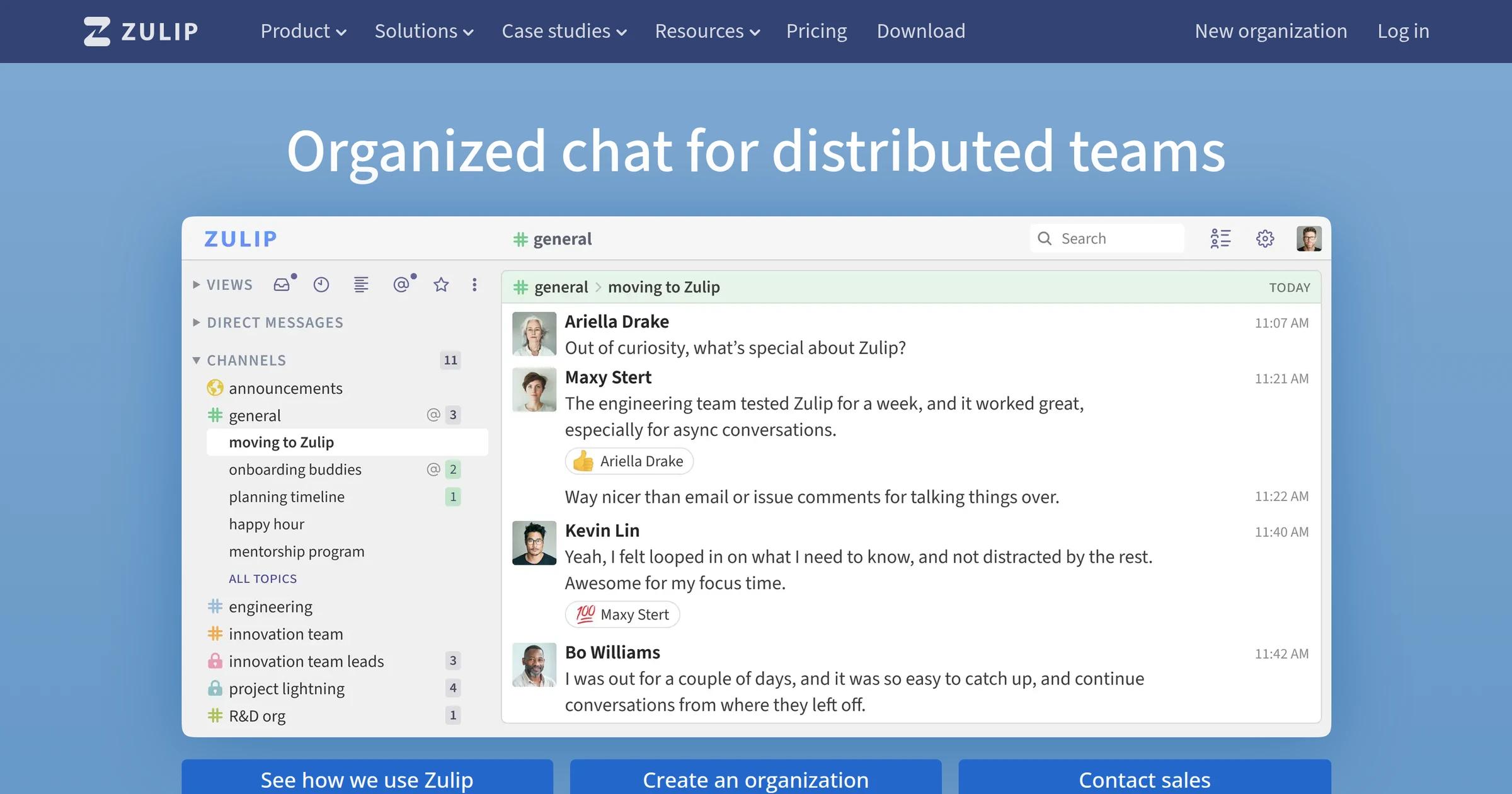
Every stream message belongs to a topic, so multiple discussions can happen in the same team space without mixing decisions, questions, and status updates.
Zulip publishes its server code under Apache-2.0, giving teams a path to run chat on their own infrastructure instead of keeping all history in a proprietary SaaS account.
The project documents integrations, bots, webhooks, and an API so engineering teams can connect deployments, CI alerts, issue trackers, and custom workflows to chat.
Official web, desktop, and mobile clients let teams keep the same threaded conversation model across laptops and phones.
Features
- Topic-based conversations
- Self-hosted server option
- Developer-focused integrations
- Cross-platform clients
Recommended for this setup
Strengths
- Better async structure than channel-only chat: Topic threads make Zulip easier to scan after time away than Slack-style channels where unrelated conversations interleave chronologically.
- Apache-2.0 licensing: The permissive license supports internal modification and commercial use without the network-copyleft obligations that some team chat platforms carry.
Trade-offs
- Different mental model: Teams used to casual channel chat need to adopt topic hygiene. Without that habit, Zulip loses much of its advantage over Slack or Discord.
- Self-hosting is an operations commitment: Running the server means maintaining databases, email delivery, backups, upgrades, and push notification configuration instead of delegating that work to Zulip Cloud.
Tech stack
FAQ
Yes. Zulip Server is open source under the Apache-2.0 license, with official clients and integrations available through the Zulip project.
Zulip can replace Slack for teams that value threaded async discussion, searchable history, and self-hosting. Slack remains stronger for teams that rely on a large app marketplace and familiar channel-first workflows.
Yes. Zulip provides a self-hosted server path, but production operation requires normal chat infrastructure work such as email, backups, upgrades, and push notification setup.