
Vikunja
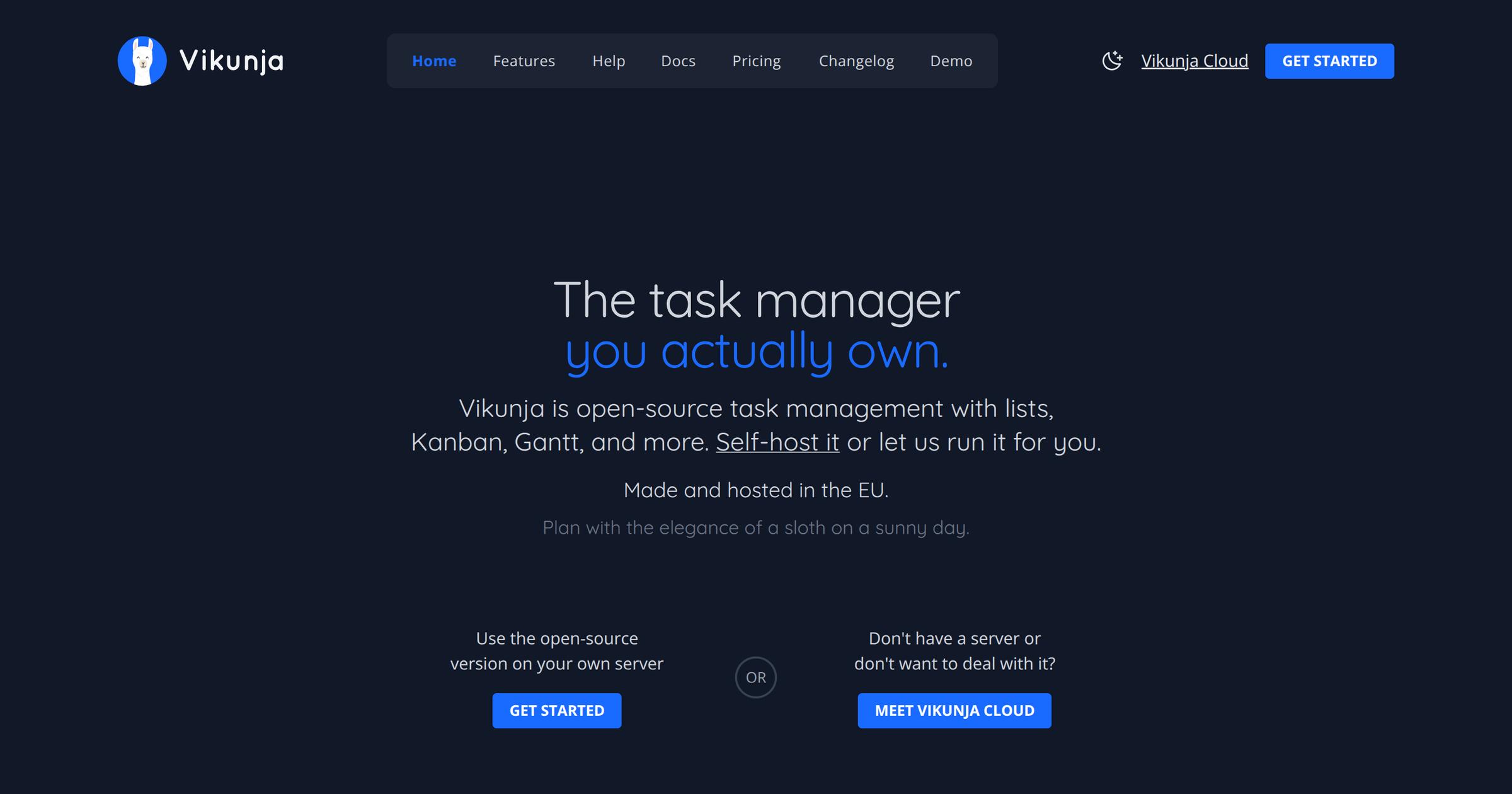
Self-hosted task manager with list, Kanban, Gantt, and table views
Replaces Todoist, Clickup, Asana, Ticktick, Trello, Monday Com, Linear
Who it's for
Teams paying per seat on Todoist Business or Trello Premium can run Vikunja on a small VPS and eliminate the monthly SaaS fee. The built-in migration imports their existing tasks and project structure directly from both services.
Your team is non-technical and has no one to manage a server. Vikunja Cloud is an option, but it adds a managed-hosting cost; Todoist may still be cheaper for small teams with no server.
Vikunja runs as a single Docker container. A developer comfortable with Docker can have a personal task manager running on their home server via a single container, with the full Kanban and Gantt view set available without a subscription.
You need mobile apps with offline sync and native push notifications as a primary workflow. Check Vikunja's current mobile app status before choosing it as your offline-capable mobile task manager.
Organizations that cannot store work data on US-based SaaS servers (GDPR compliance, client NDAs, public sector requirements) can run Vikunja on their own EU or on-premises infrastructure. The EU origin of the project and its cloud option reduces jurisdictional risk for European organizations.
Your compliance requirements extend to certifications (SOC 2, ISO 27001) that Vikunja does not currently hold. Enterprise compliance needs may require a certified SaaS tool regardless of self-hosting preference.
A single self-hosted Vikunja instance replaces Todoist Premium or TickTick Premium for a freelancer. No subscription, no per-device cap, and all four views (list, Kanban, Gantt, table) available without a tier paywall.
You rely heavily on calendar integrations or inbox-email-to-task capture. Verify those integrations are available and stable in Vikunja before switching from a tool that has them natively.
The problem
Most task managers are subscription-based SaaS products. You pay per seat, your data lives on someone else's servers, and when the company pivots or raises prices, your workflow goes with it. Todoist, Asana, ClickUp, and monday.com all operate this way: the more collaborators you add, the more you pay, with no option to run the software yourself. The challenge gets sharper for teams with data-residency or compliance requirements. A GDPR-sensitive business cannot casually store tasks, project notes, and client names on a third-party server in an unknown jurisdiction. The workaround, managing tasks in a local spreadsheet or a note app, loses the scheduling, Kanban, and collaboration features the team actually needs. Vikunja exists because those features should be separable from the subscription and the data lock-in.
How it works
List, Kanban, Gantt, and table view on the same project data. Switch between them per project without reorganizing your tasks. The Gantt chart supports due dates and scheduling; the table view gives a spreadsheet-style row layout for bulk editing.
Import existing tasks and projects directly from the Vikunja interface. The migration runs against the official APIs of each service, so subtasks, due dates, labels, and project structure transfer without manual cleanup.
Share projects with team members, assign tasks, leave comments, and attach files. Vikunja handles personal task lists and team projects in the same instance: start solo and add collaborators when the team grows, without migrating to a different tool.
Every action available in the UI is accessible through a fully documented REST API (OpenAPI spec hosted at try.vikunja.io). Integrations, automation scripts, and third-party clients all use the same API the frontend does.
Ships as a single Docker image (vikunja/vikunja on Docker Hub) or as native binaries for Linux, macOS, and Windows. Supports Postgres, MySQL, and SQLite as the backing database. An official install wizard guides first-time setup.
Features
- Four Task Views on the Same Data
- Built-in Migration from Todoist, Trello, and Microsoft To-Do
- Full Team Collaboration
- Fully Documented REST API
- Docker and Native Binary Deployment
How to install
Self-hosting Vikunja uses a single Docker image with a Postgres, MySQL, or SQLite database.
docker run -d -p 3456:3456 vikunja/vikunjaRecommended for this setup
Strengths
- Data stays on infrastructure you own: Your tasks and project data stay on the server you run. No third-party company holds your to-do list. For teams with GDPR requirements or clients who cannot consent to SaaS storage, this is the decisive advantage over Todoist or Asana.
- Made and hosted in the EU: The project and its cloud option are operated from the EU. The founder cites privacy as a core design value. For European teams, this reduces the jurisdictional complexity that comes with US-based SaaS tools.
- No per-seat pricing for self-hosters: Run Vikunja on your own server and there is no licence fee, no per-user charge, and no plan tier that removes features. The AGPL-3.0 source is freely available; you pay only for the hardware you already own.
- Active development since 2018: The repository has been in continuous development since November 2018 and received its latest push on 2026-11-05. With nearly 6,000 GitHub stars and 800 forks, the project has consistent contributor interest.
Trade-offs
- AGPL-3.0 restricts managed-service resale: The AGPL-3.0 license requires you to publish source changes if you run a modified version as a network service for others. Self-hosting Vikunja internally as a team or for personal use is fully permitted. What is restricted is offering Vikunja as a managed service to external customers without releasing your modifications.
- 186 open issues in the repository: The repository carries 186 open issues as of 2026-11-05. For a project of its scope this is manageable, but users relying on specific integrations or edge-case features may encounter unresolved bugs. Check the issue tracker before committing to a workflow that depends on a less-common feature.
- Self-hosting requires a database: Vikunja needs a Postgres, MySQL, or SQLite database. SQLite works for single-user or low-traffic setups; teams should provision a Postgres instance before deploying. This is a one-time setup step but higher than zero-dependency tools.
Tech stack
FAQ
Yes. Vikunja is licensed under the AGPL-3.0 and free to run on your own server with no licensing fee. The AGPL requires you to publish the source of any modifications if you offer it as a service to others, but internal self-hosting for personal or team use has no such restriction. A hosted cloud option (Vikunja Cloud) is also available for a fee.
Yes. Vikunja has built-in migration support for Todoist, Trello, and Microsoft To-Do. The migration runs from within the Vikunja interface and transfers tasks, project structure, and due dates directly.
Vikunja supports four views on the same task data: list, Kanban, Gantt, and table. Each view can be used independently on a per-project basis; you do not need to reorganize your data to switch views.
Vikunja supports Postgres, MySQL, and SQLite. SQLite is suitable for single-user or low-traffic setups. Teams should use Postgres for reliability at multi-user scale. The database is configured in Vikunja's config file at first setup.
Yes. Vikunja Cloud is the officially hosted version, operated from the EU. It includes automatic updates, backups, and no server maintenance. It is the fastest way to start and directly funds the project's development.