
Trawl
Self-hosted scraper with Cloudflare bypass, MCP, and a live dashboard
Replaces Firecrawl, Apify, Zyte, Scrapingbee, Browserless
Who it's for
*arr clients like Prowlarr, Jackett, Sonarr, and Radarr query Cloudflare-protected indexers continuously. Trawl's /v1 FlareSolverr-compatible endpoint connects with one URL change, and session reuse means each indexer check after the first solve takes milliseconds rather than 10-12 seconds.
If your indexers are not behind Cloudflare or other bot-detection walls, a standard FlareSolverr install is sufficient and simpler to operate.
MCP-compatible AI agents connect to Trawl's six tools (read, scrape, extract, screenshot, inspect, scrape_url) over Streamable HTTP and retrieve Markdown, structured JSON, or screenshots from any URL, including challenge-protected pages. Trawl loads known public URLs; it does not perform web search.
If your agent's data sources are APIs or structured feeds rather than HTML pages, Trawl adds complexity without benefit. Use it when unstructured web pages behind bot-detection walls are the target.
Applications that check prices, availability, or content on Cloudflare-protected sites hit per-request cloud costs at scale. Trawl's self-hosted model eliminates per-request billing, and the tier engine reuses clearance to minimize browser-open time and proxy use.
For one-off or low-frequency scraping needs where operational overhead matters more than per-request cost, a managed API service removes the need to operate your own scraping infrastructure.
Firecrawl, ScrapingBee, and similar services offer managed scraping with no server to operate. Trawl provides a self-hosted path for teams that need data to stay within their own infrastructure, face compliance requirements, or need customization that hosted APIs do not expose.
If you need managed scale across geographically distributed exit nodes, or a fully managed crawl queue without server ops, a hosted commercial service fits better.
The problem
Web scraping against challenge-protected sites has two distinct problems. The first is the challenge itself: Cloudflare interstitials, Anubis proof-of-work walls, CAPTCHA widgets, and JavaScript checks block standard HTTP clients entirely. Commercial scraping APIs like Firecrawl, Apify, and Zyte handle these for you, but their per-request or per-compute-unit pricing becomes expensive for any application that polls hundreds or thousands of URLs per day. The second problem is session reuse. Most scraping tools treat each request independently, discarding accepted browser clearance and re-running the full challenge solve on the next fetch. FlareSolverr and Byparr take 10-12 seconds per Cloudflare-protected page because they open a fresh browser context every time. For *arr media stacks that check dozens of indexers every few hours, that slowness compounds across every request in the queue.
How it works
Trawl starts each request with plain HTTP and escalates only when needed: HTTP first, then cached clearance replay, then a fresh browser solve, then a residential proxy. Accepted Cloudflare and Anubis clearance is cached in Redis or memory and reused on subsequent requests to the same domain. On repeat fetches to a Cloudflare-protected site like 1337x, that reuse cuts response time from 11 seconds (FlareSolverr) to 85ms, measured on the same machine in published benchmarks.
Built-in handling for Cloudflare, Anubis, Akamai, Imperva, DDoS-Guard, and supported AWS WAF and DataDome flows. CAPTCHA solvers cover Turnstile, reCAPTCHA v2 audio, hCaptcha auto-pass and audio, GeeTest Slide, ALTCHA, Friendly Captcha, and CAP widgets. Provider-specific challenge flows run in a Camoufox Firefox context with C++-level fingerprint patches. Persistent protection walls are reported as failures rather than silently retried.
Six Streamable HTTP MCP tools (read, scrape, extract, screenshot, inspect, and scrape_url alias) connect any MCP-compatible AI agent to Trawl's scraping and challenge-bypass engine. Agents can retrieve Markdown or plain text, scrape raw HTML, extract structured JSON records with CSS selectors, capture viewport or full-page screenshots, and inspect browser activity. Enable with one environment variable: MCP_ENABLED=true.
Named sessions retain cookies, localStorage, and sessionStorage between requests and preserve login state out of the shared clearance cache. A session can keep a page open across requests with keepPage: true for JavaScript eval. Sessions expire when idle, obey capacity limits, and are invalidated under memory pressure. The /scrape endpoint and /v1 FlareSolverr-compatible endpoint both accept a sessionId parameter.
The /v1 endpoint implements the FlareSolverr request and session API, so Prowlarr, Jackett, and other *arr tools connect by changing one URL in their configuration. Trawl prioritizes page delivery over optional embedded CAPTCHA solving on this path. Named sessions work on /v1 as well, so multi-step indexer flows that require session state also work without additional configuration.
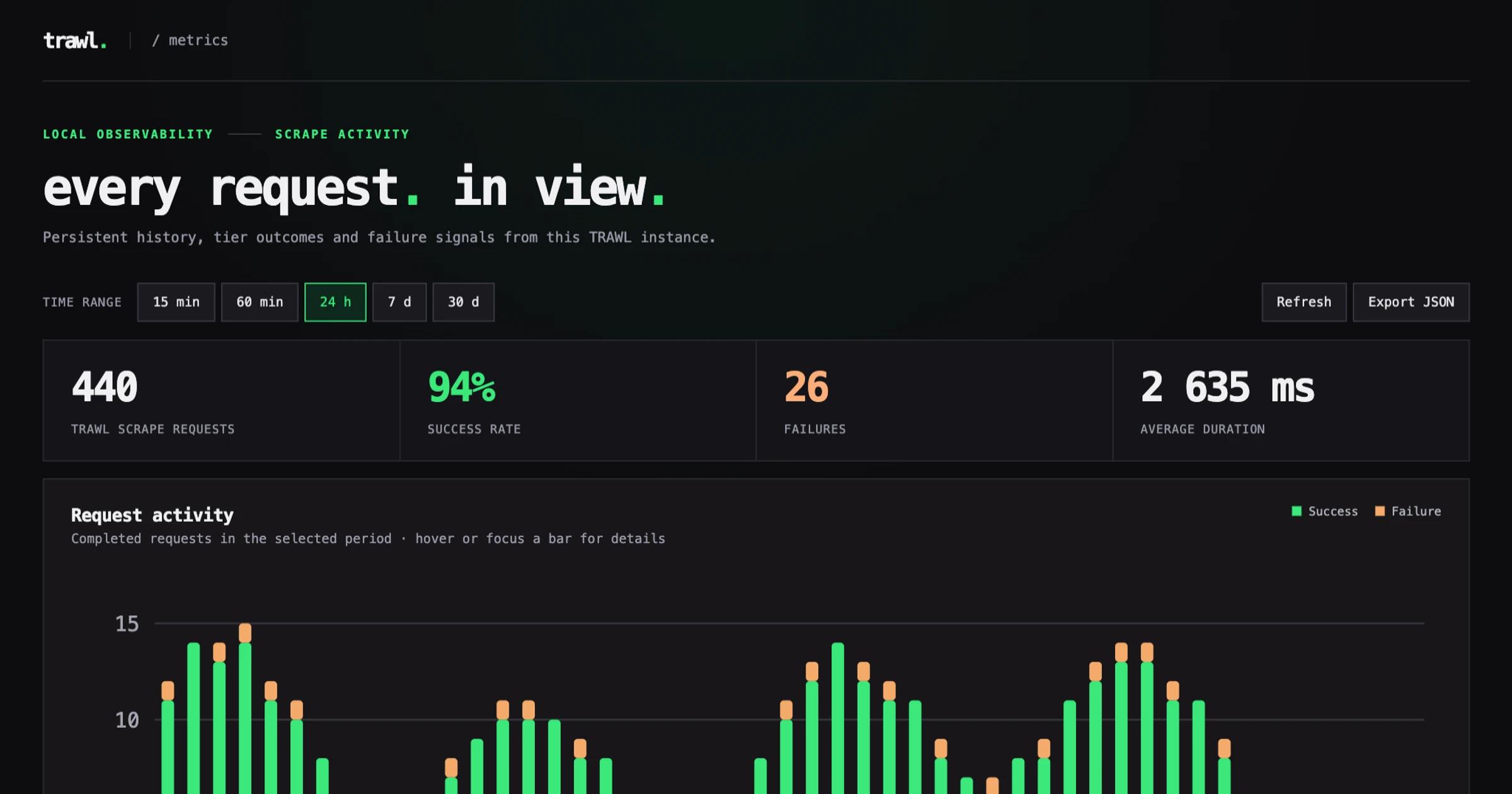
A persistent request history dashboard at /dashboard shows the winning tier, failure causes, and timings for every handled request. Metrics survive container recreation through a Docker volume mount. Live updates arrive without a page refresh, and raw data is exportable as JSON. Stored URLs are domain-scoped for privacy, not full paths.
Features
- Adaptive Tier Routing
- Browser Challenge Handling
- MCP Tools for AI Agents
- Isolated Browser Sessions
- FlareSolverr-Compatible /v1 Endpoint
- Local Metrics Dashboard
How to install
Self-hosting runs on Docker using the official image from GitHub Container Registry.
docker run -d --name trawl \
  -p 127.0.0.1:8191:8191 \
  --shm-size=1gb \
  -e SESSION_CACHE_DRIVER=memory \
  -e BROWSER_POOL_SIZE=1 \
  -e MCP_ENABLED=true \
  -e METRICS_DASHBOARD_ENABLED=true \
  -v trawl_metrics:/data/metrics \
  ghcr.io/germondai/trawl:1.11.1
Recommended for this setup
Strengths
- Session Reuse Cuts Repeat Request Time by Orders of Magnitude: When Trawl has accepted clearance cached for a domain, repeat fetches skip the browser entirely. Benchmarks from the README (measured 2026-10-17 after v1.8.0) show an 85ms repeat median on 1337x versus 11 seconds for FlareSolverr on the same machine, with 19.2s total CPU on matched requests for Trawl versus 145s for FlareSolverr across the full benchmark workload.
- Local CAPTCHA Solving Without a Paid Provider: Built-in solvers handle Turnstile, reCAPTCHA v2 audio, hCaptcha auto-pass and audio, GeeTest Slide, ALTCHA, Friendly Captcha, and CAP without 2Captcha or any other paid service. The optional 2Captcha integration adds coverage for declarative reCAPTCHA v2 Enterprise and supported Turnstile variants; it is disabled unless you provide a provider key. The default path costs nothing beyond the server.
- Drop-in FlareSolverr Replacement for *arr Stacks: The /v1 endpoint is compatible with the FlareSolverr request API. Any *arr client (Prowlarr, Jackett, Sonarr, Radarr, Lidarr, Readarr, Whisparr) connects with a single URL change, keeping existing indexer configuration intact. Response times on the shared benchmark workload are significantly faster than FlareSolverr and Byparr due to clearance reuse.
- AGPL-3.0 License Permits Self-Hosted Commercial and Team Use: AGPL-3.0 is an OSI-approved open source license. Teams can run Trawl internally for any purpose, including commercial applications, without restriction. The license's network-service clause applies when distributing a modified version: source changes must be published under the same license. For unmodified internal self-hosting, there are no additional constraints beyond the license terms.
Trade-offs
- Browser Pool Requires at Least 1 GB RAM: The default configuration starts one warm Camoufox Firefox browser in the pool. The README's benchmark data shows 991 MiB peak working RAM and 1291 MiB peak total memory for a standard Trawl workload including Redis. Very small VPS deployments under 1 GB or low-spec NAS hardware may need the :baseline image (available for older x86 CPUs and NAS kernels) and careful pool sizing to avoid out-of-memory conditions.
- AGPL-3.0 Restricts Resale as a Managed Scraping Service: Running an unmodified Trawl instance for internal use is fully permitted under AGPL-3.0. The restriction applies specifically to distributing a modified version or running a modified version as a network service for others: source changes must be published under the same license. This is a constraint only for SaaS or service businesses that want to build a commercial managed scraping service on top of Trawl.
- Very New Project with Limited Production Track Record: The repository was created in June 2026. It reached 1,152 stars and version 1.11.1 quickly, with only 1 open issue as of this writing, but has limited long-term production exposure relative to established tools like FlareSolverr. Teams running critical scraping infrastructure may want to monitor the project's maturity before full commitment.
Tech stack
FAQ
Yes. The /v1 endpoint implements the FlareSolverr request and session API. Set your Prowlarr or Jackett FlareSolverr URL to http://trawl:8191 (or the Trawl host address on your network) and existing indexer configurations continue to work without further changes. Trawl's /v1 path prioritizes page delivery and skips optional embedded widget solving by default.
No. Built-in solvers handle Cloudflare interstitials, Turnstile, reCAPTCHA v2 audio, hCaptcha auto-pass and audio, GeeTest Slide, ALTCHA, Friendly Captcha, and CAP without an external paid provider. An optional 2Captcha integration adds coverage for declarative reCAPTCHA v2 Enterprise and supported Turnstile variants; it is disabled unless you provide a provider key.
The default configuration starts one warm browser. The README benchmarks show 991 MiB peak working RAM and 1291 MiB peak total memory, including Redis, on a standard workload. A 2 GB VPS or server is a reasonable minimum. A :baseline Docker image is available for older x86 CPUs and NAS hardware. For higher throughput, increase BROWSER_POOL_SIZE and add Redis for persistent clearance caching across restarts.
AGPL-3.0 is an OSI-approved open source license. You can self-host Trawl for internal use, including commercial and team applications, without restriction. The license requires publishing source changes if you distribute a modified version or run a modified version as a network service for others. For teams running Trawl for their own applications without modification, there are no additional constraints beyond the license terms.
Yes. When a site returns ordinary HTTP responses, Trawl fetches them directly at Tier 1 without opening a browser, making it fast for ordinary pages. The /scrape endpoint, the /v1 FlareSolverr-compatible path, the MCP tools, the HTTP/HTTPS forward proxy, and isolated browser sessions all work across both challenge-protected and ordinary pages.