
Thunderbolt
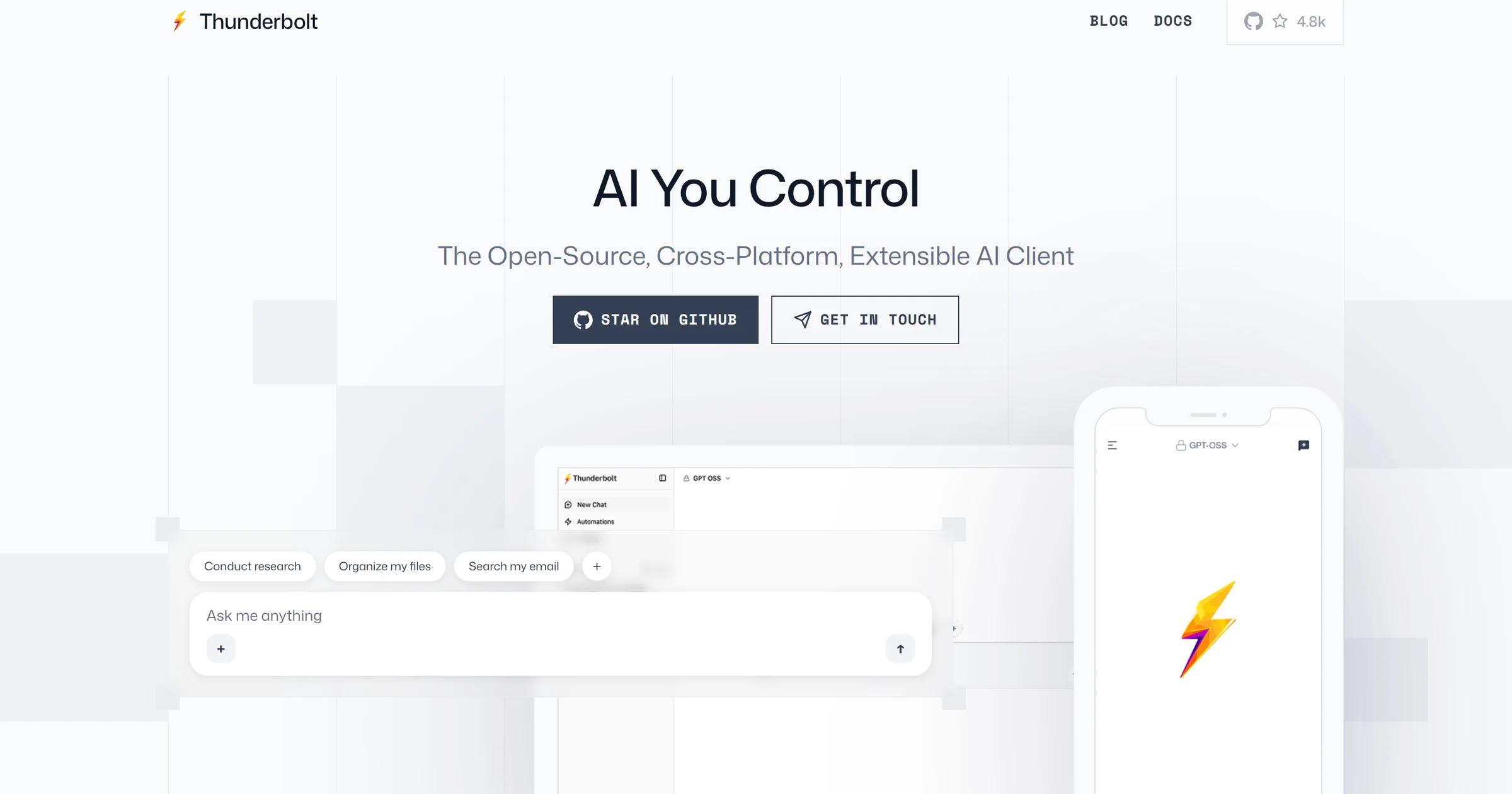
Control your AI infrastructure with Thunderbolt
Replaces Chatgpt, Claude Desktop, Github Copilot
Who it's for
Use Thunderbolt when the priority is controlling data flow and model routing rather than adopting a consumer-hosted AI app.
You need a fully managed AI assistant with no backend or provider setup.
Use Thunderbolt when developers need to switch between Ollama, llama.cpp, and OpenAI-compatible providers from one client.
Your organization has already standardized on one vendor app and does not allow alternative clients.
Use Thunderbolt to evaluate on-prem AI UX patterns before rolling them out broadly.
You require a mature production certification package today.
The problem
AI clients often bundle the interface, account system, hosted inference, and data policy into one vendor relationship. That creates lock-in when model quality, pricing, or compliance needs change. Enterprises also need clearer control over where prompts and files are processed, especially when internal data cannot be sent to a consumer AI product by default.
How it works
Web, iOS, Android, macOS, Linux, and Windows support gives teams one client direction across mixed device fleets.
Thunderbolt can work with local inference through Ollama or llama.cpp and with OpenAI-compatible providers. Teams can choose models without replacing the client experience.
The project targets enterprise customers that want to deploy on-prem and points to Docker Compose or Kubernetes deployment documentation.
`make doctor`, `make setup`, `make up`, and `make run` bring up the backend, frontend, Postgres, and PowerSync locally.
Features
- Cross-platform AI client
- Bring your own model provider
- On-prem deployment path
- Local development stack
How to install
make doctor
make setup
make up
make run
Recommended for this setup
Strengths
- Model choice is central: Thunderbolt separates the client from the model provider decision. This matters when teams want to compare hosted APIs, local models, or on-prem inference without changing daily user workflows.
- Clear enterprise control story: The project explicitly targets on-prem deployment and data ownership. That makes it more relevant to security teams than consumer AI chat clients.
- MPL-2.0 license: Thunderbolt is licensed under MPL-2.0, giving teams source access while preserving file-level copyleft obligations.
Trade-offs
- Still under active development: Thunderbolt is early, undergoing security audit work, and preparing for enterprise readiness. Treat it as an evaluation candidate, not a drop-in mature product.
- No public inference endpoint: Users must add their own model providers. That is useful for control, but less convenient than ChatGPT or Claude Desktop where hosted inference works immediately.
Tech stack
FAQ
Not fully. Thunderbolt is early, under active development, undergoing a security audit, and preparing for enterprise production readiness.
Yes. Thunderbolt supports Ollama and llama.cpp for local inference, plus OpenAI-compatible providers.
Yes. Thunderbolt provides Docker Compose and Kubernetes deployment paths for self-hosting.