
supertonic
Instantly convert text to speech with customizable options
Replaces Elevenlabs
Who it's for
supertonic is best for developers building privacy-sensitive voice features, accessibility tools, language-learning apps, and local media workflows that need multilingual speech without a hosted TTS vendor. It is a strong fit when infrastructure control matters as much as audio quality.
Pick it when you can manage local model assets and runtime packaging. Choose a hosted service if you need voice catalogs, account management, and production support more than local control.
The problem
Most high-quality text-to-speech workflows depend on hosted voice platforms that charge per use and send text through third-party infrastructure. That creates cost, privacy, and latency concerns for teams building accessibility features, reading tools, prototypes, or edge-device audio. Open models can help, but many are too large or awkward to run inside product infrastructure. A practical local deployment needs compact models, predictable runtime examples, and enough language coverage to handle real content.
How it works
Local inference keeps text and generated audio inside your own application environment.
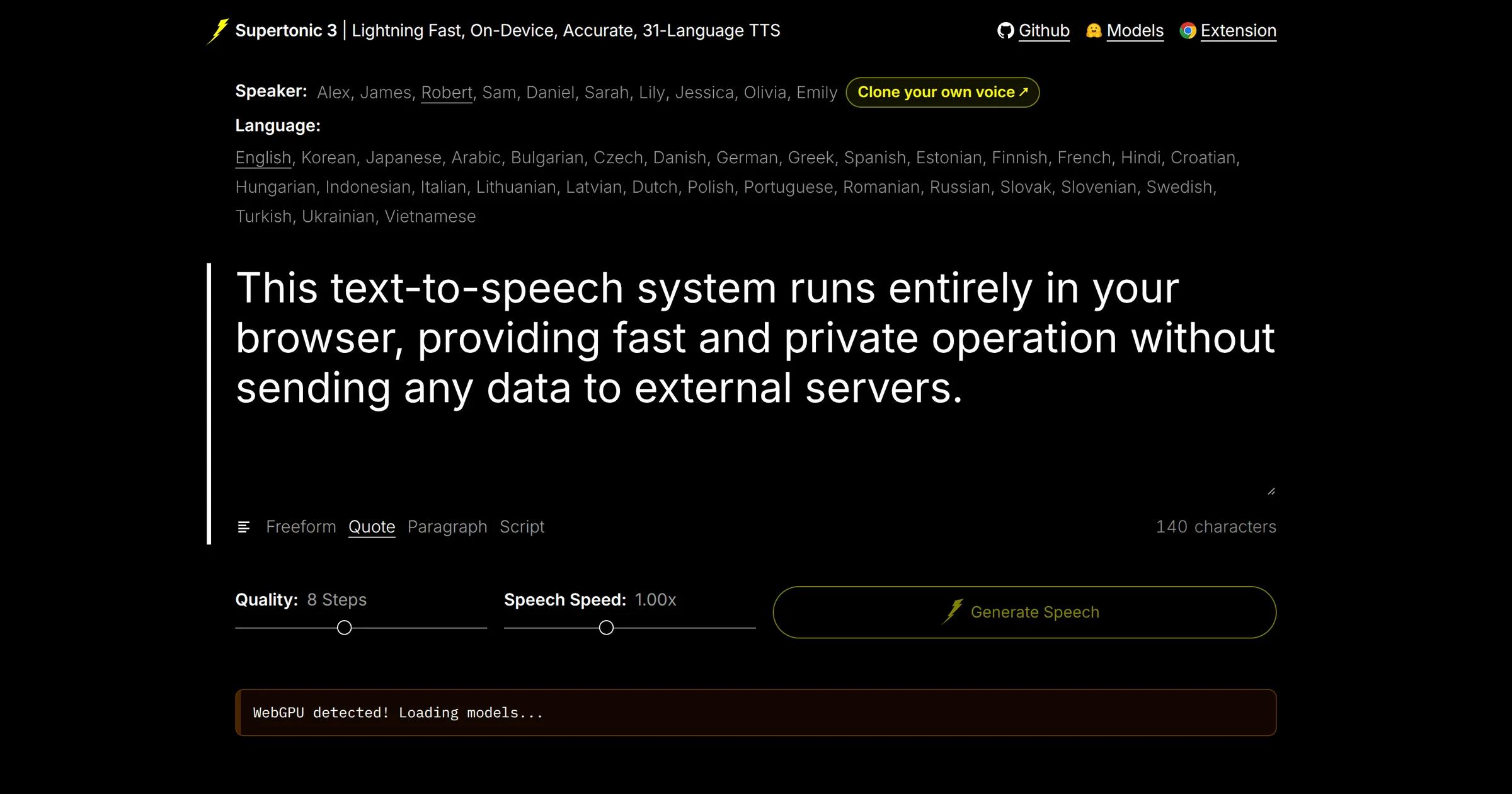
Multilingual synthesis supports 31 languages without separate language adapters.
ONNX Runtime examples make deployment realistic across backend, mobile, and browser targets.
Compact open-weight assets reduce cold-start and hardware demands compared with larger TTS models.
Python SDK and local HTTP serving help teams prototype before embedding a runtime directly.
Features
- Local inference keeps text and generated
- Multilingual synthesis supports 31 languages without
- ONNX Runtime examples make deployment realistic
- Compact open-weight assets reduce cold-start and
- Python SDK and local HTTP serving
How to install
Install the Python SDK when you want local Supertonic inference and a quick first speech generation path.
pip install supertonic
Recommended for this setup
Strengths
- supertonic provides an on-device multilingual TTS: supertonic provides an on-device multilingual TTS system built around ONNX Runtime and open-weight model assets.
- The repository is MIT licensed, includes: The repository is MIT licensed, includes a Python SDK, and ships examples for Python, Node.js, browser WebGPU, Java, C++, C#, Go, Swift, iOS, Rust, and Flutter.
- This approach fits the AI &: This approach fits the AI & Machine Learning category because it gives builders a local speech synthesis layer rather than a managed voice API.
Trade-offs
- When to choose another path: Pick it when you can manage local model assets and runtime packaging. Choose a hosted service if you need voice catalogs, account management, and production support more than local control.
Tech stack
FAQ
supertonic is best for developers building privacy-sensitive voice features, accessibility tools, language-learning apps, and local media workflows that need multilingual speech without a hosted TTS vendor. It is a strong fit when infrastructure control matters as much as audio quality.
Unlike ElevenLabs' commercial voice platform, supertonic lets developers run text to speech on their own device or infrastructure with open-weight assets. Compared to paid commercial tools in this category, supertonic gives technical teams more control over privacy, latency, and deployment shape.
Install the Python SDK when you want local Supertonic inference and a quick first speech generation path. pip install supertonic