
Recall
Local project memory for Claude Code, generated entirely offline.
Replaces Contextpool, Mem0, Zep
Who it's for
When work on a project spans days or weeks of Claude Code sessions, Recall provides a compact digest of what each session accomplished rather than requiring you to re-explain context from scratch. The `auto_save_context: "on_end"` option updates the digest automatically at the end of every session, so you never have to run `/recall:save` manually.
If your sessions are short and self-contained with no state to carry forward, maintaining a session log adds overhead without meaningful benefit.
When `.recall/` is committed, every team member resumes from the same shared session history. The log captures files touched, commands run, and decisions made, giving new contributors a quick read on recent work without requiring a separate handoff document.
If repo contributors include people you do not fully trust, committing `.recall/` introduces a prompt-injection surface. Keep `.recall/` git-ignored and treat session memory as personal in that case.
Resuming from a 1-2K token context digest costs far less than replaying a full prior transcript or re-explaining a complex codebase at the start of each session. Recall's local summarizer generates the digest without spending any model tokens. Over many sessions on a large project, this difference in token consumption is material.
If you are on an API billing plan where per-session token differences are negligible, or if you need the full fidelity of the resume flag, the compact digest is a less important optimization.
Because both tools write to the same `.recall/` files, a developer using opencode on one machine and Claude Code on another can share a single session history and context digest. The opencode installer sets up the integration once per project and requires no ongoing configuration.
The opencode path loads `context.md` through its `instructions` mechanism without untrusted-data fencing. If the repo is shared with contributors you do not fully trust, use the Claude Code path instead.
The problem
Claude Code starts every session without memory of previous work. Developers on multi-day projects spend the first minutes of each new session re-explaining the current state of the codebase, what was decided last time, and where to pick up. On longer projects this re-orientation compounds: the more context you need to carry forward, the more tokens you spend re-establishing it, which erodes the effective capacity of each session. The built-in alternatives each cover part of the problem without solving it fully. CLAUDE.md holds hand-written instructions but requires manual upkeep and does not record what actually happened. The resume flag replays a prior conversation at full transcript cost, making it token-heavy and tied to a single machine. Context compaction condenses within a session but does not produce a portable record you can open days later. None of these leaves you with a compact, readable summary of what each session accomplished and where it stopped.
How it works
Produces `context.md` using extractive summarization running entirely on your machine. The algorithm ranks sentences by TF-IDF cosine similarity and applies PageRank power iteration to select the most central ones. No LLM call is made; the summarizer is vendored Python with no runtime dependencies. If numpy is present it accelerates the matrix math; without it, a pure-Python fallback runs the same algorithm with identical results.
The `Stop` and `SessionEnd` hooks append session activity to `.recall/history.md` as you work, with no manual steps required. Capture is incremental: only new turns from the current session are appended, keeping the log append-only and the write footprint small. A `.capture-paused` file pauses logging for a project without editing any configuration.
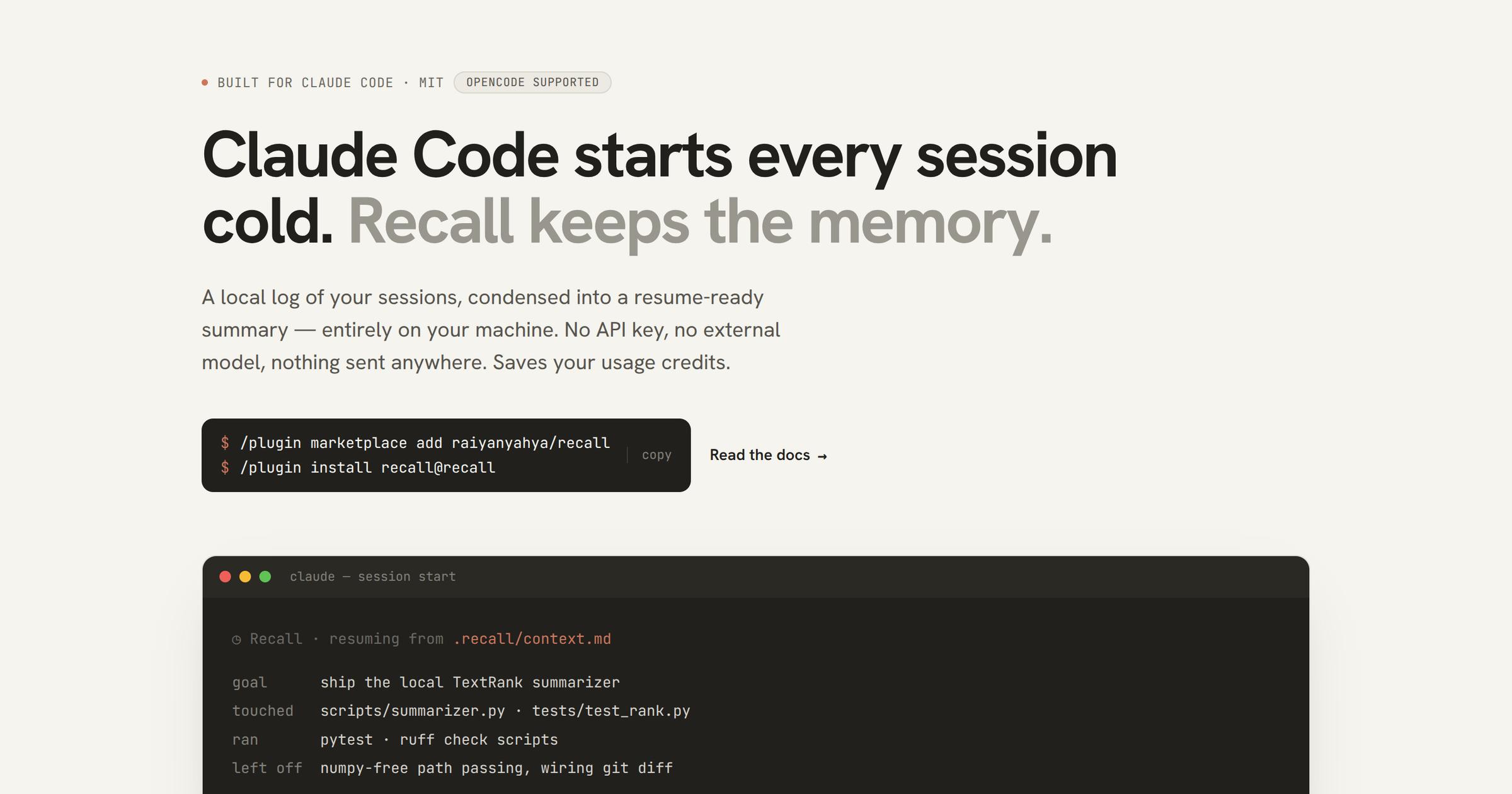
At the start of each session, the `SessionStart` hook surfaces `context.md` and asks whether to resume from it. The digest includes the project goal, files touched, commands run, next steps, and a `git diff --stat`, condensed to roughly 1-2K tokens. That is a fraction of the cost of replaying a full prior transcript, which reloads the entire conversation history.
Before writing `history.md` or `context.md`, Recall runs a best-effort pass stripping common secret shapes: API keys, tokens, `.env` assignments, and PEM keys. Redaction is enabled by default via `redact: true` in `recall.config.json`. The README notes this is best-effort, not a guarantee, and recommends reviewing before committing `.recall/` to version control.
The same `.recall/` files work with opencode via a one-time installer that generates a plugin shim, a `/recall-save` command, and an `opencode.json` entry pointing at `context.md`. Memory is shared across both tools: a Claude Code user and an opencode user on the same repo write to the same `history.md` and can resume each other's work.
Features
- Local TF-IDF + TextRank summarizer
- Automatic session capture via hooks
- Compact context digest for session resume
- Configurable secret redaction
- OpenCode opt-in integration
How to install
Install via the Claude Code plugin marketplace, or clone the repo to set up the opencode integration.
/plugin marketplace add raiyanyahya/recall
/plugin install recall@recall
git clone https://github.com/raiyanyahya/recall ~/recall
Recommended for this setup
Strengths
- Zero additional cost on a Claude Code subscription: The summarizer is a local algorithm, not an LLM call, so capturing and updating memory spends zero model tokens. Resuming from a compact `context.md` (~1-2K tokens) instead of re-explaining from scratch also reduces per-session token consumption, which stretches a subscription's usage limits without adding any separate charges.
- Nothing sent over the network: No network call is made anywhere in Recall. Your session transcripts, which may contain code, file paths, and occasionally credentials, are summarized and stored only on your own machine. Unlike cloud-based AI memory services that send context to a remote model endpoint, the privacy guarantee is structural: there is no network path to violate.
- Plain-markdown output that is diffable and portable: `history.md` and `context.md` are plain text files in `.recall/`. They are readable in any editor, diffable in git, and committable as shared team memory. Because they are not tied to a database or proprietary format, switching tools or archiving a project's session history requires no export step.
- No runtime dependencies to install: The TF-IDF + TextRank summarizer is vendored inside `summarizer.py`, with numpy as an optional accelerator that is never required at runtime. There is no `pip install` step for the plugin itself. The only system requirement is Python 3.9 or later, which is standard on most developer machines.
Trade-offs
- Extractive summaries, not semantic: The TF-IDF + TextRank summarizer selects and ranks actual sentences from your session transcript; it does not generate new text or understand intent. Summaries are deterministic and reproducible, but may miss conceptual connections, carry boilerplate from low-signal turns, or surface sentences that ranked high statistically but are not the most editorially useful. An LLM-generated summary would surface intent more reliably, at the cost of tokens and network access.
- Committed `.recall/` is a potential prompt-injection surface: At session start, `context.md` is fenced and labeled as untrusted reference data, not instructions. Claude asks before relying on its content. If `.recall/` is committed as shared team memory, any collaborator with write access can modify `context.md`, creating a prompt-injection vector. The README recommends keeping `.recall/` git-ignored if you do not fully trust all repo contributors.
- OpenCode path lacks untrusted-data fencing: In the opencode integration, `context.md` is loaded through the `instructions` mechanism rather than fenced as untrusted data. This removes the protection the Claude Code path provides against a crafted context file. The README flags this difference explicitly and recommends the opencode path only with collaborators you trust.
Tech stack
FAQ
No. Recall makes no network calls and uses no API key. All summarization runs as a local Python script on your machine. Your session transcripts, which may contain code, file paths, and sensitive values, are read and written only within your project directory.
Recall is complementary, not a replacement. CLAUDE.md holds hand-written instructions you curate; Recall automatically records what each session did. The resume flag replays a full prior transcript; Recall produces a compact digest (~1-2K tokens) for the start of a new session. The three tools cover different use cases and are designed to work alongside each other.
Yes. Recall is MIT licensed and free to run on your own machine. The summarizer is local Python with no runtime dependencies to pay for. The only cost is the standard Claude Code subscription you already have; Recall adds no usage charges of its own.
Install it through the Claude Code plugin marketplace with two commands: `/plugin marketplace add raiyanyahya/recall`, then `/plugin install recall@recall`. No pip install step is needed; the summarizer is vendored. For opencode, clone the repo and run `python3 ~/recall/scripts/install.py --opencode --project /path/to/your/project` once per project.
The TF-IDF + TextRank summarizer selects actual sentences from your session transcript rather than generating new ones, so it cannot hallucinate facts not in the log. However, sentence selection is statistical: boilerplate or low-signal sentences may rank higher than intended. You can adjust the `summary_sentences` count in `recall.config.json` to keep more or fewer sentences, and you can always read `history.md` for the full unfiltered record.