
rakazo
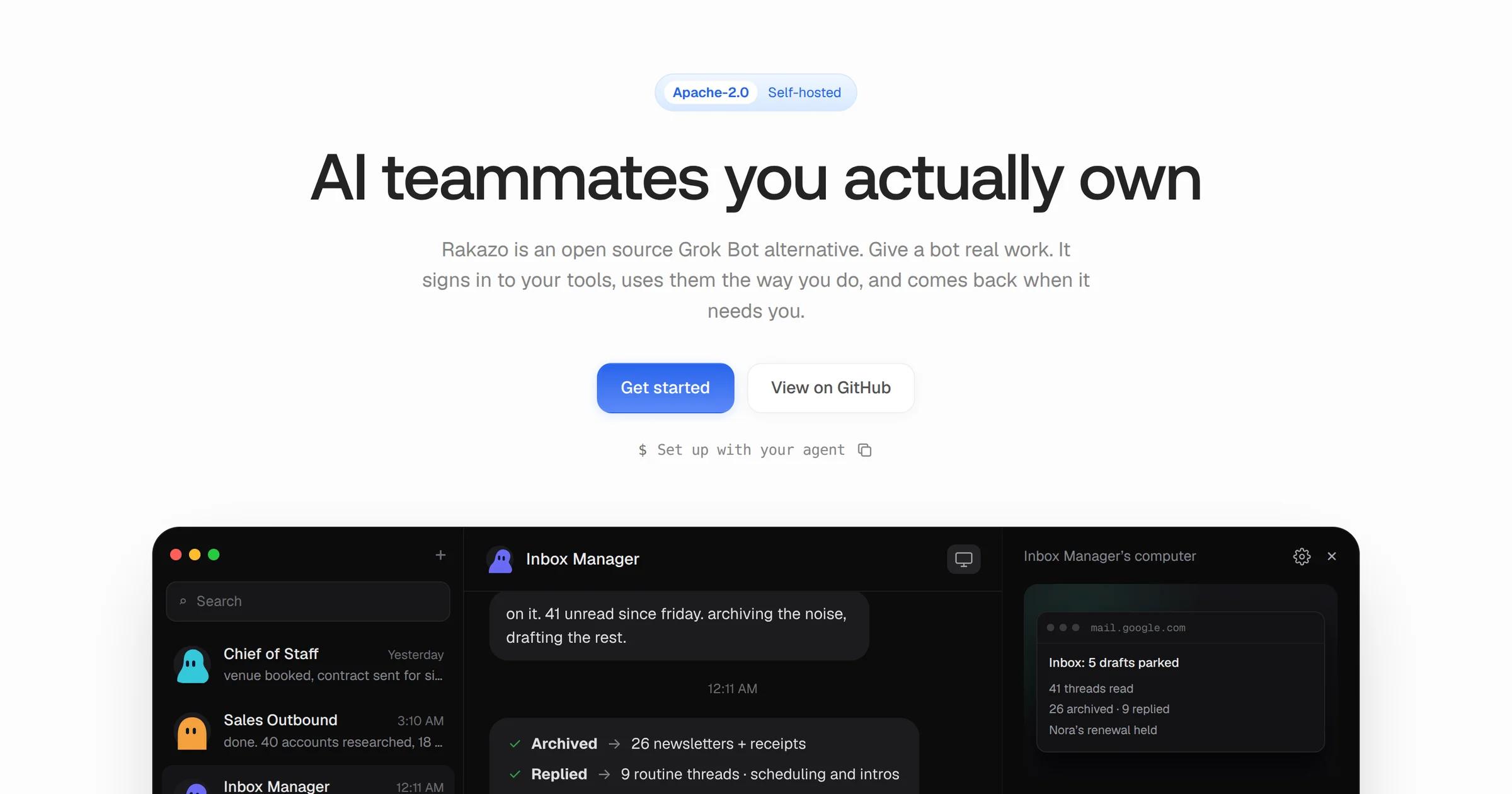
AI teammates you own: your keys, your model, your machine.
Replaces Grok Bot, Lindy Ai, Zapier Central, Make, Simular Pro, Muse
Who it's for
Rakazo gives developers a self-hosted platform to run bots against real tools, such as email, GitHub, or a CRM, with sandboxed browser sessions and persistent memory. Setting up a bot that triages issues, drafts replies, or files expense reports removes repetitive work from a dev's plate without requiring a paid automation subscription.
If you need zero-infrastructure setup or do not want to manage a Postgres database and Docker environment, a managed service like Lindy AI will have less friction to get started.
Teams paying monthly fees to Zapier Central or Make for task-based automation can self-host Rakazo and run unlimited bots against their own workflows at the cost of server time only. Bot templates for inbox management, sales outreach, and expense filing cover common business processes without per-execution fees.
If your team has no one comfortable running a TypeScript monorepo and Docker stack, the self-hosting burden will likely outweigh the cost savings compared to a managed service.
Teams in regulated industries or with strict data handling policies can use Rakazo to run AI agents without sending tool credentials or workflow data to a third-party server. Every browser session runs inside the team's own Docker environment, behind their own firewall.
If regulatory requirements mandate formal security audits of software supply chains, the beta status and early-stage codebase will require additional review time before deployment is approved.
The problem
AI automation platforms like Lindy AI, Zapier Central, and Grok Bot charge per task, per agent, or per seat, and all of them store your workflows and tool credentials on their servers. Every automation you build adds to a monthly bill that scales with usage, and switching means migrating logic that is locked inside their proprietary workflow editors. The harder problem is trust: your AI agents sign in to email, CRM, and banking tools on your behalf. On a managed platform, those sessions and credentials leave your machine. For teams handling sensitive data, customer records, or financial workflows, that is a real pain point with no opt-out.
How it works
Each bot runs in an isolated Docker container with its own headless browser and terminal. Bots can navigate websites, fill forms, and run shell commands the same way a person would, without sharing session state with other bots or the host system.
Bots maintain conversation history, memory, and task routines across sessions. Routines are stored as plain Markdown files you can read, edit, and commit to version control, making agent behavior auditable and version-controlled like any other code.
Point any bot at Claude, GPT-4, Grok, or a local model via OpenRouter. Models are configured per bot, so you can use a cheaper model for routine triaging and a more capable one for complex drafts, all with your own API keys.
Set exactly what each bot may do without asking, and what requires your sign-off. Every action the bot takes is recorded in an audit log stored on your own infrastructure. No action happens silently, and every decision trace stays with you.
Rakazo ships with templates for Sales Outbound, Inbox Manager, Talent Scout, Expense Manager, Bug Triage, Account Manager, Paid Media, and Chief of Staff. Each template interviews you on setup to capture your workflows, voice, and tool access before getting to work.
Features
- Sandboxed browser and shell per bot
- Persistent memory and saved routines
- Bring-your-own model support
- Approval gates and audit log
- Bot templates for eight common roles
How to install
Self-hosting Rakazo requires Node.js 22+, pnpm 9, and Docker Desktop before running the setup steps below.
git clone https://github.com/elie222/rakazo.git
cd rakazo
cp .env.example .env
docker compose --env-file .env -f infra/compose/docker-compose.yml up postgres -d
pnpm install
pnpm db:generate
pnpm db:migrate
pnpm sandbox:build
pnpm dev
Recommended for this setup
Strengths
- No seat pricing or feature gates: Rakazo is Apache-2.0 licensed with no pricing page. Every feature in the codebase is available to self-hosters without paying for seats, agents, or tasks. Unlike Lindy AI or Zapier Central, usage does not generate a monthly bill.
- Credentials stay on your infrastructure: Agent browser sessions and tool logins never leave your Docker environment. For teams handling sensitive data or regulated workflows, this removes a real risk present in every managed AI automation platform where credentials transit a third-party server.
- Routines stored as plain Markdown: Agent workflows are saved as readable Markdown files, not proprietary workflow graphs. You can inspect, modify, and version-control bot behavior with the same tools you use for code, and move routines between instances without a migration tool.
Trade-offs
- Multi-step install, not a single command: Getting Rakazo running requires Node.js 22+, pnpm 9, Docker Desktop, environment variable setup, a Postgres database, database migrations, and a sandbox image build. The process has six distinct steps and assumes familiarity with TypeScript monorepo tooling. Not suitable for non-technical users.
- Beta stage with active development: Rakazo was created in August 2026 and is labeled beta in its README. The project has 16 open issues and is under active development. Production deployments should account for the possibility of breaking changes between releases.
- No managed cloud option yet: A hosted cloud tier (bring your own keys, managed sandboxes) is listed as coming soon but is not available at time of writing. Teams that want always-on bot availability without managing their own server must wait for the cloud option or run their own uptime infrastructure.
Tech stack
FAQ
Yes. Rakazo is Apache-2.0 licensed and free to self-host with no pricing page and no feature gates. You pay for your own server infrastructure and whatever API costs your chosen LLM provider charges. A managed cloud option (bring your own model keys, managed sandboxes) is listed as coming soon but is not yet available.
Rakazo supports any model you connect through your own API keys, including Claude, GPT-4, Grok, and local models via OpenRouter. Models are configured per bot, so different bots can use different providers. You can point a cheaper model at routine triage tasks and a more capable one at writing or analysis.
Moderate. You need Node.js 22+, pnpm 9, and Docker Desktop installed before starting. The setup involves six steps: clone the repo, configure environment variables, start a Postgres instance via Docker Compose, run database migrations, build the sandbox image, and start the dev server. Detailed self-hosting documentation is available in the repo's docs folder.
Rakazo is labeled beta in its README. It was created in August 2026 and has 16 open issues as of that date. Active development means breaking changes between releases are possible. The project recommends evaluating it for non-critical or internal workflows before committing it to production-critical pipelines.
Zapier and Make are managed cloud services with per-task billing that store your workflow logic and credentials on their servers. Rakazo is self-hosted, Apache-2.0 licensed, and keeps everything on your own infrastructure. The key difference is model: Rakazo bots are persistent agents with memory that span multiple sessions, whereas Zapier and Make run discrete trigger-action automations per event. Zapier and Make require no server management; Rakazo requires running your own Docker environment.