
paperclip
Self-hosted AI agent management with org charts and budgets
Replaces Grok Bot
Who it's for
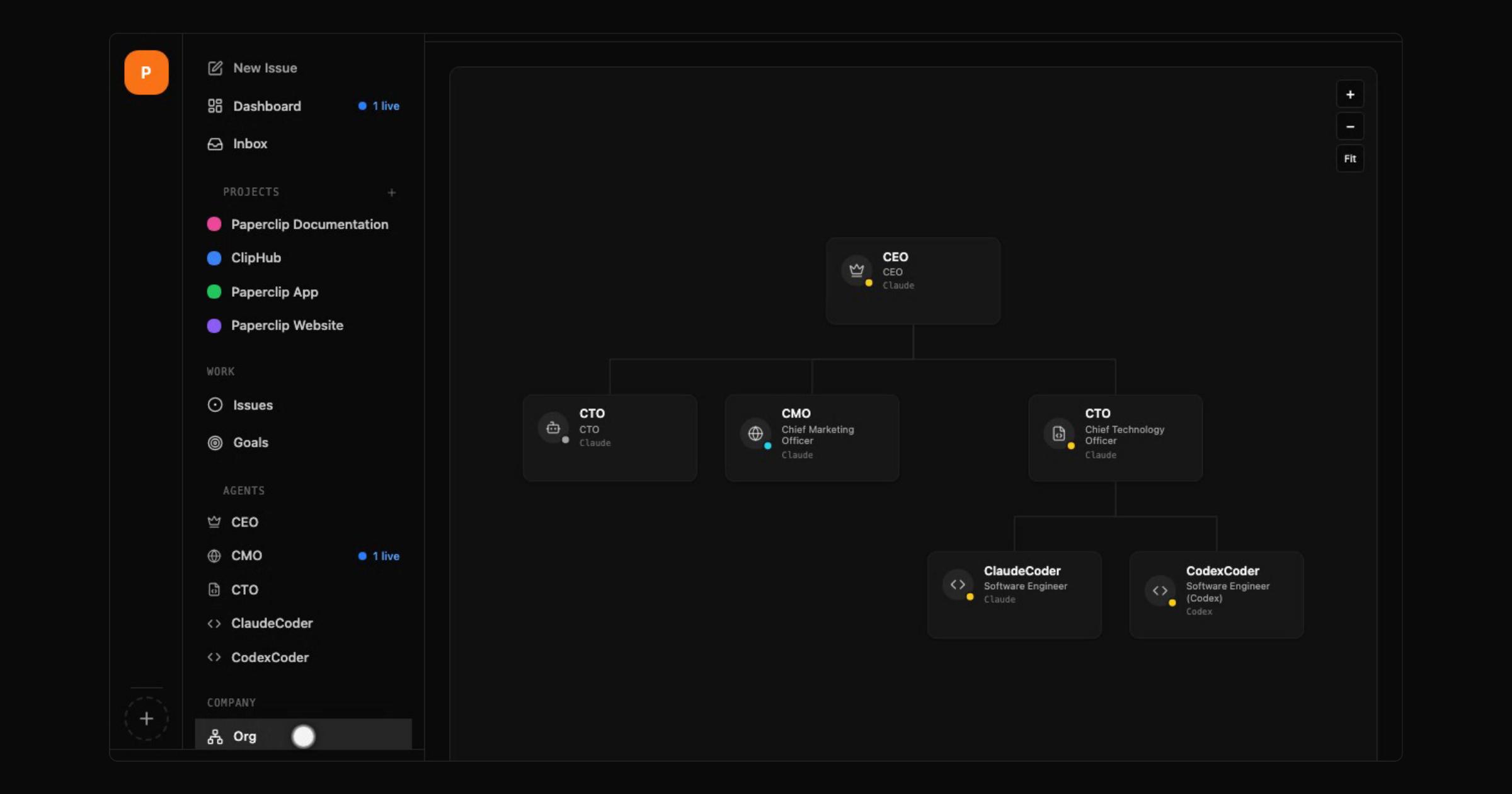
Paperclip's org chart model is designed for this: define a company goal, hire CEO, CTO, engineer, and marketing agents, approve the CEO's strategy, and monitor from the dashboard. The multi-company feature means one deployment can run multiple portfolio companies in isolation.
You only want to run one or two agents on a single project. Paperclip's governance and org overhead is not worth it for that scope; a simpler task runner or direct CLI invocation is faster.
The ticket system tracks every agent conversation, decision, and tool call. Persistent task context means agents resume where they left off after a reboot, and budget controls prevent runaway spend. Works directly with Claude Code, Codex, and Cursor under one org chart.
You are running a single coding agent and primarily care about code output quality. Paperclip adds coordination infrastructure, not coding capability; if your bottleneck is the agent's output rather than management overhead, Paperclip does not address that.
Monthly budgets are enforced per agent and per project. When an agent hits its budget limit, it stops. Cost events are tracked by provider and model. You get warning thresholds before the hard stop, so you can adjust budgets before work is interrupted.
Your agent spend is small and predictable enough to monitor manually. Paperclip's budget system adds value at scale; for light usage with one or two low-cost agents, a monthly API dashboard is sufficient.
Heartbeat scheduling handles recurring tasks with cron, webhook, and API triggers. Each routine run creates a tracked issue, assigns it to the relevant agent, and produces a full audit trail. No manual kick-offs, no lost runs.
Your recurring tasks are simple enough for a cron job calling a script directly. Paperclip's routing, audit logging, and governance add value when coordinating multiple agents; for a single automated script, the overhead is not warranted.
The problem
Running multiple AI agents without centralized management is messy. You open twenty coding agent tabs, lose track of which agent is working on what, and restart context from scratch every time a session drops. There is no shared view of costs, no way to enforce budgets, and no audit trail of what each agent decided and why. Recurring tasks require manual kick-offs. Agents work in isolation without shared goals, so they duplicate work or pull in conflicting directions. The problem worsens at scale. Token spend goes unmonitored until a bill arrives. There is no governance layer: any agent can run any command without approval gates. Moving between providers or agent runtimes means rebuilding your orchestration layer from scratch each time. Most teams end up with folders of disconnected agent configs and no coherent model for who is working on what.
How it works
Gives each agent a role, title, reporting line, and job description inside a visual org chart. Delegation flows up and down the hierarchy: a CEO agent can spin up engineers, designers, or marketing agents and assign work to them. Roles scope what each agent can do and what secrets it can access.
Every task carries the full goal ancestry from the company mission down to the individual ticket, so agents always know what they are doing and why. Tasks are ticket-based, with threaded conversations, attachments, comments, and work products. Atomic task checkout prevents double-work across agents.
Monthly token and cost budgets are set per agent. When an agent hits its limit, it stops automatically. Cost events are tracked by company, agent, project, goal, and model provider, so you can see exactly where spending is concentrated and adjust budgets without waiting for a surprise invoice.
Agents wake on a configurable schedule, check their assigned work, and act. Recurring tasks such as customer support responses, social posts, or nightly reports run without manual kick-offs. Each heartbeat run produces structured logs, cost events, and an audit trail. Orphaned runs are recovered automatically.
Works with any agent that can receive a heartbeat: Claude Code, Codex, Cursor, Gemini, Bash scripts, and HTTP bots. No model or provider lock-in. Adapter examples cover CLI agents, HTTP/webhook bots, and plugin-based extensions. One org chart, many agent types.
Board approval workflows let you review and approve an agent's strategy before it runs. You can pause, resume, or terminate any agent at any time. Config changes are revisioned, bad changes can be rolled back, and every mutating action is recorded in an immutable audit log.
Features
- Org chart for AI agents
- Goal-aligned task system
- Per-agent budget enforcement
- Heartbeat scheduling
- Bring-your-own-agent runtime
- Governance and approval gates
How to install
Paperclip installs via a shell script that sets up Node.js, the CLI, and optionally a background service on Linux or macOS.
curl -fsSL https://paperclip.ing/install.sh | bashRecommended for this setup
Strengths
- Provider-agnostic by design: Paperclip does not tie you to a specific model or agent vendor. The same org chart runs Claude Code, Codex, Cursor, Gemini, Bash agents, and HTTP bots simultaneously. Switching providers or adding new agent types does not require rebuilding the orchestration layer.
- Persistent task state across reboots: Tasks and agent context persist across heartbeats and system reboots. Agents resume the same task context instead of restarting from scratch, solving the practical problem of losing work context when running many agent sessions simultaneously.
- MIT license with full source access: The self-hosted tier is MIT licensed. You can run it commercially, fork it, modify it, and extend it without licensing fees or restrictions. Proprietary agent management services cannot offer the same guarantee: the source is closed and the terms can change.
- True multi-company isolation on one server: A single Paperclip deployment can run multiple companies with complete data isolation. Each company has its own agents, budgets, secrets, and audit trails. One control plane manages the portfolio without data leaking between entities.
Trade-offs
- Not useful for single-agent workflows: If you have one agent, you probably do not need Paperclip. The overhead of org charts, governance, and budget tracking adds friction not justified for simple single-agent tasks. Users running fewer than three or four agents will likely find a lighter orchestration script more practical.
- 5,080 open issues reflects rapid early growth: The repository had 5,080 open issues as of August 2026, high relative to its five-month age. This reflects rapid community growth, but users should expect rough edges in less common adapter configurations and plugin integrations as the project matures.
- Self-hosting requires running a Node.js server: Paperclip is a full Node.js server plus React UI. There is no managed cloud tier: you run the server. The install script handles Node.js bootstrapping on Linux and macOS, but users on other platforms or restricted environments will need to handle dependencies manually.
Tech stack
FAQ
Yes. The self-hosted version is MIT licensed and free to run on your own infrastructure with no licensing fees. There is no managed cloud tier and no Paperclip account required. You pay for your own server and the model API keys for whichever agents you run.
Any agent that can receive a heartbeat. The project lists Claude Code, Codex, Cursor, Gemini, Bash scripts, and HTTP/webhook bots as supported adapter types. Paperclip does not supply or run agents itself; it organizes and schedules agents you bring from their respective providers.
Monthly budgets are set per agent and per project. When an agent hits its budget limit, Paperclip stops it automatically and cancels any queued work. Cost events are tracked by provider, model, goal, and issue, so you can see exactly where spending is concentrated before it becomes a problem.
Yes. The multi-company feature gives each company complete data isolation: separate agents, budgets, secrets, projects, and audit trails on a single server. One control plane manages the portfolio without any data leaking between companies.
Paperclip does not use drag-and-drop pipelines or node graphs. It models an organization: agents have roles, report to managers, and work toward company goals. A workflow automation tool connects discrete triggers and actions; Paperclip manages a team of autonomous agents that decide how to accomplish goals on their own.