
orbi
self-hosted, open-source (AGPL-3.0) AI coding agent
Replaces Conductor, Claude Code
Who it's for
Orbi runs delivery loops over your existing issues without requiring a new workflow, new tooling, or changes to branch protection rules. The team writes issues, labels them ai-ready, and the agent develops, reviews, and merges them as standard pull requests. Works best when issues are scoped to single bounded changes with clear acceptance criteria.
The repository lacks a test suite or has no passing CI baseline. Orbi reruns tests during review, but if the baseline is failing or absent, the reviewer has nothing to verify against and issues land in an ai-blocked state.
Orbi is available under AGPL-3.0 for personal use and internal company use at any scale. A solo developer or a small team using Orbi on their own repositories pays nothing for the self-hosted core and brings their own model credentials. This covers most solo and startup workloads.
If you plan to modify Orbi and offer it as a network service but cannot publish your changes, AGPL-3.0 may not fit that deployment.
Orbi's self-hosted mode and its Managed Cloud offering share the same GitHub-native delivery model. A team can run the self-hosted version on their own machine first, inspect the delivery record on GitHub, and migrate to Managed Cloud later without changing their workflow. The first three managed deliveries are free with no credit card required.
If your goal is interactive code pairing rather than unattended delivery from a backlog, Orbi is not designed for that workflow. Tools like Claude Code serve interactive use cases better.
The problem
AI coding agents have changed how fast code gets written. Shipping it still needs a system. Reviewing AI-generated diffs, coordinating branch dependencies, keeping test suites green, tagging versions, and maintaining an audit trail of what shipped and why all require human supervision at each step. For teams running agents at any scale, the gap between code written and code in production becomes the bottleneck. State management compounds the pain. When a run crashes halfway or a test suite fails mid-merge, most automated tools leave an ambiguous half-finished state spread across local files, logs, and a dangling pull request. Reconstructing what happened and deciding what to retry takes longer than the original run. Teams either accept that cost or build their own recovery logic around every tool they run.
How it works
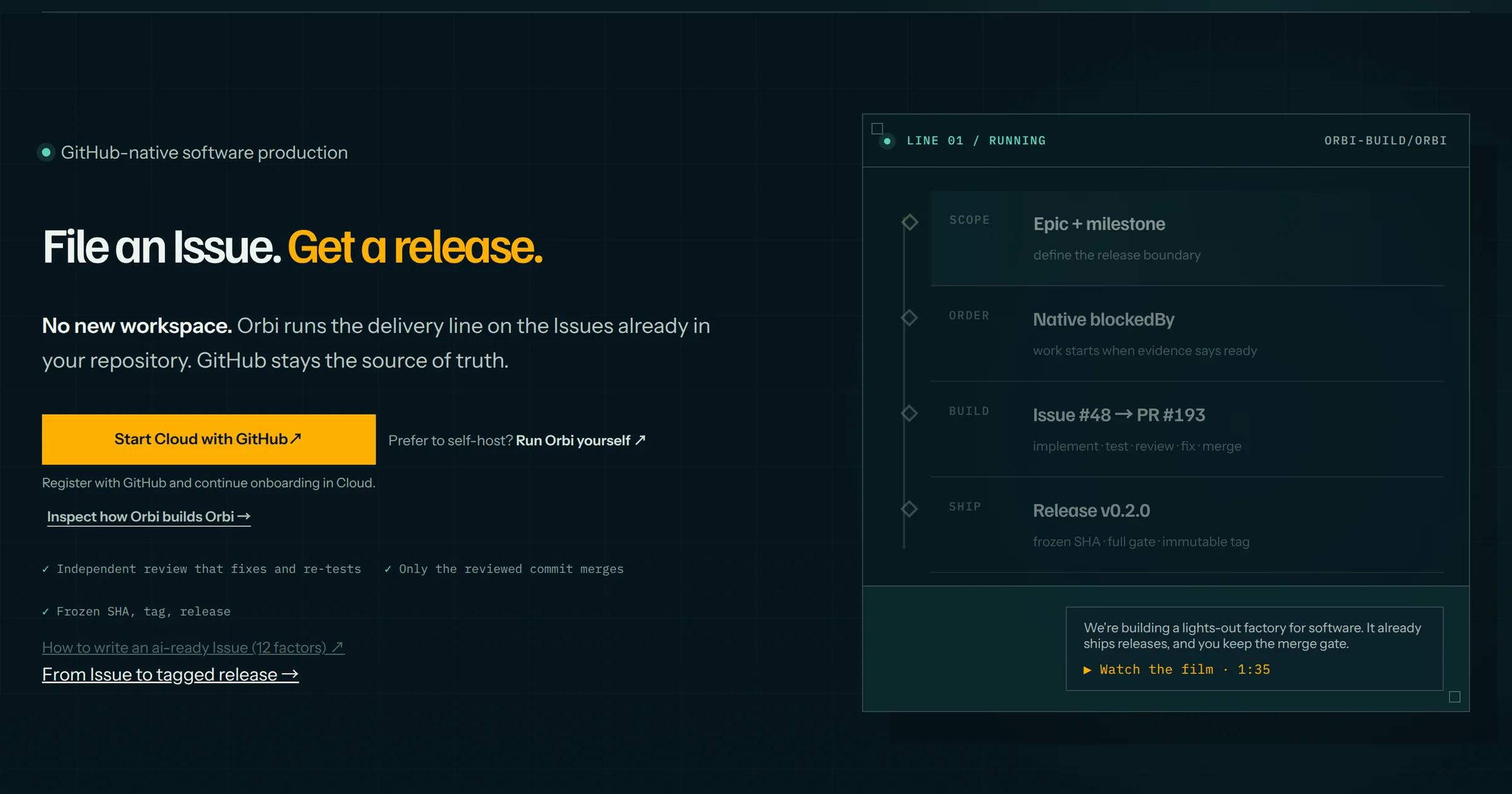
Work is dispatched from issues labeled ai-ready in your repository. All coordination writes back to GitHub: comments, labels, pull request bodies, and run IDs. No external database, queue, or separate task system is required. Every delivery record is a standard GitHub event, inspectable at any time without additional tooling.
After a development session opens a pull request, a separate review session reads the exact diff independently. That session can change the branch rather than only comment on it, reruns the test suite against its own repairs, and approves only the repaired head for merge. AI-generated code is never merged without a review pass from a session distinct from the one that wrote the code.
A killed process, a failed test, or a model timeout leaves run state in GitHub rather than in process memory. The next scheduled tick returns to the same issue, branch, worktree, pull request, and run ID. Recoverable failures resume from the same PR; unrecoverable ones mark the issue ai-blocked with a log record, and no silent fallback runs.
Orbi drives the agent through your own API credentials and supports any OpenAI-compatible endpoint, including locally hosted models. Model spend goes to your provider at your rate with no platform markup. You can change the model without changing your workflow.
Epics and milestones define the boundary of a release. The blockedBy field in GitHub Issues controls work ordering: a task enters production only after its blockers close. A Release Issue then validates scope across the repository, freezes the SHA, and publishes an immutable tagged version.
Features
- GitHub Issues as the sole state store
- Independent review that can rewrite and retest
- State recovery without a second story
- Any OpenAI-compatible model or local endpoint
- Scoped releases with dependency ordering
How to install
Self-hosting uses the uv package manager; the setup command installs scheduler units and configures issue labels in one pass.
git clone https://github.com/orbi-build/orbi.git && cd orbi
uv tool install --force --reinstall --editable --python python3 .
cp src/orbi/example_config.toml orbi.toml
orbi setup --config orbi.toml
Recommended for this setup
Strengths
- Unattended delivery with human-controlled merge gates: The scheduler triggers a new tick every five minutes and runs unattended until the issue closes. Every merge still passes through your existing GitHub branch protection, required checks, and human approval requirements. You retain the final gate without supervising each step of the pipeline.
- Review session catches and repairs errors before merge: A separate session reviews the AI's diff before merge, and that reviewer can change the branch rather than just comment. It reruns the tests against its own repairs and approves only the repaired head. The review step is active code repair, not a comment thread a human still needs to act on.
- Self-hosted with code staying on your machine: Orbi runs where the repository and model access already live. No code or keys are uploaded to a third-party service in self-hosted mode. The self-hosted core is available under AGPL-3.0 for personal and internal company use at any scale.
- Fully auditable delivery trail in GitHub: Every step of a delivery, from issue claim through worktree creation, PR opening, review comments, and release tag, is recorded as a normal GitHub event. The run ID appears in every journal log and GitHub comment, so the full timeline can be reconstructed with one grep.
Trade-offs
- AGPL-3.0 requires sharing changes to modified network services: Orbi is free to self-host for personal and internal business use. Under AGPL-3.0, offering a modified Orbi as a network service means publishing your changes. Teams using it internally pay nothing regardless of company size or repository count.
- Requires Python 3.14+, gh CLI 2.94+, and systemd or launchd: The standard install path requires Python 3.14 or later and the GitHub CLI at version 2.94 or newer. Ubuntu 24.04 ships Python 3.12 and GitHub CLI 2.45.0, both below the minimums, so both need out-of-band upgrades before Orbi can run on a fresh Ubuntu server. The installer can provision a compatible Python interpreter, but the GitHub CLI upgrade is manual.
- Early-stage project with an open issue backlog: The repository was created in August 2026 and had 33 open issues at the time of listing. Development is active with daily commits, but Orbi has a short production history. Teams with strict stability requirements should review the current open issue list before deploying it against critical repositories.
Tech stack
FAQ
The self-hosted core is available under AGPL-3.0 for personal and internal company use of any size. The Sustainable Use License remains available as an optional alternative. Managed Cloud starts with three free deliveries, then runs at $79 per month with 300M tokens of model usage included; when the token allowance runs out, new deliveries pause until the next billing cycle.
Claude Code is an interactive AI coding tool you work alongside at the keyboard to write and review code in real time. Orbi handles unattended delivery from a labeled issue to a tagged release, running without supervision at each step. The review runs in a separate automated session that can modify the branch and rerun tests rather than waiting for a human to act on comments. The two tools address different parts of the development workflow rather than competing directly.
The next scheduled tick returns to the same scene. The issue, pull request, branch, labels, and run ID all live in GitHub rather than in process memory, so Orbi reconstructs the delivery state from that record and continues the same run. If the failure is unrecoverable, the issue is marked ai-blocked for a human to review; no silent fallback occurs and a second duplicate run is never started.
Any OpenAI-compatible API endpoint, including locally hosted models. You bring your own credentials and the model spend goes to your provider at your rate with no platform markup on the self-hosted core. You can switch models without changing your workflow. No GPU is required for the Orbi process itself; the model runs remotely or via a locally hosted API endpoint.
Python 3.14 or later (the uv installer can provision a compatible interpreter if your system Python is older), the GitHub CLI at version 2.94 or newer, git, and either systemd on Linux or launchd on macOS for scheduling. No GPU is required. The orbi doctor command names any missing prerequisite after installation. macOS support via launchd exists but is listed as not yet verified on real hardware in the README.