
OpenHands
Delegate scoped coding tasks in isolated, reviewable agent sessions
Replaces Devin Ai, Github Copilot, Claude Code
Who it's for
Use OpenHands for work such as adding tests, fixing small bugs, migrating one module, or reproducing a failing command. The agent can edit files and run commands while the developer reviews the final diff.
Skip if the task has unclear requirements, no testable outcome, or needs product judgment before implementation.
Use OpenHands to process scoped issues that are important but repetitive, such as dependency fixes, vulnerability patches, and PR review chores. Reviewable outputs make it easier to keep humans in the approval loop.
Skip if your team does not have time to review agent output. Autonomous work still needs code review and verification.
Use the Software Agent SDK when the default CLI or GUI is not enough. Teams can define specialized agents, tool sets, and workflows for internal developer automation.
Skip if you only need a consumer coding assistant. The SDK path adds engineering overhead that small teams may not need.
Use OpenHands when source visibility, VPC deployment, and integration with existing engineering systems matter. The enterprise path supports Kubernetes deployment and team controls for larger organizations.
Skip if you need a fully managed SaaS experience with no infrastructure ownership. OpenHands Cloud is available, but self-hosting shifts operational work to your team.
The problem
AI coding assistants are useful for snippets, but real backlog work usually requires editing multiple files, running commands, reading failures, and trying again. Closed hosted coding agents can help with that workflow, but they leave teams with less visibility into the runtime, less control over model choice, and fewer options for running work near their own repositories. Teams evaluating autonomous coding agents need a way to delegate bounded engineering work without turning every task into a black box. The hard part is not only generating code. The hard part is giving the agent a real workspace, letting it execute safely, and keeping the output reviewable by a human engineer.
How it works
Runs as a terminal CLI or a local web GUI, so developers can choose the workflow that matches the task. The docs support `uv tool install openhands --python 3.12`, `openhands`, and `openhands serve` for GUI mode.
Runs agent work inside a Docker sandbox for isolation and reproducibility. Teams can mount the current repository with `openhands serve --mount-cwd` or configure `SANDBOX_VOLUMES` when the agent needs write access to a workspace.
Provides a Python SDK for defining agents in code, running them locally, or scaling them through hosted infrastructure. This is useful when teams want custom coding agents rather than only the packaged CLI or GUI.
Supports Claude, GPT, and other LLM providers through settings in the CLI or GUI. Local model setups are also documented, with the caveat that agent-style tasks need capable hardware and instruction-following models.
Offers OpenHands Cloud for hosted use and an enterprise option for self-hosting OpenHands Cloud in a customer VPC via Kubernetes. Cloud adds integrations such as Slack, Jira, and Linear, plus multi-user controls.
Features
- Local CLI and GUI workflows
- Docker sandbox execution
- Composable software agent SDK
- Model-agnostic LLM configuration
- Cloud and enterprise deployment paths
How to install
# CLI, recommended uv install
uv tool install openhands --python 3.12
openhands

# Local GUI server
openhands serve

# Local GUI with current directory mounted
openhands serve --mount-cwd
Recommended for this setup
Strengths
- MIT-licensed core code: The main OpenHands code outside the `enterprise/` directory is MIT licensed, and the README states that the core `openhands` and `agent-server` Docker images are fully MIT licensed. That gives teams more auditability than a closed hosted agent.
- More deployment choice than hosted-only agents: OpenHands can run through CLI, local GUI, OpenHands Cloud, or an enterprise VPC deployment. That range matters for teams comparing Devin-style agents but needing local runs, private infrastructure, or a path from trial use to production.
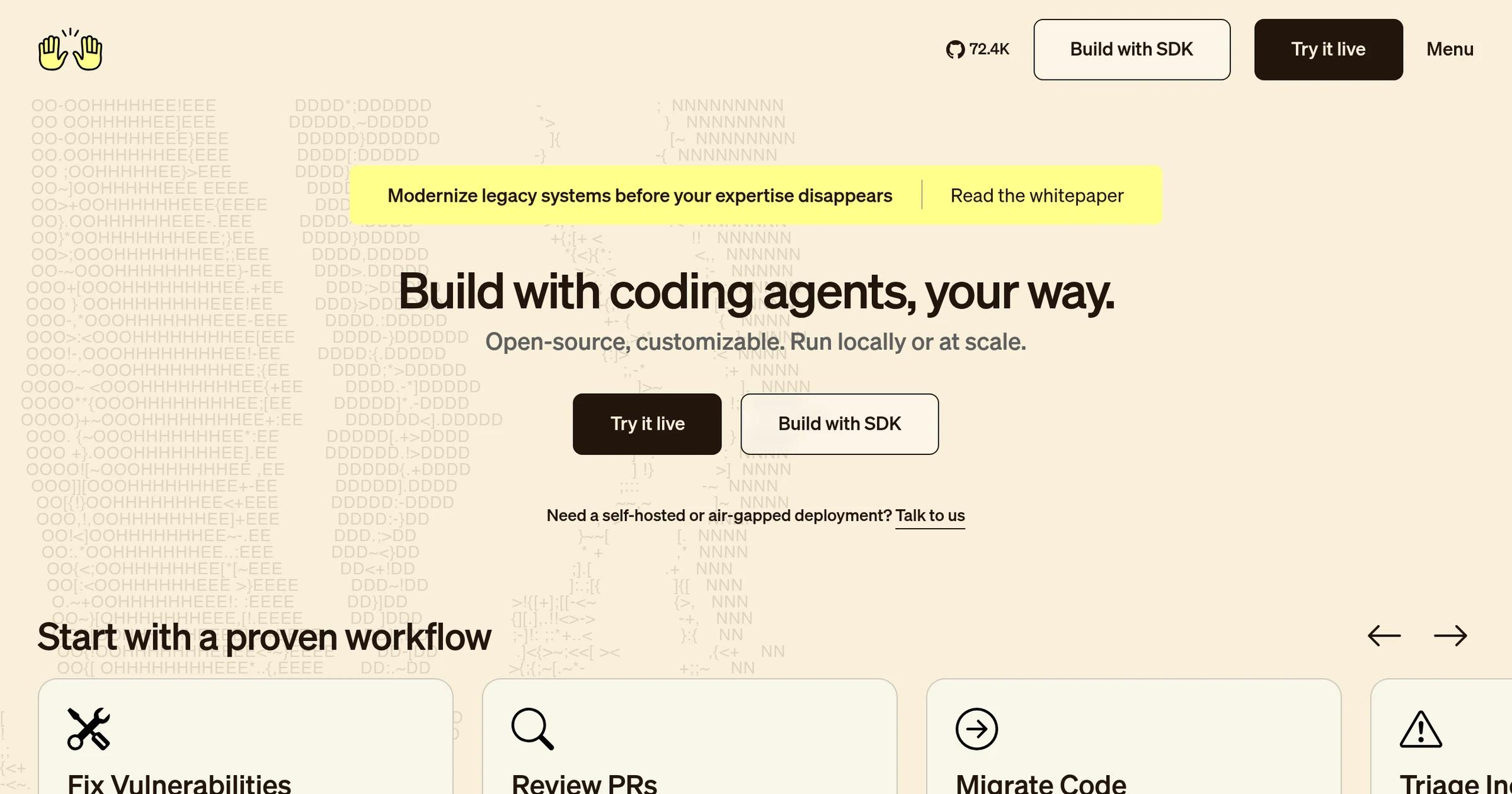
- Built for executed engineering tasks: OpenHands is positioned around fixing vulnerabilities, reviewing PRs, triaging incidents, and opening reviewable PRs, not only completing inline code suggestions. The sandbox model gives the agent a place to run commands and tests.
- SDK path for custom agent work: The Software Agent SDK exposes the agentic core as a composable Python library. Teams building internal developer automation can define specialized agents instead of forcing every workflow through the default app.
Trade-offs
- Needs clear task boundaries: OpenHands works best when the input looks like an engineering ticket with repo context, acceptance criteria, and a verification command. Vague product problems still need human scoping before an autonomous agent can produce reviewable work.
- Docker and LLM setup are real requirements: Local GUI runs require Docker, and most model providers require an API key. Teams using local LLMs need hardware and models that can follow instructions and use tools reliably.
- Enterprise features use a different license: The core project is MIT licensed, but the `enterprise/` directory uses the PolyForm Free Trial License and requires a commercial license beyond the allowed trial use. Teams should separate core self-hosting from enterprise Cloud features when evaluating licensing.
- Workspace mounts need care: The Docker sandbox reduces risk, but mounted repositories can still be modified by the agent. Teams should use clean branches, review diffs, and avoid giving broad write access when testing unfamiliar tasks.
Tech stack
FAQ
Yes. The main OpenHands code outside the `enterprise/` directory is MIT licensed, and the README says the core `openhands` and `agent-server` Docker images are fully MIT licensed. Enterprise code uses a separate PolyForm Free Trial License.
Yes. OpenHands can run as a local CLI or a local web GUI. The official docs recommend installing with `uv tool install openhands --python 3.12`, then running `openhands` for CLI mode or `openhands serve` for the GUI.
Docker is required for the local GUI and recommended sandbox workflow. The Docker sandbox gives the agent an isolated, reproducible environment, and `openhands serve --mount-cwd` mounts the current directory into that sandbox.
OpenHands is closest to Devin or Jules when you want an autonomous agent that can work on repository-level tasks. It is a better fit than closed hosted agents when MIT-licensed core code, local execution, and model choice matter more than a fully managed experience.
Yes for most hosted model providers. The local setup docs require selecting an LLM provider, model, and API key after launch. Local LLM setups are supported, but the docs warn that agent tasks need capable hardware and instruction-following models.