
Nvke
Kubernetes management plane for NVIDIA AI factory operators.
Replaces Nvidia Run Ai
Who it's for
Operators who run GPU fleets and want to offer isolated Kubernetes clusters to their customers gain API-driven provisioning, isolated control planes per customer, automatic node replacement, and an artifact chain they control. NVKE eliminates the work of assembling and maintaining a bespoke cluster management system through every Kubernetes and GPU generation update.
Teams running a small number of clusters for internal use only, where the operational overhead of a management plane exceeds the benefit of automation. At that scale, managing clusters by hand with kubeadm or a lightweight distribution is simpler.
NVIDIA Cloud Partners that offer inference or fine-tuning services as a managed product can use NVKE as the Kubernetes management layer beneath their service. NVKE and NVKR handle artifact signing, cluster provisioning, and node health, while the partner builds the customer-facing service on top.
Teams whose offering does not include managed Kubernetes and whose customers interact only with an application API, not a Kubernetes API. NVKE adds infrastructure complexity that is unnecessary if the cluster layer is not customer-facing.
Kubernetes ISVs and platform teams that want specific NVKE components, such as CAPNICo (the Cluster API provider for NICo) or the OpenTelemetry-based NKTP telemetry pipeline, can integrate them individually without adopting NVKE whole. Both components are open source and designed to work in other Cluster API environments.
Teams not running on NVIDIA or NICo infrastructure. CAPNICo is specific to NICo; the telemetry pipeline works more broadly, but NVKE's other components are designed for the NVIDIA/NICo hardware stack.
Teams that require verifiable node identity and an auditable software supply chain benefit from NVKE's TPM-based SPIFFE/SPIRE attestation, SBOM-recorded builds from NVKR, and signed release artifacts. Each node presents its TPM attestation before joining; build provenance is checked against operator policy.
Teams that cannot use TPMs or run virtualized nodes where vTPM support is unavailable. The node attestation path requires TPM hardware or virtual TPM support and is not optional in the production flow.
The problem
AI factories use Kubernetes to operate GPU fleets and as the foundation for managed inference, training, and fine-tuning services. Offering Kubernetes to customers as a managed service means building a full cluster management system: API-driven provisioning, isolated control planes per customer, upgrades, node replacement, node identity, and observability across a fleet of GPU machines. Without a dedicated tool for this, an operator or Kubernetes ISV assembles and maintains that system from open-source and commercial components, keeping it working through every Kubernetes release and GPU hardware generation. The gap is not just the initial build. Cluster management must handle node attestation before machines join, etcd encryption per customer, certificate renewal, node pool scaling, and fault remediation when NVSentinel reports a faulty GPU node. Each Kubernetes upgrade potentially touches all of these concerns. Teams maintaining this stack from scratch carry that toil indefinitely on top of running the actual AI workloads.
How it works
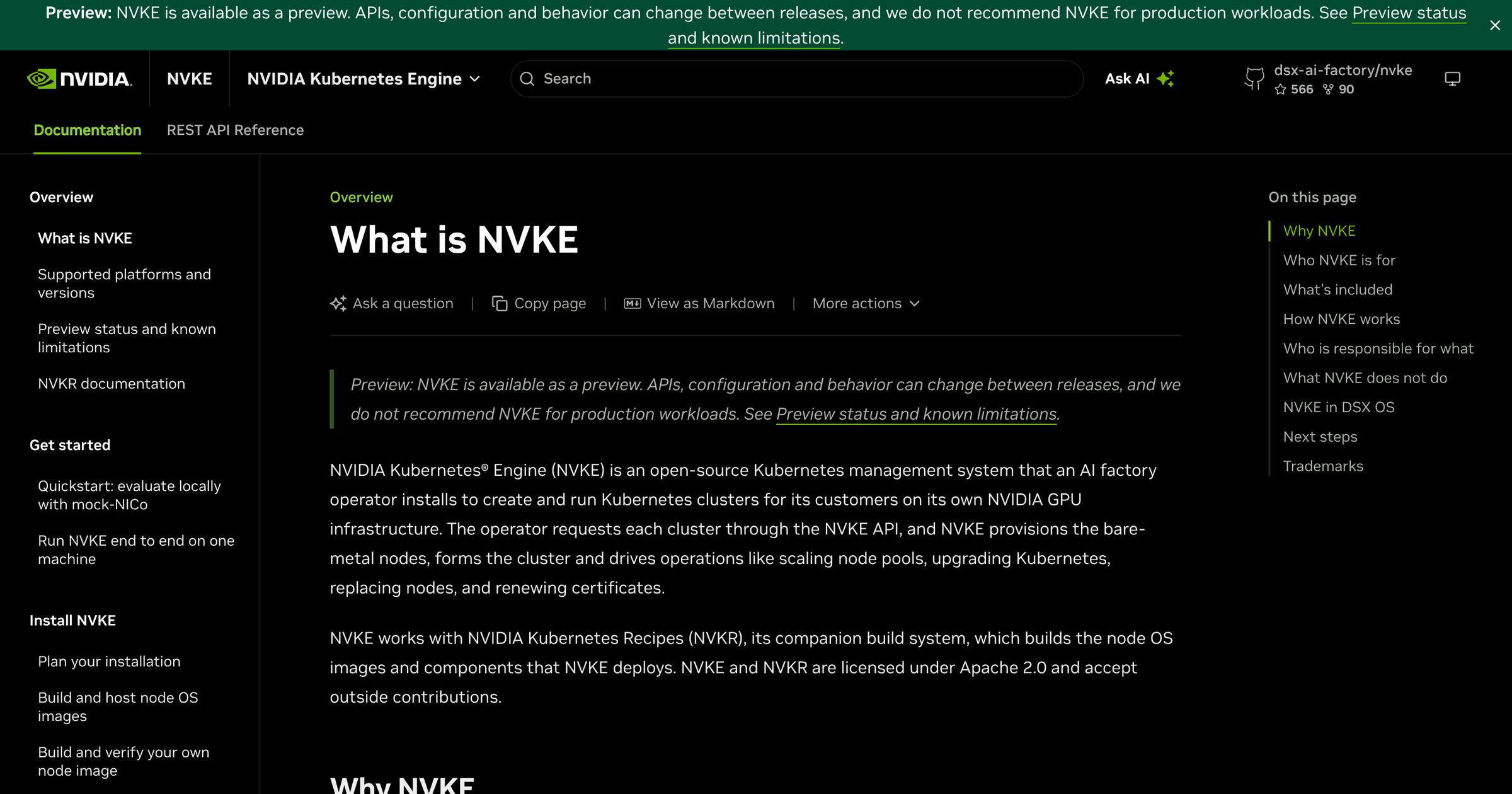
Request workload clusters through the NVKE API or the `nvkectl` CLI. NVKE calls your infrastructure provider (NICo) through Cluster API (CAPNICo), provisions the bare-metal nodes, runs kubeadm to form the cluster, and delivers the customer a kubeconfig. Each workload cluster has its own Kubernetes control plane and etcd.
Create, scale, and delete node pools, upgrade Kubernetes versions, and replace faulty nodes through the same API. With NVSentinel installed, NVKE automatically reboots or replaces nodes that NVSentinel flags as faulty. Node pools share an instance type, a release, and a Kubernetes version.
On bare metal, each node attests with its TPM through SPIFFE/SPIRE before it receives a join credential, so only verified nodes enter the cluster. Per-cluster etcd encryption at rest is available. These controls apply at bootstrap time and are not add-ons.
The companion NVKR project builds node OS images, binaries, container images, and Helm charts from pinned sources and records a software bill of materials (SBOM) for each artifact. Releases from NVKR's hosted pipeline are signed and carry build provenance you check against your own policy before any artifact reaches a cluster.
The NVKE telemetry pipeline runs OpenTelemetry Collectors that gather metrics, logs, and traces from each cluster and export them to your backend over OTLP. NKTP is installed on the management cluster and can run on any other Kubernetes cluster independently.
NVKE creates clusters certified as conformant Kubernetes by the Cloud Native Computing Foundation. Customers' workloads, tools, and skills transfer from other Kubernetes environments without modification. NVKE is a Certified Kubernetes AI Platform.
Features
- API-Driven Cluster Provisioning
- Workload Cluster Lifecycle Management
- TPM-Based Node Identity and Encryption
- Verifiable Build Artifact Chain (NVKR)
- OpenTelemetry Fleet Telemetry (NKTP)
- CNCF-Conformant Kubernetes Clusters
How to install
Install NVKE from source by building the management plane binaries with Go 1.27.3 and GNU Make 4.
git clone https://github.com/dsx-ai-factory/nvke.git
cd nvke
make build
Recommended for this setup
Strengths
- Operator Owns the Full Stack: You control the build, the registries, and the supply chain. NVKE can be adopted whole, integrated piece by piece (for example, CAPNICo or the telemetry pipeline alone), or extended. No dependency on NVIDIA-managed infrastructure beyond NICo for bare-metal provisioning.
- Apache 2.0 License: Licensed under Apache 2.0, NVKE can be run internally, modified, and deployed as part of a commercial service without licensing fees. NVKR, the companion build system, is also Apache 2.0 and accepts outside contributions.
- Upstream Kubernetes, Not a Fork: NVKE uses upstream Kubernetes, kubeadm, and Cluster API without forking them. CNCF conformance certification means no NVKE-specific behavior to unlearn. Teams migrating workloads from other Kubernetes clusters need no tool or manifest changes.
- Actively Developed by NVIDIA: Created in August 2026 and reaching 561 GitHub stars and 90 forks in its first few months, NVKE is under active development by NVIDIA and the DSX AI Factory. The project's CI dashboard shows the last 30 runs of every workflow and refreshes hourly.
Trade-offs
- Preview Status: Not Production-Ready: NVKE is explicitly a preview. APIs, configuration, and behavior can change between releases without notice. The management cluster cannot upgrade, scale, or replace itself, and there is no management-plane backup or restore procedure. The team recommends against production workloads until these gaps close.
- Requires NVIDIA Infra Controller (NICo): Real installations depend on NICo as the sole supported infrastructure provider for bare-metal machine provisioning. Teams without NICo access cannot run NVKE against real hardware. Local evaluation uses mock-NICo on a Linux host, but that path is for testing only and requires Docker, virtual TPM support, and at least 6 CPUs and 12 GiB of free memory.
- API Authentication Is Off by Default: After bootstrap, the NVKE API runs over plain HTTP with authentication disabled. The operator must configure API authentication and protected access before admitting callers. Skipping this step leaves the management plane open on the network.
- 108 Open Issues at Preview: The repository had 108 open issues at the time of indexing, expected for a preview project. Teams evaluating NVKE should review open issues for blockers in their specific hardware, networking, or Kubernetes version combination before committing to an integration path.
Tech stack
FAQ
No. NVKE is currently in preview. APIs, configuration, and behavior can change between releases without notice. The team explicitly recommends against production workloads. The management cluster has no upgrade path and no backup or restore procedure in preview. Review the Preview status and known limitations guide in the repository docs before planning a production timeline.
For real installations, yes. NVKE currently supports only NICo (NVIDIA Infra Controller) as its infrastructure provider, and NICo manages NVIDIA GPU bare-metal machines. Local evaluation and development run on any Linux host (amd64 or arm64) without GPU hardware, using mock-NICo and a local quickstart path that requires Docker and virtual TPM support.
NVKR (NVIDIA Kubernetes Recipes) is the companion build system. It builds the node OS images, binaries, container images, and Helm charts that NVKE deploys. NVKR produces signed, SBOM-recorded releases from pinned sources; NVKE deploys those artifacts into clusters. They are separate open-source repositories designed to work together as part of the DSX AI Factory stack.
kubeadm creates a single Kubernetes cluster from machines you prepare by hand. NVKE manages a fleet: a management cluster that provisions many isolated workload clusters on demand through an API. NVKE adds bare-metal provisioning via NICo, TPM-based node attestation, automatic node replacement with NVSentinel, and certificate renewal across the fleet, things kubeadm leaves to the operator.
Apache 2.0. You can run NVKE internally, modify it, include it in commercial products, and distribute it, with no licensing fee. Apache 2.0 requires preserving copyright notices and the license text; it does not require distributing source modifications when you run a modified version as a service (unlike AGPL). NVKR uses the same Apache 2.0 license.