
Infisical
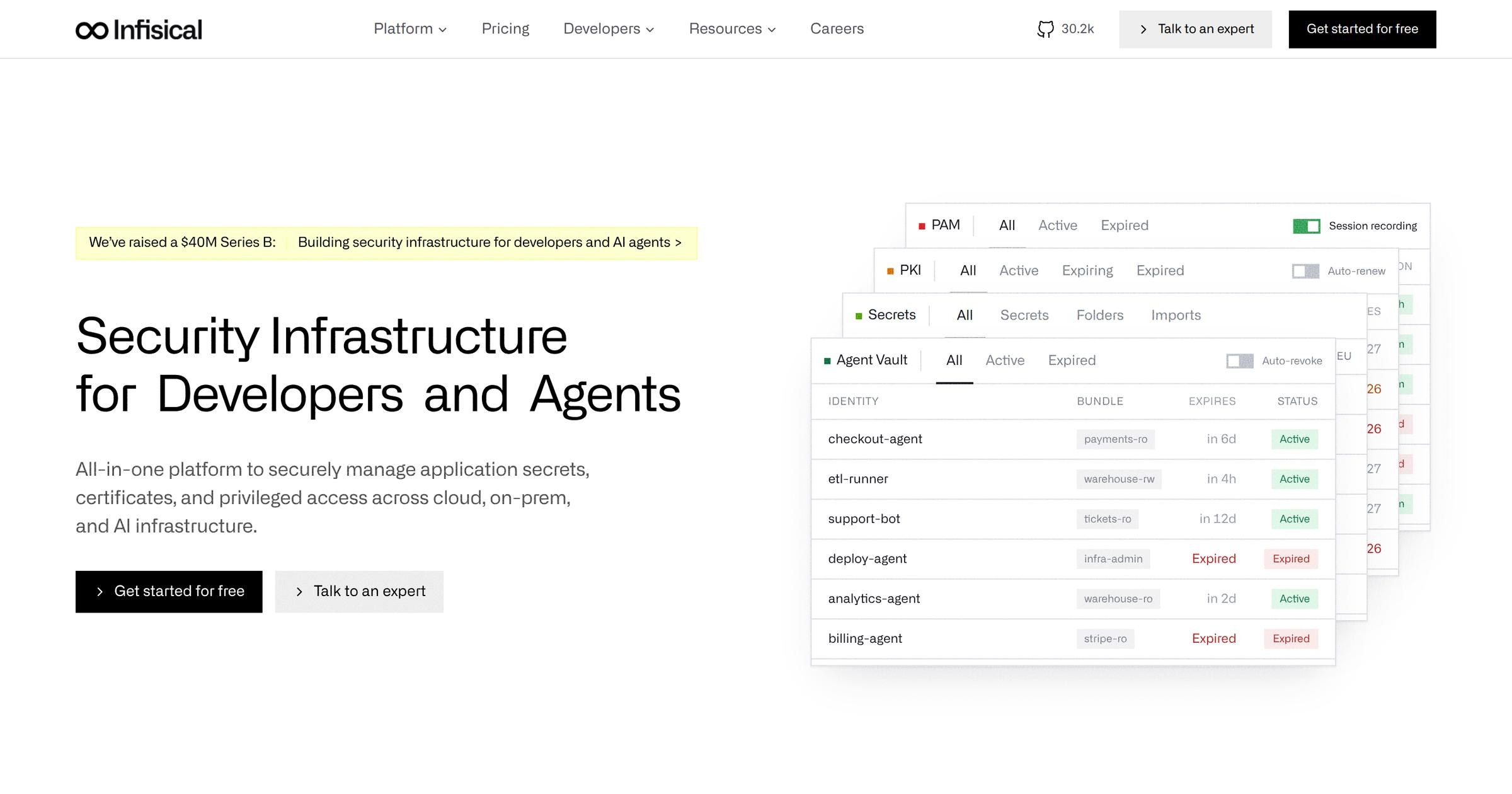
Self-hosted secrets, certs, and privileged access in one platform.
Replaces Hashicorp Vault, Doppler, Aws Secrets Manager, Akeyless, Azure Key Vault, Google Secret Manager, 1password
Who it's for
Teams running services across development, staging, and production environments gain a central secrets store with environment-scoped access controls and secret syncs to CI/CD platforms like GitHub Actions, GitLab CI, and Vercel. Secret rotation and dynamic secrets remove the manual work of cycling credentials on a schedule.
If your team is already running HashiCorp Vault Enterprise with established workflows built around Vault's API, migrating mid-flight may outweigh the benefits. Infisical is better positioned as a greenfield choice or for teams whose current secrets setup is underpowered.
PAM replaces shared admin credentials with just-in-time access brokered through Infisical. Engineers connect to production databases and SSH servers through the browser with sessions scoped to exactly what they need, automatically revoked when the access window closes. Session recording gives auditors a complete record.
If your organization already uses a dedicated PAM product with established compliance reporting workflows, adding Infisical for PAM alone may create duplication rather than consolidation.
Agent Vault gives each AI agent access to the APIs it calls through a proxy that never hands the agent a real credential. This directly addresses prompt-injection risk in multi-agent systems. Works with Claude Code, Codex, and custom agents; session logs are stored in your own S3 bucket.
If your AI agents only call internal services with no external API access, or if you already manage agent permissions through a service mesh with mutual TLS, Agent Vault may add more complexity than it removes.
The Kubernetes operator delivers secrets as native Kubernetes Secrets and reloads deployments automatically on rotation. Nine language SDKs let application developers fetch secrets at runtime without storing them in environment files. The CLI injects secrets into local development without code changes.
If your team is small enough to manage secrets through a cloud provider's native secret store with no cross-cloud or on-premises workloads, the operational overhead of a self-hosted Infisical deployment may not be warranted.
The problem
Managing application credentials is unglamorous work that rarely gets dedicated tooling until after a breach or a lockout. API keys accumulate in .env files, database passwords get shared over chat, and production credentials occasionally appear in git history. When a team member leaves or a service key rotates, tracking down every place that credential appears is a manual audit with no guarantee of completeness. The challenge compounds at scale. Each additional cloud service, CI pipeline, and Kubernetes workload needs credentials, but there is no central place to issue, rotate, or revoke them. Certificate expirations go unnoticed until a service goes down. Access to production databases relies on shared credentials with no session-level audit trail. Teams end up with credential state scattered across environment variable panels, configuration files, and secrets stores that diverge over time.
How it works
Store and version application secrets across development, staging, and production environments with AES-256-GCM encryption. Secret rotation handles scheduled credential changes for PostgreSQL, MySQL, and AWS IAM. Dynamic secrets generate ephemeral, short-lived credentials on demand for each database connection, so standing credentials never accumulate.
Stand up private certificate authorities within Infisical and automate the full X.509 lifecycle: issuance, renewal, revocation, and expiry alerting. Integrates with Let's Encrypt, DigiCert, and Microsoft AD CS via ACME, EST, and SCEP. Certificate syncs push issued certs directly to AWS Certificate Manager and Azure Key Vault automatically.
Replace standing admin credentials with just-in-time, identity-based sessions brokered through Infisical. Users authenticate with their SSO identity; Infisical grants scoped, time-limited access to PostgreSQL, SSH servers, Kubernetes, Active Directory, MySQL, and Redis. Every session is recorded and replayable, with AI-generated summaries for audit and compliance.
AI agents get access to external APIs through a credential proxy that attaches real secrets at the network boundary, so an agent never holds a credential it could leak from a prompt injection. Works with Claude Code, Codex, OpenCode, and any custom agent. Every request the agent makes is logged in an encrypted session log stored in your own Amazon S3 bucket.
Scans GitHub, GitLab, and Bitbucket repository histories and each new push for over 140 secret types. A CLI pre-commit hook blocks commits containing secrets before they reach the remote. Findings surface in the Infisical dashboard for triage and remediation alongside your managed secrets.
Client SDKs for Node.js, Python, Go, Ruby, Java, .NET, PHP, Rust, and C++ let applications fetch secrets directly from Infisical at runtime. The Kubernetes operator delivers secrets as native Kubernetes Secrets and automatically reloads deployments when secrets rotate. The Infisical Agent injects secrets into applications without code changes.
Features
- Secrets Management with Rotation and Dynamic Secrets
- Certificate Lifecycle Management
- Privileged Access Management
- Agent Vault for AI Workloads
- Secret Scanning and Leak Prevention
- SDK and Kubernetes Operator
How to install
Self-hosting Infisical uses Docker Compose with a Postgres database included in the compose configuration.
git clone https://github.com/Infisical/infisical
cd infisical
cp .env.example .env
docker compose -f docker-compose.prod.yml up
Recommended for this setup
Strengths
- One platform for secrets, certificates, PAM, and AI agent access: Most teams use separate tools for each of these: a secrets manager, a PKI solution, a PAM product, and agent-access tooling. Infisical covers all four in one platform with a shared identity model and single audit log. That means one fewer vendor, one fewer integration to maintain, and one audit trail across every credential type.
- MIT-licensed core with no self-hosting restrictions: The MIT-licensed core is free to self-host for internal and commercial use, with no licensing fees for core features. Teams can modify the source, fork it, and run it without restriction. Enterprise features in backend/src/ee/ are separately licensed and require a paid Infisical Enterprise subscription for production use; development and testing are exempt.
- 30,000+ stars and active development: With over 30,000 GitHub stars and 2,400+ forks, Infisical has one of the largest communities in the open source secrets management space. The repository saw its last push on November 4, 2026, and ships regular releases. Active development reduces the risk of adopting infrastructure software that gets abandoned.
- Compliance-ready by design: The platform uses AES-256-GCM encryption, enforces strict access controls, and provides full audit logging with optional streaming to external providers. Both the cloud offering and self-hosted deployments are designed to meet SOC 2, HIPAA, and FIPS 140-3 requirements, covering healthcare, fintech, and enterprise security use cases.
Trade-offs
- Self-hosting requires Docker Compose and a Postgres database: The self-hosted deployment needs Docker Compose and a running Postgres instance. Getting the basic platform up takes one command locally, but production hardening requires configuring TLS, managing Postgres backups, setting up high-availability, and planning version upgrades with the Infisical Upgrade Tool. It is more involved than a single-binary deploy for a production environment.
- Full platform scope may outweigh the need: Infisical ships secrets management, certificate PKI, PAM, KMS, and AI agent access as one integrated product. Getting full value from that breadth requires onboarding teams to multiple modules and maintaining access policies across each. Teams that only need secrets management will find the full platform over-specified; a narrower tool is simpler to operate in that case.
- 276 open issues at time of research: The repository has 276 open issues. For infrastructure software that manages production credentials, reviewing the open security-labeled issues before deploying is standard practice. Most issues cover feature requests and integrations, but any self-hoster should audit the issue tracker before committing to the platform for production use.
Tech stack
FAQ
The MIT-licensed core is free to self-host on your own infrastructure, covering secrets management, the web UI, the CLI, SDKs, and integrations. Infisical Cloud also offers a free tier for small teams. Enterprise features in backend/src/ee/ require a paid Infisical Enterprise License for production use; the license states they may only be used in production with 'a valid Infisical Enterprise License for the correct number of user seats.' Development and testing use is exempt. For most team self-hosting needs, the MIT core features are sufficient.
Infisical covers more ground in one product, handling secrets, certificates, PAM, KMS, and AI agent access. HashiCorp Vault is primarily a secrets and PKI engine with deep extensibility through plugins. Infisical ships a web UI and managed upgrade tooling out of the box; Vault requires more operational expertise to run at scale. Vault is the stronger choice if you already have Vault operators on staff, need its specific plugin ecosystem, or have existing Terraform Vault Provider workflows that would be costly to migrate.
Yes. The Infisical docs cover Kubernetes deployment using Helm charts, with both single-node and high-availability configurations. The Infisical Kubernetes Operator integrates directly with workloads to deliver secrets as native Kubernetes Secrets and reload deployments on rotation. Postgres is required as the backing database.
The MIT-licensed core covers secrets management, the web UI, the CLI, SDKs, and integrations. Enterprise features in backend/src/ee/ are licensed under the Infisical Enterprise License, which requires a paid subscription for production use. The license states: 'This software may only be used in production, if you have agreed to, and are in compliance with, the Infisical Subscription Terms of Service...and otherwise have a valid Infisical Enterprise License for the correct number of user seats.' Development and testing are exempt. Review backend/src/ee/LICENSE.md in the repository before deploying enterprise features in production.
Yes. Infisical supports automated credential rotation for PostgreSQL, MySQL, AWS IAM users, and several other services. Dynamic secrets go further: instead of rotating a standing credential, Infisical generates a fresh, short-lived credential for each request and revokes it automatically when the session ends. This removes standing database credentials entirely for services that support it.