
Hallmark
Design skill for coding agents with 48 themes, real photos and lint.
Replaces —
Who it's for
Hallmark gives Claude Code, Codex, Cursor, or OpenCode a set of design rules it cannot override below the floor tier. A one-line prompt produces a page that fits the subject, selects real photographs, and passes browser lint before the build ends. Developers who regularly generate marketing or product pages with AI get non-generic output without writing CSS.
Your team has a design system and component library the agent must adhere to. Hallmark's output is self-contained HTML and CSS; it does not generate React components or Tailwind classes unless those are specified in the project's `design.md`.
`sloplint` can be installed and run standalone on any HTML file or directory: `node skills/hallmark/scripts/sloplint.mjs <file-or-dir> --render`. Teams that use other AI page generators and want a lint pass before shipping can adopt the linter without using the full Hallmark skill.
Your pages are React or Vue components and never render to standalone HTML. The linter needs a rendered HTML file and cannot analyse component source directly.
`/hallmark redesign ./src/app` reads the page's content, links, and forms, then rebuilds the visual system around them. The `sloplint --kept` check fails the redesign if any handler or heading went missing, so the restyle is a one-command operation with a built-in regression guard.
The site uses a CMS with its own design tokens and build pipeline. Hallmark's redesign targets standalone HTML and CSS; CMS-managed templates are outside its scope.
Hallmark reads `design.md` and the project's token file before building. A designer can write type, spacing, and color rules in those files and trust the agent will read them before picking a theme. This works for the common case of 'here are our tokens; use them' without a full design system handoff.
The handoff needs component-level constraints (specific button sizes, responsive breakpoints, animation curves). Hallmark's rules operate at material and layout level; component-level precision needs a design system the agent can query directly.
The problem
Coding agents build pages from their defaults. Without a design constraint, they reach for the same patterns: a tracked-capitals label above every heading, a gradient where a real photograph would fit, an email sign-up form at the bottom of every page regardless of the goal. The layout is structurally correct but visually identical to every other page the agent has built. The problem compounds when the agent invents material. It fills placeholder frames with generic stock images, writes made-up statistics, and sizes the hero for a 1440px desktop while the actual first load is mobile. A page that looks generated loses trust with visitors before a line of content is read.
How it works
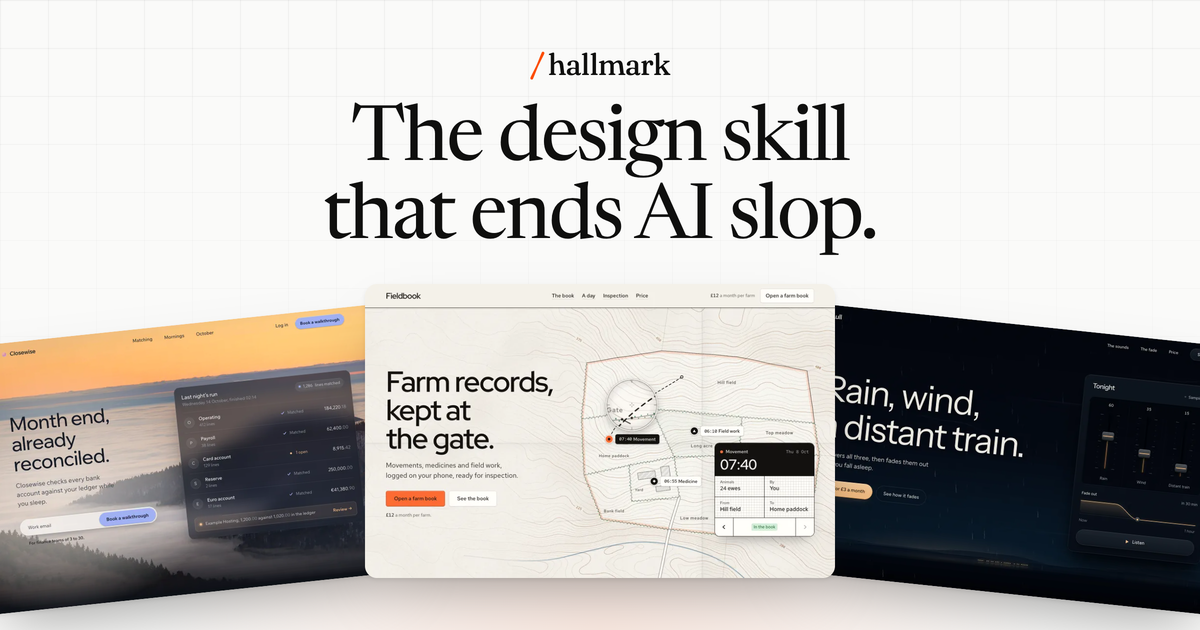
Each theme is a material: a paper, a type set, a color palette, and rules for using photographs. Hallmark selects three themes that fit the prompt and offers them to the agent; `draw` then lays out the page structure within the chosen theme. Two prompts in the same theme produce different layouts, so the theme constrains materials, not page structure.
`sloplint` renders the finished page at eight viewport widths and checks for the visual tells that read as machine-made: tracked capitals on labels, text over photographs with insufficient contrast, filled buttons side by side, a gradient where a photograph belongs. A fresh-context subagent then reviews the result. Run it standalone on any HTML file with `node skills/hallmark/scripts/sloplint.mjs <file> --render`.
Photos come from Wikimedia Commons (CC0, public domain, CC BY, and CC BY-SA). Hallmark selects them by subject and credits each one on the page. The photo library uses no stock sites; Unsplash, Pexels, and Pixabay bar AI tools from picking their images, so Hallmark's library is purpose-built for agent use.
`/hallmark redesign <path>` rebuilds a page around the same content, links, and forms while replacing the visual system and layout. `/hallmark audit <path>` reports lint findings without touching the page. Both use `sloplint --kept` to fail the redesign if any link, field, handler, or heading went missing in the process.
Say 'custom' and Hallmark drops the themes entirely. No plan, no components, no palette recipe, only the floor rules, the gates, and a short direction to find the one idea the client has and build the page from it. Custom mode follows the same lint and review steps as a themed build.
One command (`npx skills add nutlope/hallmark -g`) installs the skill for Claude Code, Codex CLI, Cursor, and OpenCode simultaneously. Pass `--agent claude-code` (or `codex`, `cursor`, `opencode`, `github-copilot`) to target one agent. Claude Code also supports a plugin install path via `/plugin marketplace add nutlope/hallmark`.
Features
- Forty-eight design themes
- Browser-based sloplint
- 755 openly licensed photographs
- Redesign and audit commands
- Custom mode with no preset themes
- Install across all coding agents at once
How to install
Install globally with Node 18 or later; browser render checks also need puppeteer-core and Chrome.
npx skills add nutlope/hallmark -g
npm install -g puppeteer-core
Recommended for this setup
Strengths
- No API key and no external image service: Photographs come from Hallmark's own library of 755 openly licensed images on Wikimedia Commons. There is no image API key to configure, no paid account to maintain, and no license terms that bar AI tools from using the photos.
- MIT license with no usage restrictions: Fully MIT licensed. Fork it, ship it, modify it for internal use or client work with no restrictions on commercial use. Unlike proprietary AI design tools that require accounts and ongoing subscriptions, Hallmark runs as a local skill you own.
- Lint runs in a real browser at eight widths: `sloplint --render` uses puppeteer-core and Chrome to render the page and catch issues a static DOM check would miss. Checking eight viewport widths catches mobile regressions that only appear at small sizes. Without puppeteer-core and Chrome, the static checks still run.
- Layout varies on every build: A theme specifies materials (paper, type, color, photograph rules), not page structure. Every build chooses its own hero, section order, and navigation shape within the theme. Two prompts for different products in the same theme produce visually distinct pages.
Trade-offs
- Browser checks require puppeteer-core and Chrome: Render-time lint and screenshot features require `npm i -g puppeteer-core` and Chrome on the machine. Without them, browser checks are skipped and only static analysis runs. Headless Chrome adds memory overhead; machines under 1 GB RAM may see instability during the render step.
- Output is self-contained HTML and CSS, not framework components: Hallmark produces standalone HTML and CSS files, not React or Vue components. Teams with existing component libraries may need to adapt or re-implement the generated output. The skill can read a project's `design.md` and tokens, but it does not generate shadcn/ui or Tailwind component code.
- Short maintenance history with 49 open issues: The repository was created in April 2026 and has 49 open issues. It has 32,173 stars and recent pushes, but the short history means some edge cases are still being resolved. Users may encounter rough edges in less common prompts or agent configurations.
Tech stack
FAQ
No. Photos come from Hallmark's own library of 755 openly licensed images sourced from Wikimedia Commons. An image API key is optional if you want to supplement the library with your own source. No paid account is required to use the built-in photo library.
Hallmark installs as a skill for Claude Code, Codex CLI, Cursor, OpenCode, and GitHub Copilot. One command installs it globally for all agents; pass `--agent <name>` to target one. It also installs as a Claude Code plugin via `/plugin marketplace add nutlope/hallmark`.
Yes. `/hallmark redesign <path>` reads all existing content, links, and form handlers, then rebuilds the page visually around them. It uses `sloplint --kept` to verify no link, field, handler, or heading was lost in the process. Say 'keep the layout' for a restyle only, or 'polish' to fix visual tells without changing the layout.
Yes, with reduced coverage. Static sloplint checks run on any machine. Browser-based rendering and screenshot capture require `npm i -g puppeteer-core` and Chrome; without them, the render-time checks are skipped. The Floor gates (contrast, focus, invented facts, broken mobile layout) run regardless of whether Chrome is present.
MIT. The core skill and all scripts are MIT licensed. The photograph library (`photos.json`) lists photos hosted on Wikimedia Commons; each image keeps its own original license (CC0, public domain, CC BY, or CC BY-SA) and is credited on every page that uses it.