
Gemini Skills
Multimodal AI API with 1M token context
Replaces Openai Api, Anthropic Claude, Azure Openai Service
Who it's for
Teams processing contracts, financial reports, or technical PDFs can send up to 1,000 pages in a single request and use structured outputs to extract tables, figures, and key fields reliably for downstream automation.
Documents are plain text with no tables or visual elements, where simpler text extraction suffices.
Developers building customer-facing voice agents can use the Live API's WebSocket streaming with the gemini-3.8-live-preview model for sub-second latency, natural interruption handling, and multilingual voice responses.
The application only needs batch transcription or non-interactive text-to-speech.
Safety and trust teams can run Gemini Decision 1 over text, images, audio, or video with up to 1,000 rubric questions per request, receiving calibrated probabilities without paying for output token generation.
Classification needs require generated explanations or rationales alongside each verdict.
Platform teams can invoke Managed Agents (Antigravity) for multi-step research or code-generation tasks, letting the agent search the web, write and execute code, and produce file outputs in a remote sandbox from a single API call.
The task is a single-turn prompt with no need for autonomous tool use or multi-step planning.
The problem
Building production AI applications requires handling diverse input types, managing conversation state, running autonomous multi-step tasks, and reliably extracting structured data from model responses. Developers assembling these capabilities from separate services face integration overhead, inconsistent latency, and APIs that become outdated as models evolve. The Gemini API centralizes text, image, video, audio, decisions, and agent orchestration behind a single versioned interface with SDKs for the most common languages.
How it works
Gemini 4 Carbon and Gemini 4 Hydrogen accept up to 1 million tokens of text, code, images, audio, video, and PDFs in a single prompt, with long decodes also up to 1M tokens. The File API lets applications upload large assets once and reference them by URI across requests.
The default interface since June 2026, the Interactions API manages conversation state, streaming, function calling, and agent invocations in one endpoint. It replaces the legacy `generateContent` API and supports all current models and agent types.
A specialized model for calibrated yes/no (noul), single-select choice, and rubric score questions. Up to 1,000 independent questions can be evaluated over a shared input in a single prefill pass, returning calibrated probabilities with zero output tokens, across text, image, audio, video, and PDF modalities.
WebSocket-based bidirectional streaming with sub-second latency enables voice and video agents with natural voice activity detection, barge-in handling, and expressive multilingual voices. The model (gemini-3.8-live-preview) streams raw PCM audio back to the caller.
A single API call to the Antigravity agent can research, write code, execute it, and produce file outputs autonomously in a remote hosted sandbox. Developers can customize the agent with their own instructions and tools, or start with the prebuilt Antigravity configuration.
Models can call Google Search for live web grounding, run Python in a secure Code Execution sandbox, and invoke custom function declarations in parallel. Structured outputs constrain responses to a JSON Schema, Pydantic model, or Zod type, and are compatible with built-in tools.
Features
- 1M token context window
- Interactions API
- Gemini Decision 1
- Live API for real-time voice and video
- Managed Agents (Antigravity)
- Built-in tools and function calling
How to install
pip install google-genai # or for JavaScript npm install @google/genai
Recommended for this setup
Strengths
- Multimodal in a single request: Text, image, audio, video, PDF, and document inputs can be combined in one Interactions API call. Nano Banana 2.1 generates images up to 4K resolution with multi-turn editing consistency, while Gemini Omni 1.2 Flash produces video with natively synchronized audio and dialogue.
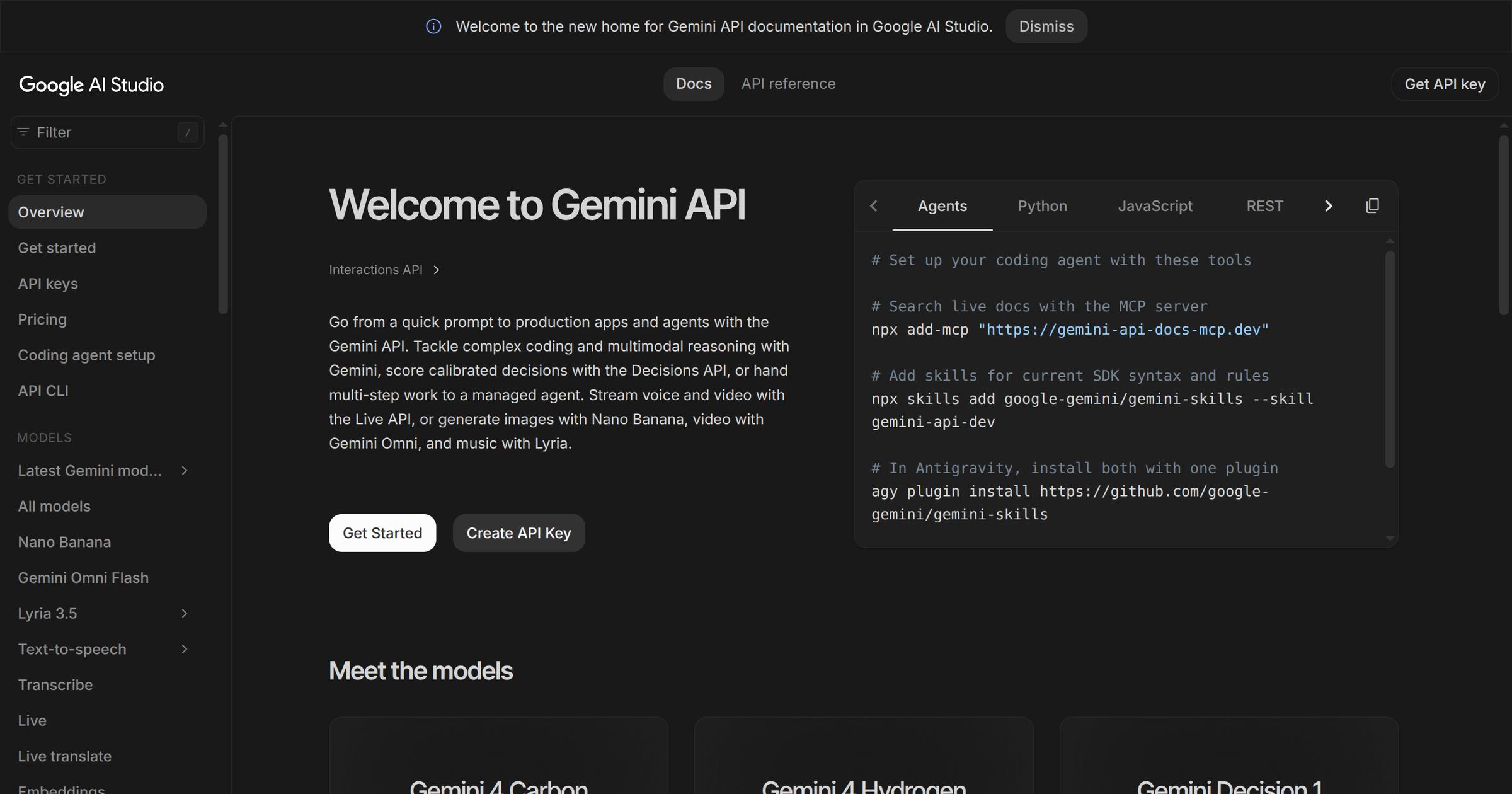
- Unified SDK across languages: Official SDKs for Python (`google-genai`), JavaScript (`@google/genai`), Java, and Go share the same Interactions API shape. A REST interface and a CLI (`gemini-api`) cover scripting and agent tooling use cases. Skills for coding agents (gemini-api-dev) are available via npx for Claude Code, Cursor, and OpenAI Codex.
- Zero-token decision scoring: Gemini Decision 1's design scores up to 1,000 questions per request without generating output tokens, making it cost-efficient for classification pipelines, content moderation, and rubric evaluation over large batches of multimodal inputs.
- Context caching: Repeated prompts over the same large input can use context caching to reduce both cost and latency, relevant for document analysis pipelines that revisit the same 1M-token corpus across multiple queries.
Trade-offs
- generateContent is now legacy: Applications written against the `generateContent` API will continue to work but are considered legacy as of June 2026. Teams maintaining existing integrations will eventually need to migrate to the Interactions API; the migration guide is available in the docs.
- Managed Agents require v1beta: The Antigravity agent and several preview models require setting `api_version` to `v1beta` explicitly in the SDK client. Features available only in beta carry standard preview stability caveats.
- Gemini Decision 1 has no text output: Gemini Decision 1 is specialized for calibrated scoring and returns zero output tokens. It cannot generate explanations, summaries, or any free-form text alongside its decisions, so workflows that need both a verdict and a rationale require a separate model call.
Tech stack
FAQ
The Interactions API became the default interface in June 2026 and handles conversation state, streaming, function calling, and agent orchestration in one endpoint. The `generateContent` API remains supported but is now considered legacy; Google recommends new projects start with the Interactions API.
Gemini 4 Carbon and Gemini 4 Hydrogen both support a 1M token context window for inputs including text, code, images, audio, video, and PDFs. For large files, the Files API lets you upload once and reference by URI rather than re-sending the content on each call.
Gemini Decision 1 returns calibrated probability scores (not text) for each question. For a yes/no (noul) question it returns a probability and confidence value; for choice questions it returns a probability distribution over the options. No explanatory text is generated.
Install the `gemini-api-dev` skill via `npx skills add google-gemini/gemini-skills --skill gemini-api-dev` for Vercel skills CLI, or via `npx ctx7 skills install /google-gemini/gemini-skills gemini-api-dev` for Context7. For Antigravity, the skills come bundled. For Claude Code, use `/plugin marketplace add google-gemini/gemini-skills` then `/plugin install gemini-skills@gemini-skills`.
Yes. The Interactions API supports streaming of tokens, incremental thought summaries, and tool call events. For real-time audio and video, the Live API uses a WebSocket connection rather than HTTP streaming.