
Fluffychat
Open source Matrix messenger with E2E encryption and video calls.
Replaces Threema, Wire, Element, Telegram
Who it's for
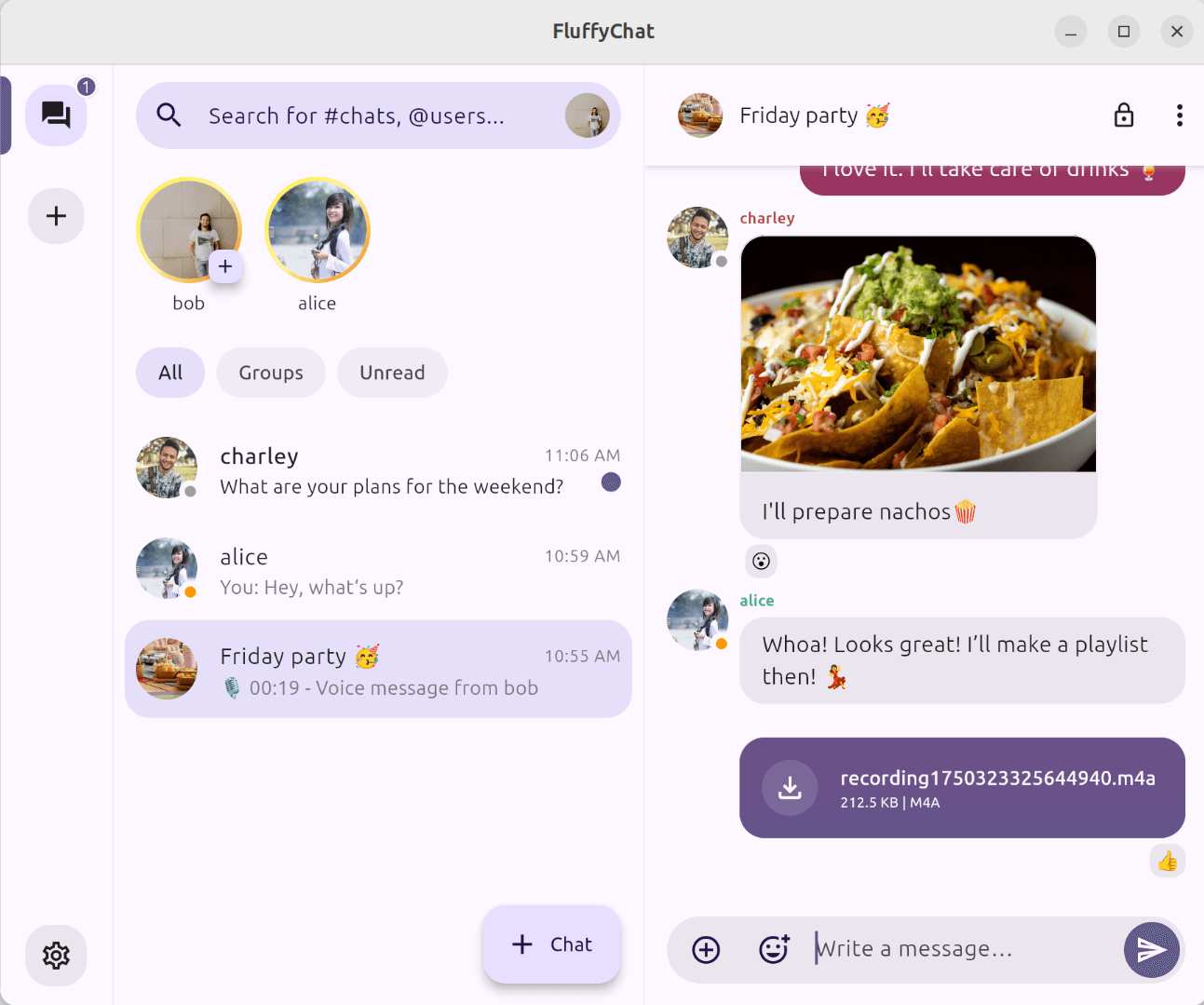
Users who want verifiable end-to-end encryption with no central company holding their metadata. FluffyChat provides the same group chats, voice messages, and file sharing as Telegram on a protocol where any server operator can verify the encryption independently.
Skip if you rely on Telegram-specific features like bots, channels with millions of subscribers, or its sticker ecosystem. Those do not transfer to Matrix, and onboarding contacts requires them to create a Matrix account.
Teams in healthcare, legal, or regulated industries that need messages stored on their own servers. FluffyChat works with any Matrix homeserver, so IT departments can deploy Synapse internally and give employees a polished cross-platform client without per-seat licensing fees.
Skip if your organization has no server administration capacity. The Matrix homeserver requires Linux server management; there is no zero-ops self-hosted path for the backend component.
Built by a European volunteer community, FluffyChat targets users seeking independence from big tech messaging monopolies. Infrastructure is funded by European donors and operated independently, making it suitable for teams that need GDPR-aligned messaging with no US data routing.
Skip if your contacts are not on Matrix and are unwilling to sign up. Migrating from WhatsApp or iMessage adds friction for every contact who needs to create a new account.
Non-profits, open source projects, and hobby communities that want public discussion channels without platform risk. FluffyChat supports public rooms with tens of thousands of participants, custom stickers, and moderation tools on the decentralized Matrix network, with no platform owner who can shut down your community.
Skip if you need mature bot integrations or workflow automation. Matrix bots exist but the ecosystem is less developed than Slack or Discord for automated team workflows.
The problem
Most popular messaging apps operate as proprietary services where your conversations flow through servers owned and controlled by a single company. WhatsApp, iMessage, and Telegram each run walled gardens: switching apps means leaving your contacts behind, and you have no way to independently verify their encryption implementations or data retention policies. For teams and communities that need genuine end-to-end encryption with cross-device verification, the challenge is that proprietary messengers frequently encrypt message content while leaving metadata in plaintext on centralized servers. Organizations in healthcare, legal, or government contexts face an additional pain point: they cannot demonstrate data sovereignty with a third-party hosted service, and building custom messaging infrastructure from scratch is prohibitively expensive.
How it works
Uses olm/megolm encryption with emoji verification for cross-signing devices. Encrypted chat backup keeps your message history recoverable across devices without exposing plaintext to the server. Key cross-signing lets users confirm device identity manually, providing cryptographic assurance closed-source apps cannot match.
Built on the open Matrix protocol, so FluffyChat users can send messages to anyone on any Matrix homeserver including those running Element, Nheko, Cinny, or NeoChat. There is no walled garden: one account reaches the entire federated Matrix network regardless of which server hosts your account.
Direct one-on-one calls and group video conferences use Matrix RTC-compatible encryption, keeping calls private end-to-end. Voice messages are supported for asynchronous audio communication. Both features run on the Matrix federation layer and work across homeservers.
Connects to any Matrix homeserver, including self-hosted instances running Synapse or Conduit. Organizations can host their own server and keep all message data on their own infrastructure, with FluffyChat as the cross-platform client. No vendor lock-in: switching homeservers is supported without losing your account.
Supports public channels with tens of thousands of participants, polls, and feature-rich moderation tools. Spaces organize multiple rooms into a unified directory, similar to Discord servers or Slack workspaces, but running on open decentralized infrastructure anyone can join or host.
Built with Flutter and Dart, FluffyChat runs on Android, iOS, web, Linux, macOS, and Windows from a single codebase. Material You design adapts to system themes. MDM configuration is supported on Android and iOS since v2.10.0, enabling enterprise deployment and policy management.
Features
- End-to-End Encryption with Key Verification
- Matrix Protocol Interoperability
- Video Calls and Voice Messages
- Self-Hosted Homeserver Support
- Public Channels, Spaces, and Moderation Tools
- Cross-Platform Flutter App with MDM Support
How to install
Download FluffyChat for your platform from GitHub Releases: https://github.com/krille-chan/fluffychat/releases/latest
Recommended for this setup
Strengths
- Non-Profit Volunteer Project with No Monetization: FluffyChat is a nonprofit project developed entirely by volunteers and funded by donations via Ko-fi and Liberapay. There are no subscription fees, no investor interests, and no monetization of user data. The AGPL-3.0 license ensures all modifications are shared back, keeping the project permanently open.
- Federation Across the Entire Matrix Network: Unlike Telegram, Wire, or Threema, FluffyChat connects to a federated network where any two Matrix homeservers exchange messages natively. Users on different servers and different clients (Element, NeoChat, Cinny) communicate freely without needing the same app or the same server.
- Auditable Open Source Encryption: The olm/megolm encryption library is open source and independently auditable. Key cross-signing and emoji verification let users confirm their contacts' devices manually, giving a level of cryptographic assurance that closed-source apps cannot offer because their implementations remain hidden.
- Self-Hosted Messaging Without Per-Seat Fees: Organizations can pair FluffyChat with a self-hosted Matrix server (Synapse, Conduit, or Dendrite), keeping all message data inside their own infrastructure. This is a direct alternative to per-seat licensing from Wire for Enterprise or Threema Broadcast, with no recurring vendor fees.
Trade-offs
- 526 Open GitHub Issues on a Volunteer-Only Team: The project carries 526 open GitHub issues as of October 2026. Many are long-standing feature requests or edge-case bugs, but the backlog reflects limited bandwidth from a volunteer-only team with no commercial backing. Users running into niche issues may wait longer for fixes than with commercially maintained messengers.
- AGPL-3.0 Restricts Offering It as a Managed Service: The AGPL-3.0 license permits running FluffyChat for internal use, including commercial teams. However, offering it as a hosted service to external customers requires publishing source code for any modifications. Organizations planning to resell or white-label FluffyChat as a managed product must comply with AGPL copyleft terms.
- Matrix Homeserver Setup Requires Server Administration: Running your own Matrix homeserver requires server administration knowledge: Synapse needs a PostgreSQL database, a reverse proxy, and ongoing maintenance. FluffyChat itself installs as a standard app, but the full self-hosted backend is not a one-click setup and is not suitable for users without Linux server experience.
Tech stack
FAQ
Yes. FluffyChat is free to download and use on all platforms. It is a non-profit project funded entirely by donations, with no subscription fees or paid tiers. You can use a free public Matrix homeserver like matrix.org or host your own. The AGPL-3.0 license also permits using the app for internal commercial team communication without paying a license fee.
FluffyChat runs on the Matrix protocol, which is federated and decentralized: no single company controls the network. Telegram is a centralized service where all messages pass through Telegram's servers. FluffyChat's end-to-end encryption uses olm/megolm and applies by default to direct messages, while Telegram's E2E encryption is opt-in through Secret Chats and does not apply to standard group chats. FluffyChat is also fully open source under AGPL-3.0; Telegram's server code is closed source.
Yes. FluffyChat is fully compatible with any Matrix client including Element, Nheko, Cinny, and NeoChat. Your account works across all of them because Matrix is an open federated protocol, not a walled garden. You can switch clients at any time without losing your message history or contacts, and you can message users on different Matrix clients freely.
FluffyChat is a client app you install on your device; it connects to a Matrix homeserver separately. You can point it at any Matrix homeserver, including a self-hosted instance running Synapse, Conduit, or Dendrite. Hosting your own homeserver gives your organization full control over message data and user accounts. The homeserver setup requires Linux server experience, but FluffyChat itself installs like any standard app.
FluffyChat runs on Android, iOS, web, Linux, macOS, and Windows. It is built with Flutter, which means a consistent experience across all platforms from a single codebase. Mobile apps are available through standard app stores; desktop and web builds are available from GitHub Releases and the official website at fluffychat.im.