
Dokploy
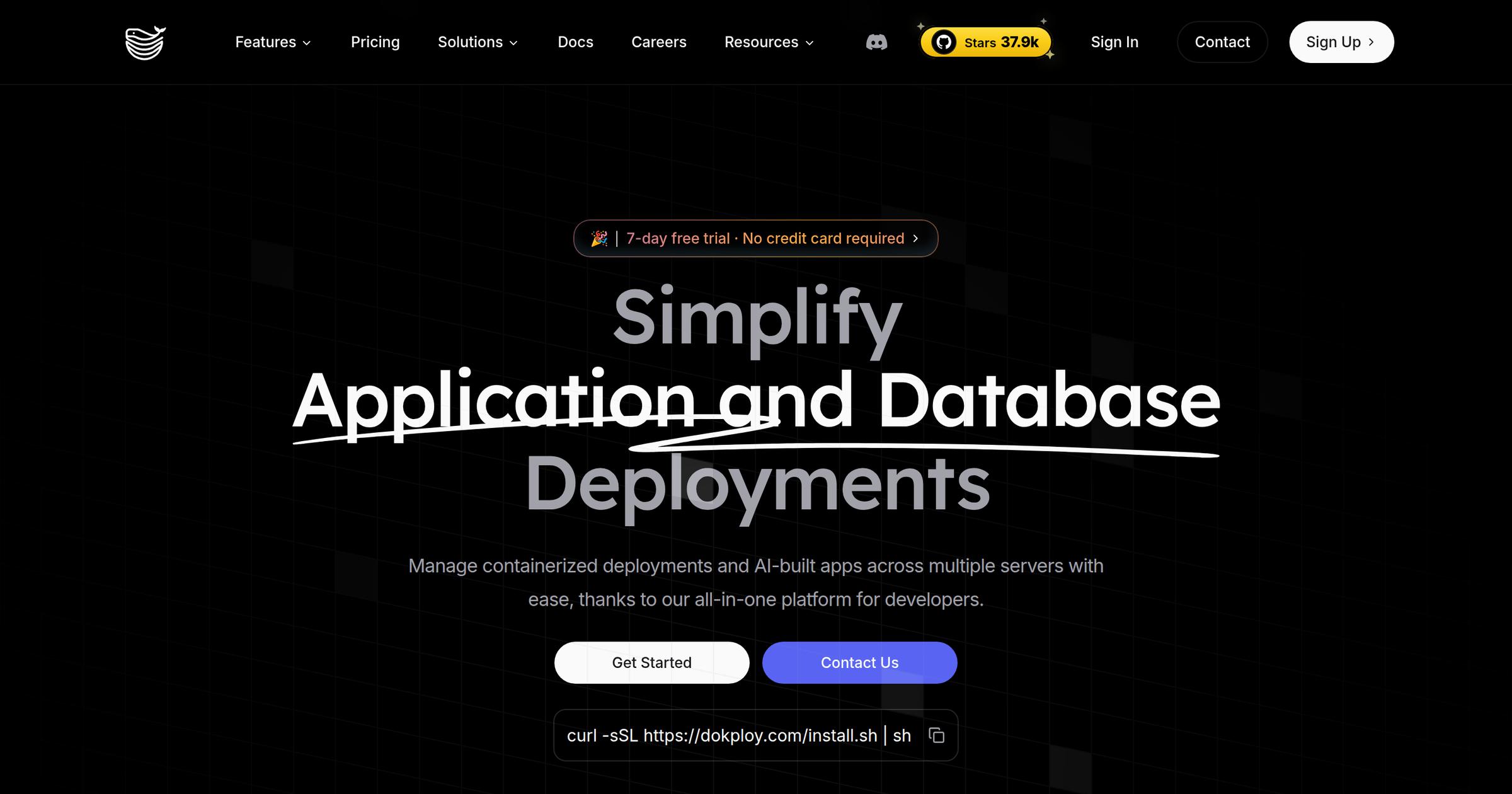
Self-hosted PaaS to deploy apps and databases across multiple servers
Replaces Heroku, Vercel, Railway, Render, Netlify, Digitalocean App Platform, Northflank
Who it's for
Dokploy installs on a low-cost VPS and manages multiple applications from a single server, eliminating per-dyno or per-service fees. The dashboard handles SSL, routing, and database connections so you keep PaaS convenience without per-service billing.
If you need managed autoscaling, zero-ops incident response, or compliance certifications out of the box, a managed PaaS is the faster path. Dokploy requires active server management.
The one-click template library deploys tools like Supabase, PocketBase, and Cal.com with pre-configured service definitions. Multi-server support lets you spread workloads across dedicated hosts without managing each server's routing and SSL configuration separately.
If your team has no member with Linux and Docker experience, template deployments are accessible but incident recovery is not. Budget for learning or outside help before relying on this in production.
Multi-server support and role-based user management let a single Dokploy instance serve multiple projects with separate access controls. API and CLI access enables automation and integration with existing pipelines, with log forwarding to Datadog or other tools clients already use.
Dokploy is not a CI system. For complex pipeline orchestration with test gates and environment promotion workflows, pair it with a dedicated CI platform like GitHub Actions or GitLab CI.
For teams building on a tight budget, consolidating applications, databases, and background workers onto one or two VPS instances can reduce monthly infrastructure costs compared to paying separately for each service on a managed platform.
If uptime SLAs or global CDN delivery are requirements, a bare VPS with Dokploy cannot match what Vercel or Cloudflare offer for frontend delivery and edge networking.
The problem
Managed PaaS services like Heroku, Vercel, and Render solve the deployment problem but create a new one: costs that grow with every service, database, and team member you add. Running a production application with a database, background workers, and a staging environment means paying for each of those as separate billable resources. Vercel and Netlify add per-seat pricing on top of compute costs for teams. Beyond cost, these platforms own your deployment configuration. When you want to move to another provider, you rebuild from scratch: different build configurations, different environment variable systems, different routing rules. The infrastructure knowledge your team accumulates is tied to that provider's proprietary tooling, not to transferable skills. Self-hosting the deployment layer is the alternative, but traditional approaches require building your own CI/CD pipelines, configuring Nginx, managing SSL certificates, and setting up database backups manually, each a separate configuration problem before you can focus on shipping features.
How it works
Deploys any application stack (Node.js, PHP, Python, Go, Ruby, and others) using Nixpacks for automatic build detection, Heroku Buildpacks for compatibility with existing configs, or a custom Dockerfile for full control. No vendor-specific config files are required for Nixpacks-detected applications.
Run complex multi-service applications using standard docker-compose.yml files without translating them to a provider-specific format. Applications that already have a compose config in development can use the same file in production without changes.
Deploy applications across multiple remote servers from a single dashboard. Docker Swarm mode enables multi-node scaling for high-availability setups. Add a new server from the UI and deploy to it without SSH-ing into each machine individually.
Creates and manages PostgreSQL, MySQL, MongoDB, MariaDB, libsql, and Redis instances directly from the dashboard without a separate database service subscription. Automated backups ship to an external storage destination of your choice.
Ships container logs and host/container metrics to Grafana (Loki, Prometheus/Mimir), Datadog, New Relic, InfluxDB, VictoriaMetrics, Better Stack, Elasticsearch/OpenSearch, Splunk, or AWS CloudWatch. Logs are tagged by project, environment, and application.
Deploys popular open source tools like Supabase, Cal.com, and PocketBase from pre-configured templates with a single click. Templates handle service definitions, volume mounts, and environment variables that would otherwise require manual docker-compose configuration.
Features
- Multi-language deployment via Nixpacks, Buildpacks, or Dockerfile
- Native Docker Compose support
- Multi-server deployment and Docker Swarm clustering
- Integrated database management with automated backups
- Log and metrics forwarding to external observability tools
- One-click open source application templates
How to install
Self-hosting Dokploy on a Linux VPS uses a single install script that handles Docker setup and initial configuration.
curl -sSL https://dokploy.com/install.sh | bashRecommended for this setup
Strengths
- Apache-2.0 core with full self-hosting rights: The core codebase is Apache-2.0 licensed, meaning you can self-host it, modify it, and use it for internal commercial workloads without licensing fees. This contrasts with managed PaaS services that charge per-dyno or per-seat for the same deployment capabilities.
- 37,900+ GitHub stars with active maintenance: Launched in April 2024, Dokploy accumulated over 37,900 GitHub stars and 3,100 forks, with the repository last updated in October 2026. Active development means reported issues and missing features have a reasonable chance of being addressed in near-term releases.
- Traefik integration for automatic SSL and routing: Traefik handles routing, load balancing, and SSL certificate management automatically when you add a domain to an application. You do not need to configure Nginx, Certbot, or reverse proxy rules manually; the integration manages certificates and can be further customized via the built-in file editor.
- No vendor lock-in on deployment configuration: Applications deploy using Dockerfiles, docker-compose.yml files, or standard Nixpacks and Buildpack configs, all formats that work identically on other platforms. Migrating away from Dokploy does not require rewriting deployment configurations into a proprietary format.
Trade-offs
- Enterprise features require a commercial license: SSO/OIDC, SAML, SCIM, audit logs, custom roles, and license key management are covered by the Dokploy Source Available License 1.0. Production use of these features requires a valid commercial agreement from Dokploy. Development and testing without a subscription are permitted, but redistribution and resale are forbidden.
- You own the server uptime, not Dokploy: Unlike Heroku or Render, Dokploy does not manage your server. If the VPS goes down, your deployments go down. You are responsible for server maintenance, OS updates, disk usage monitoring, and incident response. Teams without any ops experience should budget time for this overhead before committing to a full migration.
- 792 open issues as of October 2026: With 792 open issues on GitHub, the project carries a meaningful backlog. Some reported issues involve edge cases in deployment configurations, multi-server setups, and specific database types. Check the issue tracker for issues relevant to your stack before committing to a production migration.
Tech stack
FAQ
The core self-hosted version is Apache-2.0 licensed and free to run on your own server. Enterprise features including SSO, SAML, SCIM, audit logs, and custom roles require a commercial license from Dokploy. A managed Dokploy Cloud option is also available for users who prefer not to manage their own infrastructure.
Dokploy installs on any Linux VPS with Docker support via a one-line install script. Basic single-server deployments run on a low-spec VPS; multi-server setups with Docker Swarm require more capacity depending on workload. The install script handles Docker setup and initial configuration automatically.
Yes. Dokploy deploys Node.js applications using Nixpacks for automatic detection, Heroku Buildpacks, or a custom Dockerfile. It creates and manages PostgreSQL instances from the same dashboard. Traefik handles SSL and domain routing automatically, so a standard Node.js and PostgreSQL stack requires no manual reverse proxy configuration.
MySQL, PostgreSQL, MongoDB, MariaDB, libsql, and Redis. All are created and managed from the dashboard with automated backup support to an external storage destination. Databases run as Docker containers on the same server or on separate servers in a multi-server setup.
Yes. Dokploy has native Docker Compose support, so you can deploy multi-service applications using a standard docker-compose.yml file without translating it to a proprietary format. This makes it straightforward to promote an existing local Docker Compose setup to production.