
CocoIndex
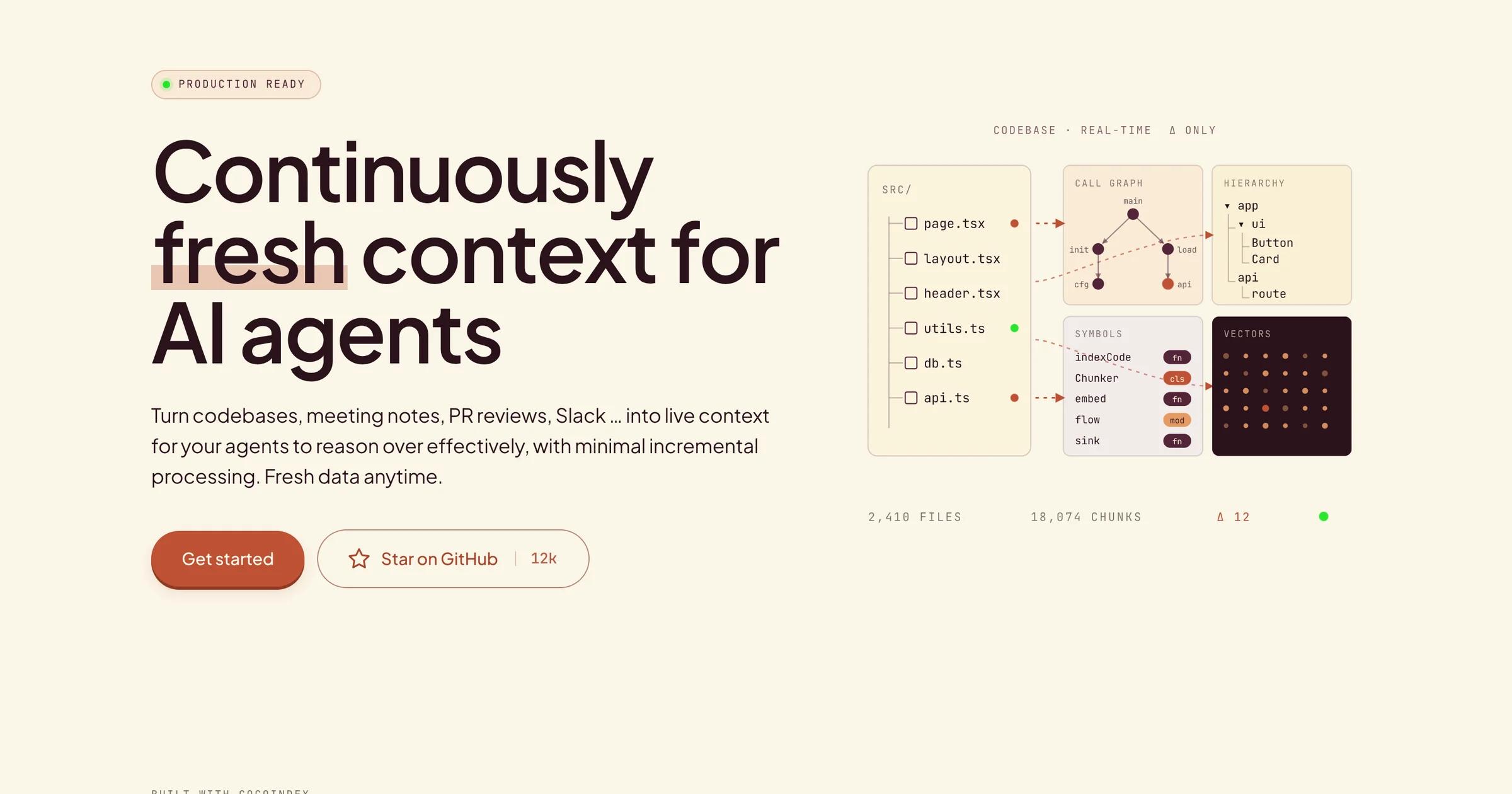
Incremental data framework for AI agents.
Replaces Llamaindex, Fivetran, Databricks, Pinecone
Who it's for
Use CocoIndex when source data needs consistent transformation before it reaches a vector database or search index.
Skip if your corpus is tiny and a one-time import script is enough.
It fits teams that want indexing behavior reviewed and maintained like application code.
Skip if your organization prefers a fully hosted no-code ingestion product.
The problem
RAG and search projects often start with a notebook that loads files, chunks text, embeds records, and writes to a database. That path breaks when sources change, indexing needs to run repeatedly, or multiple developers need to understand what data produced a given answer.
How it works
Provides a framework for defining how data moves from sources through transformations into indexes used by AI or search applications.
The Apache-2.0 repository lets teams keep indexing behavior in source control rather than hiding it behind a managed ingestion UI.
Targets the data preparation layer behind retrieval, search, and AI applications rather than general ETL alone.
Features
- Indexing pipeline structure
- Developer-controlled codebase
- AI data workflow focus
Recommended for this setup
Strengths
- Good fit for RAG infrastructure: CocoIndex speaks to the indexing problem that appears after teams move beyond proof-of-concept retrieval demos.
- Apache-2.0 licensing: The permissive license is friendly to commercial AI applications that need to embed or extend the framework.
Trade-offs
- Framework adoption cost: Teams must model their indexing pipeline inside CocoIndex. A simple script may be faster for a small, static document set.
Tech stack
FAQ
CocoIndex is used to build repeatable data indexing pipelines for AI and search applications.
Yes. The repository is Apache-2.0 licensed.
No. It helps prepare and index data; you still choose the storage or search backend that serves queries.