
Changedetection.io
Website change monitor with AI summaries and 85+ alert channels.
Replaces Visualping, Distill Io, Wachete, Hexowatch, Changetower
Who it's for
Track product pages for price drops, back-in-stock events, and limited-time offers. Set upper and lower price thresholds or restock triggers and get alerted via Discord, Telegram, or email the moment the page changes. Price history is tracked over time as a graph so you can identify seasonal pricing patterns.
You want to track prices without self-hosting a server; the official managed subscription at $8.99/month covers this without infrastructure setup.
Watch government websites, regulatory bodies, and legal document repositories for page updates that do not come with RSS feeds or email notifications. Useful for compliance teams tracking policy changes, data journalists following public records, or researchers monitoring institutional announcements.
The pages you need to monitor actively block automated HTTP fetchers; Playwright rendering adds resilience but cannot bypass every anti-bot measure.
Watch competitor pricing pages, job boards, changelog feeds, and release notes for updates. Use JSON API monitoring with JSONPath or jq filters to track specific API fields rather than full-page diffs. The browser steps feature handles pages that require a logged-in session before the content loads.
You need a managed monitoring service with uptime SLAs and no server administration.
Set up change detection on your own public-facing pages to get immediate alerts if content is added, removed, or modified unexpectedly. Useful for PCI compliance monitoring of HTML source and for detecting unauthorized changes to critical pages before visitors encounter them.
You need a commercially supported tool with audit trails and compliance certifications for enterprise security programs.
The problem
Keeping track of changes on web pages you care about is a manual, error-prone process. For bargain hunters checking product prices, compliance teams watching regulatory pages, or developers monitoring competitor feature announcements, the volume of pages to track quickly outgrows manual checking. Paid services address this but charge per URL and route all traffic through their own cloud infrastructure, which is a problem when the URLs are sensitive, proprietary, or simply numerous. Free tiers on Visualping, Distill, and similar tools cap out at a handful of watched pages, and pricing scales steeply from there. For anyone monitoring hundreds of URLs or needing data to stay in-house, the cost and privacy trade-offs make commercial tools impractical.
How it works
Integrates with over 85 notification services, covering Discord, Slack, Telegram, Rocket Chat, email, Matrix, NTFY, Office 365, custom JSON webhooks, and more. Each watch in changedetection.io accepts its own notification URL, and Jinja2 templates let you customize notification titles and body content per watch.
Connect any LLM provider (OpenAI, Anthropic, Gemini, Ollama, or any OpenAI-compatible endpoint via LiteLLM) to get plain-English change summaries. Write a plain-English intent once and the AI evaluates every diff against it, suppressing irrelevant changes and reducing false-positive alerts. Works with GPT-4o-mini, Gemini Flash, local Ollama instances, and 100+ other providers.
Configure interactive browser steps before running change detection: fill form fields, click buttons, log in with username and password, accept cookie banners, or add items to a cart. This makes it possible to monitor pages that require authentication or multi-step navigation. Requires the Playwright fetcher to be enabled.
Instead of monitoring the entire page, use the Visual Selector to pick specific elements by clicking them in a visual overlay. Supports CSS selectors, XPath 1.0 and 2.0, JSONPath, and jq. This prevents spurious alerts from navigation menus, ads, or footer text that change constantly. Available when connected to a Playwright content fetcher.
Enable the restock and price detection mode on any product page to extract pricing metadata from the HTML and track it over time as a graph. Set upper and lower price thresholds, percentage change triggers, or restock event alerts. Sends a notification when the price hits your target or when an out-of-stock item becomes available again.
Monitor JSON APIs directly with JSONPath or jq filters to extract, restructure, and compare specific fields. Changedetection.io can also parse JSON embedded in HTML pages (such as embedded ld+json structured data blocks), making it possible to track prices and availability on e-commerce sites that render from embedded JSON data. jq supports logic filters for conditional monitoring.
Features
- 85+ notification channels via apprise
- AI-powered change summaries and smart alert filters
- Browser Steps for pages behind logins and interactions
- Visual Selector for targeted element monitoring
- Price and restock tracking for product pages
- JSON API monitoring with JSONPath and jq
How to install
Deploy changedetection.io with Docker using a persistent data volume.
docker run -d --restart always -p "127.0.0.1:5000:5000" -v datastore-volume:/datastore --name changedetection.io docker.io/dgtlmoon/changedetection.ioRecommended for this setup
Strengths
- Apache-2.0 license with no per-URL fees: Self-hosters run as many URL watches as their server can handle at no additional cost. Paid tools like Visualping charge per URL and scale fees with volume; changedetection.io has no such ceiling. The Apache-2.0 license permits commercial use, modification, and distribution without restriction.
- 35,508 GitHub stars with active maintenance: With 35,508 stars and a last push in November 2026, changedetection.io is one of the most starred self-hosted monitoring tools in this category. Active maintenance means security patches, new notification integrations, and browser-compatibility fixes arrive regularly.
- MCP support for AI agent integration: Exposes an MCP (Model Context Protocol) endpoint so Claude, ChatGPT, and other AI agents can query your watched page data directly. This turns your change detection history into a resource for building automated workflows and asking natural-language questions about what changed and when.
- Per-watch proxy configuration: Each watch can be assigned its own proxy configuration, including Bright Data and Oxylabs integrations. Useful for monitoring geo-restricted content, rotating IPs to avoid blocks, or accessing pages through the Tor network. This is a capability most paid tools in this space do not expose at the per-URL level.
Trade-offs
- JavaScript rendering requires Playwright alongside Docker: Plain HTTP fetching is lightweight, but monitoring JavaScript-rendered pages requires running headless Chromium via Playwright or Selenium WebDriver alongside the main container. This adds memory overhead; the project documentation recommends the sockpuppetbrowser image in the Docker Compose configuration. A minimal VPS with limited RAM will struggle with concurrent JavaScript-rendering sessions.
- 323 open issues in the repository: The repository carries 323 open issues. For typical use cases this is a normal backlog for a popular open source project, but users who rely on edge cases like specific proxy configurations or unusual site structures may encounter bugs that have not yet been addressed.
- No built-in multi-user access control: Changedetection.io is designed as a single-user self-hosted tool. There is no built-in role-based access control or multi-user authentication. Teams running a shared instance need to handle access via a reverse proxy or VPN; the tool does not distinguish between users or restrict which watches they can see.
Tech stack
FAQ
Yes, but it requires a Playwright or Selenium WebDriver fetcher running alongside the main container. The Docker Compose file in the repository includes configuration for the sockpuppetbrowser image, which provides a headless Chromium instance. Plain HTTP fetching (the default) works for static pages and many server-rendered sites but cannot execute JavaScript.
Changedetection.io supports over 85 notification services, including Discord, Slack, Telegram, Rocket Chat, email, Matrix, NTFY, Microsoft Teams, Office 365, custom JSON webhooks, and syslog. Each watch accepts one or more notification URLs, and Jinja2 templates let you customize the notification title and body per watch.
Yes. Bring your own API key for OpenAI, Anthropic, Google Gemini, or any OpenAI-compatible endpoint such as Ollama, LM Studio, or vLLM. Once configured, write plain-English rules (for example, 'only alert me when the price drops below $50') and get change summaries in plain language rather than raw HTML diffs. The LLM integration is powered by LiteLLM, which supports 100+ providers.
Browser Steps let you configure interactive actions before change detection runs: fill form fields, click buttons, log in with username and password, or accept cookie banners. Browser Steps require Playwright to be enabled and are configured in the watch's edit tab. After the steps complete, the Visual Selector tab lets you pick which elements to monitor.
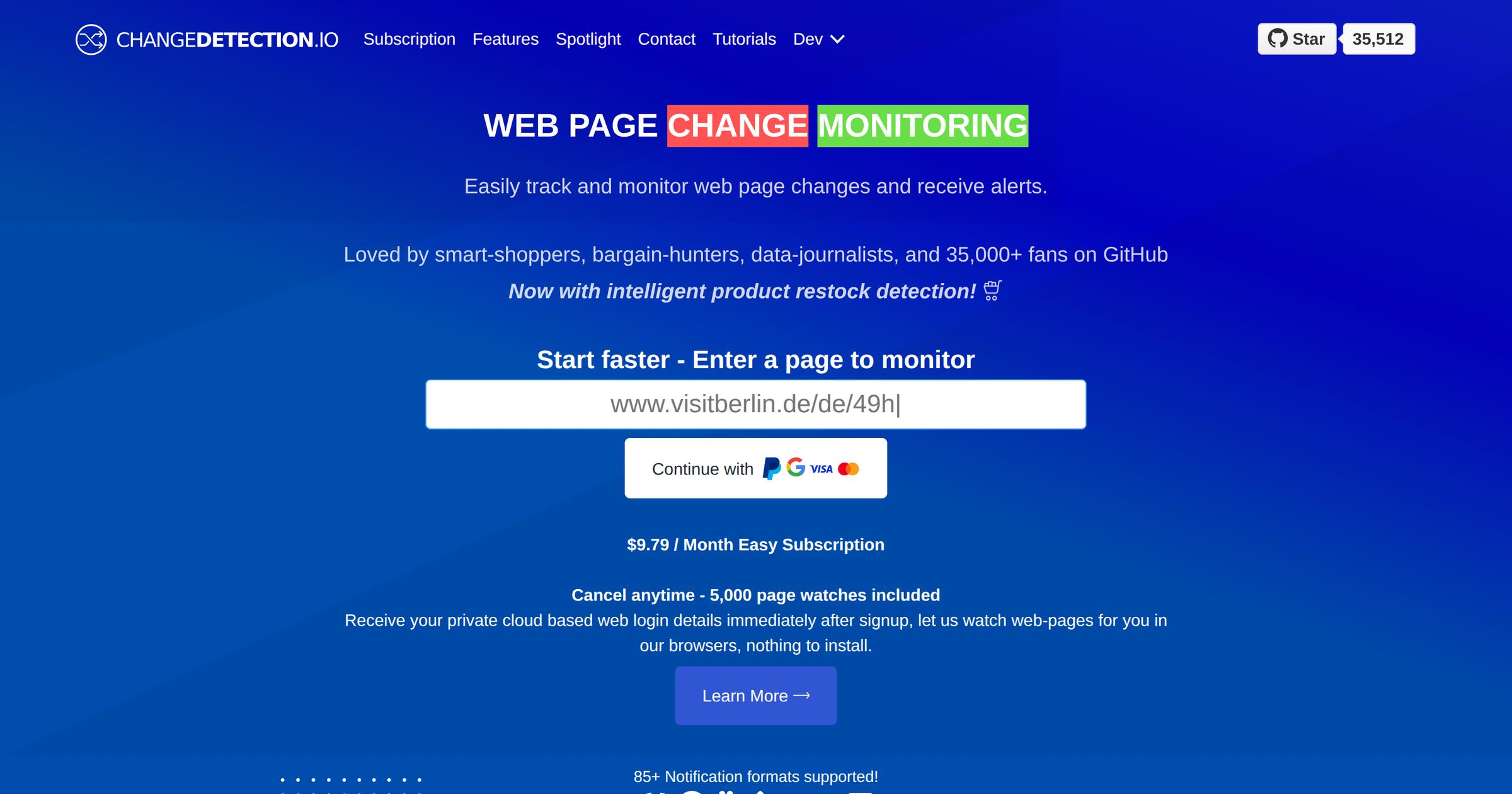
Yes. The same project offers a paid cloud subscription at $8.99/month that includes up to 5,000 URL watches, a real Chrome browser for JavaScript-rendering, proxy access including European, US, and Tor locations, and automatic updates with no server administration. The self-hosted version and the hosted version run the same open source codebase.