
Awwwards-mcp
MCP server for Awwwards design inspiration, no API key required.
Replaces Lazyweb, Mobbin
Who it's for
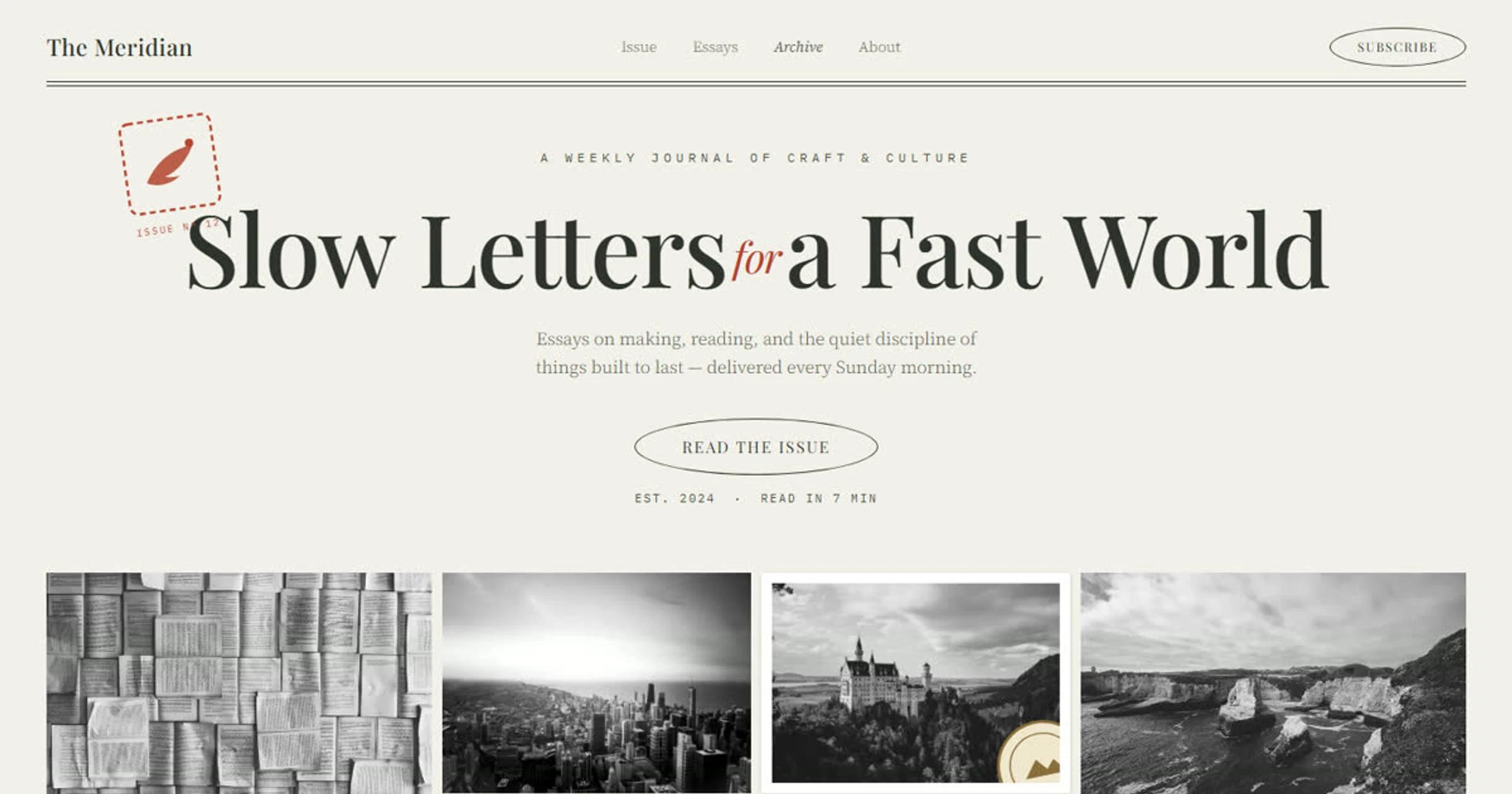
Search Awwwards for sites with the visual style you want, pull their design DNA (palette, stack, elements), band-map the target sections, and feed the structured output to an AI coding agent to generate matching components. The rebuild pipeline handles motion too: scroll and hover animations are censused and re-wired into GSAP timelines in the final project.
Skip if your design brief is already fully specified in a Figma file or design spec. Awwwards-mcp adds value at the reference-research and motion-analysis stage; if that work is done, the tool adds nothing to the build step.
Claude Code, Cursor, Codex, and OpenCode can use awwwards-mcp as an MCP server to search, analyze, and rebuild award-winning sites without a human passing screenshots manually. The agent issues a natural language search, receives screenshots and design data inline, and proceeds to band-map and rebuild in one tool-call chain.
Skip if the target site is not publicly accessible (intranet, auth-gated, or localhost-only). capture_live_site and the motion tools require a reachable URL.
get_motion_dna returns a runtime motion fingerprint for any live URL: animation libraries, ScrollTrigger stats (trigger count, scrub ratio), tween easing vocabulary, and the scroll model. analyze_scroll_map goes deeper, returning a per-element census with the full animated property set and scrub curves. This turns qualitative design briefs into measurable data.
Skip if your team needs a GUI-based design tool. Awwwards-mcp is a command-line MCP server; all interaction is through an AI agent, not a web interface.
The problem
Frontend developers building visually ambitious sites typically work from screenshots and mental notes. Passing design inspiration to an AI coding agent means copying color hex codes by hand, describing animation timing from memory, and guessing at the CSS behind a motion sequence you saw once and cannot re-examine. The gap between a design reference and working code stays wide when the agent has no way to see, analyze, or measure the original. The challenge compounds for teams using AI coding tools like Cursor or Claude Code. Those agents can write components, but they cannot observe a live site's motion system, measure its scroll triggers, or identify its framework from a bundle. The result is generated code that looks approximately right, then requires rounds of manual correction to match the actual reference.
How it works
Search the Awwwards index in free text: "dark 3D portfolio sites", "soft pastel e-commerce", by award type ("soty", "nominees"), by color (27 options), or by technology (200+ tags). Every result includes a real screenshot inline. The index runs a porter-stemmed FTS5 engine with BM25 ranking, so "magazines" matches Magazine-tagged sites where a substring search returns nothing. Multi-word queries apply AND semantics.
Pull the color palette, technology stack, design element types, award history, and full description for any Awwwards site. Batch mode accepts up to 10 slugs at once for compact enrichment of a shortlist. Element details include component-level poster images (3D models, video content, mobile layouts) with video URLs, served from a local 7-day cache.
For any live URL, the tool maps per-element scroll-motion triggers: selector path, source (GSAP ScrollTrigger, native CSS scroll timelines, CSS keyframes), animated properties, duration, easing, and scrub or pin flags. A separate hover census extracts :hover CSS rules and samples up to 20 interactive elements before and after hover, capturing transform, color, and filter diffs with timing. Requires Playwright.
Band-map any URL into structural sections, then recreate it section by section with a measured motion manifest and per-section hooks. The build_project tool converts a single-file rebuild into a runnable Vite, Astro, or Next.js project with framework-idiomatic GSAP timelines. verify_build scores the result against the reference on structure and motion, returning a 0-100 score and pass/warn/fail verdict.
Fetch and analyze a live page's script chunks (up to 40 chunks, 10 MB total, one request per second). The tool saves and hashes each chunk, optionally de-obfuscates with webcrack, and greps keywords across the code so an agent reads the actual animation mechanism directly. Optional static import graph analysis adds edge coverage over the captured chunks. Needs no browser.
Features
- Natural language site search with inline screenshots
- Design DNA extraction
- Scroll and hover motion census
- Section-by-section page rebuild to a framework project
- Bundle forensics and framework detection
How to install
Install awwwards-mcp globally to run it as a local MCP server for Claude Code, Cursor, or any compatible coding agent.
npm install -g awwwards-mcpRecommended for this setup
Strengths
- No API key or account required: The server queries Awwwards' public pages and maintains a local index. No Awwwards account, no paid API, no registration. The GitHub repo description explicitly states "No API key." Any agent with MCP protocol support can point at this server and start querying immediately.
- Works on any public URL, not only Awwwards: Every capture, census, motion analysis, and verification tool runs on any public URL. Point the agent at a competitor site, a design reference, or a build under active development; the same band-map, motion fingerprint, and accessibility evidence tools apply without restriction.
- MIT license, no self-hosting restrictions: MIT means you can run it on your own infrastructure, modify the codebase, and use it in commercial projects without restriction. The only note in the README is that aggregated data features (index stats, element corpus, collections) are for personal, non-commercial inspiration use, consistent with Awwwards' own terms.
- Offline FTS5 search index with BM25 ranking: Search does not require a network request to Awwwards per query. The local FTS5 index (porter-stemmed, BM25-ranked) stores crawled site data and responds instantly. get_index_status checks index count, crawl progress, and freshness without any network requests at all.
Trade-offs
- Playwright required for live capture and motion tools: capture_live_site, analyze_page_structure, record_site_motion, analyze_scroll_map, analyze_hover_census, analyze_accessibility, verify_build, verify_flow, and capture_component all require Playwright. record_site_motion additionally requires ffmpeg-static. Agents without Playwright in the server environment will find around half the tool surface unavailable. Setting up Playwright and ffmpeg alongside an MCP server is a non-trivial configuration step.
- Local index requires a crawl before searching: The FTS5 search index is populated from a local crawl of Awwwards. get_index_status shows crawl state; a fresh install has an empty or partial index until the crawl completes. get_index_stats covers only locally cached data, not the full Awwwards catalogue. Early search results may be sparse until the crawl has run.
Tech stack
FAQ
No. The server queries Awwwards' public pages and maintains its own local FTS5 index. No account, no API key, and no registration is needed. The GitHub repo description explicitly states "No API key."
The README and GitHub topics list Claude Code, Codex, Cursor, OpenCode, and ZCode as supported agents. Any agent that speaks the MCP protocol and can connect to a local MCP server should work. The server follows the standard MCP interface, so compatibility extends to any client that implements the protocol.
Yes. Every capture, census, and verification tool runs on any public URL: capture_live_site, analyze_page_structure, record_site_motion, analyze_scroll_map, analyze_hover_census, analyze_bundle, audit_url, and verify_build all work on any reachable site. Only the search and design DNA tools (search_sites, get_site_details, get_collections) are specific to the Awwwards index.
Playwright handles live-site interactions: full-page screenshots (capture_live_site), section band-mapping (analyze_page_structure), motion recording (record_site_motion), scroll-motion census (analyze_scroll_map), hover census (analyze_hover_census), accessibility sampling (analyze_accessibility), build verification (verify_build), and component serialization (capture_component). The motion recorder also needs ffmpeg-static for video output. Static analysis tools (analyze_bundle, analyze_network_capture) do not require Playwright.
The MIT license allows commercial use of the server itself with no restrictions: run it in a commercial project, modify the code, deploy it on paid infrastructure. The README notes that aggregated data features (index stats, element corpus stats, collections, directory browsing) are for personal, non-commercial inspiration use, consistent with Awwwards' own terms. Building and shipping websites using the tool's output is not restricted.