
Astryx
Agent-ready React design system with 150+ accessible components.
Replaces Mui X, Kendoreact
Who it's for
Astryx ships seven themes and a theming system built on CSS custom property overrides, so a team can apply a custom brand without forking components. The 150+ accessible components cover most UI needs from foundations to complex patterns, and the MIT license means no subscription required.
Your codebase is on React 17 or React 18 and an upgrade is not planned. Astryx requires React 19 and there is no compatibility shim for older versions.
The CLI and API are designed so an AI coding agent and a human developer reach the same documentation and use the same commands. If your team uses AI coding tools and wants consistent component usage between human and agent contributions, Astryx was designed for that workflow.
You do not use AI coding agents and need a mature, stable component API today. KendoReact or MUI X offers larger stable component sets with enterprise support contracts.
MIT licensed with no per-seat fees, Astryx is a viable component foundation for open source projects, internal tools, and startups that cannot absorb a component library subscription. The seven ready-made themes let a project look polished without custom design work.
You need a component library that has been stable and battle-tested at large external scale for years. Astryx's beta status means the API is still evolving.
The problem
Building and maintaining a consistent design system across a large React codebase is expensive. Teams that start with a third-party component library eventually need deep theming: a component that renders fine out of the box needs a brand color, custom radius, or a different density, and most libraries make those changes without wrapping or forking the source nearly impossible. Wrapping creates a maintenance layer you now own; forking creates version drift that never stops accumulating. The problem grows once AI coding agents join the workflow. An API not designed for agents produces inconsistent outputs: the agent reaches for props that exist, misses composition patterns documented only in the reference, and builds differently than the developer working next to it. The result is review cycles that catch agent-generated code rather than approve it, which defeats the purpose of the tool.
How it works
Pre-built UI components covering foundations, interactive elements, and patterns, all with full TypeScript support. Each component follows the same prop and composition conventions, so once you learn a few the rest behave predictably. The library includes ready-to-ship templates for common page patterns.
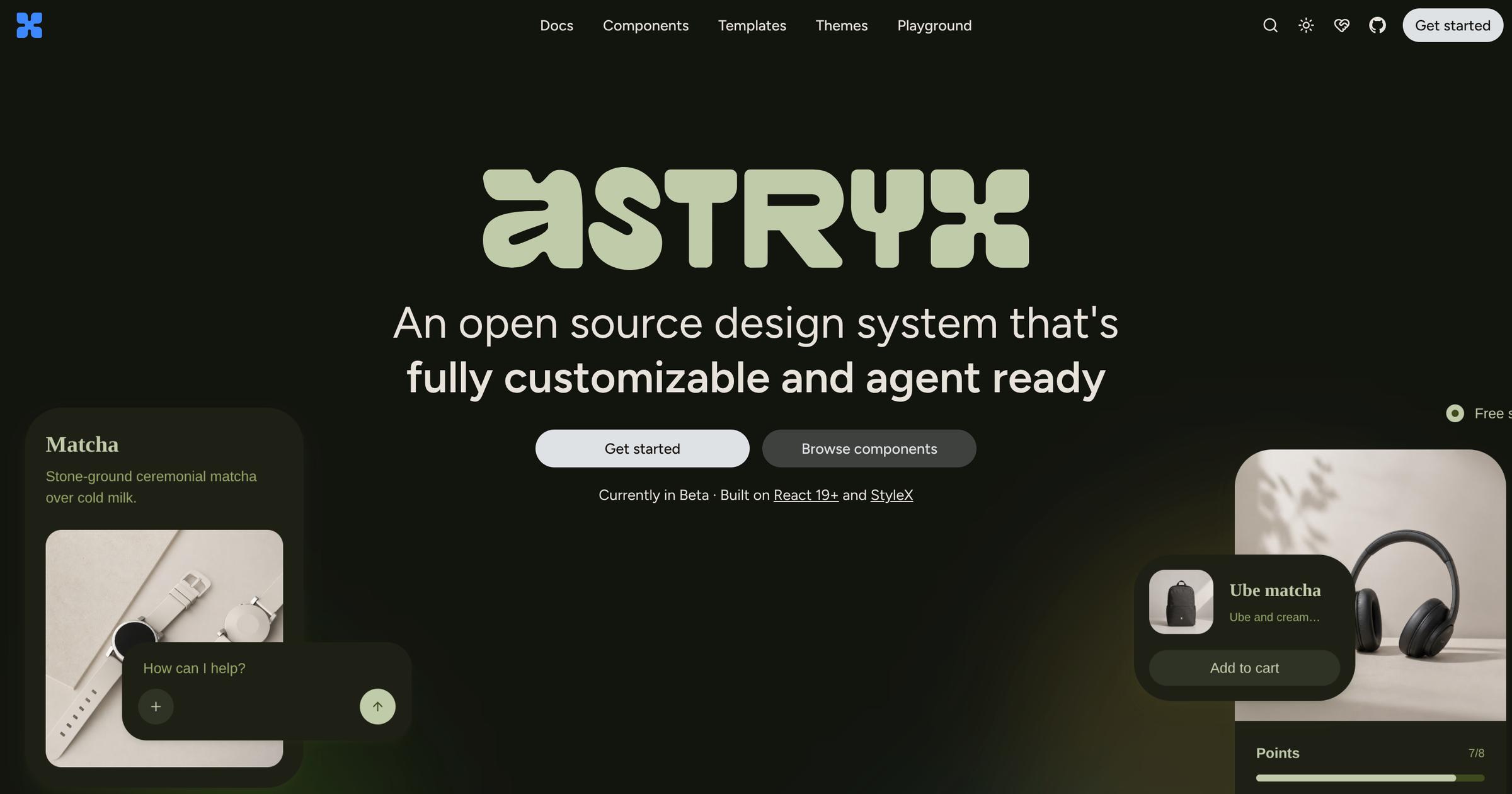
Themes are sets of CSS custom property overrides, not wrapper components or forked source. A designer can restyle every component to match a custom brand without touching component code. Seven ready-made themes are included: neutral, butter, chocolate, matcha, stone, gothic, and y2k.
The @astryxdesign/cli package documents components, generates scaffolding, and runs codemods. It can be installed globally so an AI coding agent and a developer reach the same component documentation with the same commands. Add a package.json script to avoid path errors when agents invoke it directly.
When a component's public API is not enough, swizzle ejects its full source into your project. You own the code from that point, can modify anything, and lose only automatic upstream updates for that specific component. It removes the need to fork the whole library for one deep customization.
Astryx uses StyleX internally to author its component styles, but consuming projects are not required to adopt StyleX. Override component appearance with Tailwind utility classes, CSS modules, or plain CSS through the standard className prop. No build plugin or PostCSS config is needed to get started.
Features
- 150+ Accessible Components
- Brand-Level Theming with CSS Custom Properties
- Agent-Ready CLI
- Swizzle: Component Source Ejection
- No Styling Lock-In
How to install
Install Astryx and its peer dependencies using npm, pnpm, or yarn.
npm install @astryxdesign/core @astryxdesign/theme-neutral @stylexjs/stylex
npm install -D @astryxdesign/cli
Recommended for this setup
Strengths
- MIT License with No Per-Seat Cost: The full component library is MIT licensed. Unlike MUI X's paid grid and advanced components or KendoReact's subscription pricing, every Astryx component is free to use in commercial projects with no seat count or license fee.
- API and Docs Designed for Humans and Agents Together: The API, documentation, and CLI were designed so both human developers and AI coding agents use the same tooling and reach the same documentation. The stated design principle is that every change that makes Astryx easier for AI also makes it easier for people, reducing inconsistency between human-authored and agent-authored code.
- Meta-Scale Internal Track Record: Astryx grew inside Meta over eight years and powers 13,000+ internal apps as of its open source release. The design conventions and component lifecycle were shaped by real product teams at scale before the library was published, giving it production depth unusual for a beta-stage open source project.
- Open Component Internals: Components expose their building blocks directly rather than locking them behind a closed top-level API. The swizzle mechanism lets you eject full component source when you need to go deeper, and the contributing wiki documents API conventions, design conventions, and the component lifecycle for contributors.
Trade-offs
- Currently in Beta: Astryx is explicitly in beta, meaning the API may carry breaking changes between releases. Teams that need a stable component API for a large production codebase should evaluate the beta maturity before committing. The MIT license means you can pin and fork, but upstream breaking changes still require migration work.
- Requires React 19 or Later: Astryx requires React 19 as a peer dependency. Projects on React 17 or React 18 cannot use it without upgrading their React version first. This is a hard requirement, not a recommendation, and limits adoption in codebases where upgrading React is not feasible.
- 322 Open Issues as a Beta Project: The repository carries 322 open issues. As a beta-stage project opened to external contributors, this is expected, but it reflects an early-stage support surface. Teams that need a commercial support contract should consider MUI X or KendoReact instead.
Tech stack
FAQ
Astryx is currently in beta, so the API may include breaking changes. Meta uses it internally to power 13,000+ apps, but the external release is still beta-stage. Teams with low tolerance for API churn should wait for a stable release or be prepared to pin versions and absorb migration work.
No. Astryx uses StyleX internally to author its component styles, but consumers do not need to adopt StyleX. You can override component appearance using Tailwind utility classes, CSS modules, or plain CSS through the standard className prop. No build plugin or PostCSS config is required.
React 19 or later is required. Both react and react-dom are peer dependencies of @astryxdesign/core. Projects on React 17 or React 18 cannot use Astryx without upgrading their React version first.
The @astryxdesign/cli package documents components, generates scaffolding, and handles codemods. It can be installed globally so an AI coding agent and a developer invoke the same commands and reach the same component documentation. The stated design goal is that people and agents build the same way from the same reference.
Yes. Astryx is MIT licensed, so you can use it in commercial projects, modify it, and distribute it without paying licensing fees. Beyond the standard MIT attribution requirement, there are no seat restrictions or subscription costs.