
Ardupilot
Open source autopilot for drones, planes, and rovers
Replaces Auterion
Who it's for
Teams building fixed-wing planes, multirotors, or VTOL aircraft for research use ArduPlane and ArduCopter to get a production-grade autopilot baseline with MAVLink ground station support and DataFlash logging.
You need a fully integrated commercial autopilot with vendor support contracts.
Developers building ROVs or AUVs use ArduSub with supported hardware like the Navigator board for a purpose-built submarine autopilot with active subsystem maintainers.
Builders of autonomous rovers and boats use the Rover firmware target, which shares the core ArduPilot codebase and benefits from the same GPS, compass, and avoidance sensor subsystems.
Your ground vehicle application is better served by a dedicated ground robotics middleware like ROS Navigation Stack alone.
Hardware kit makers and integrators use ArduPilot across the listed drone kit tags to ship open source flight stacks that end users can configure, extend, and contribute back to.
The problem
Building autonomous or remotely piloted vehicles typically requires expensive proprietary autopilot software and hardware locked to specific manufacturers. Developers and researchers need a reliable, flexible autopilot firmware that supports a wide range of vehicle types and hardware platforms without vendor lock-in.
How it works
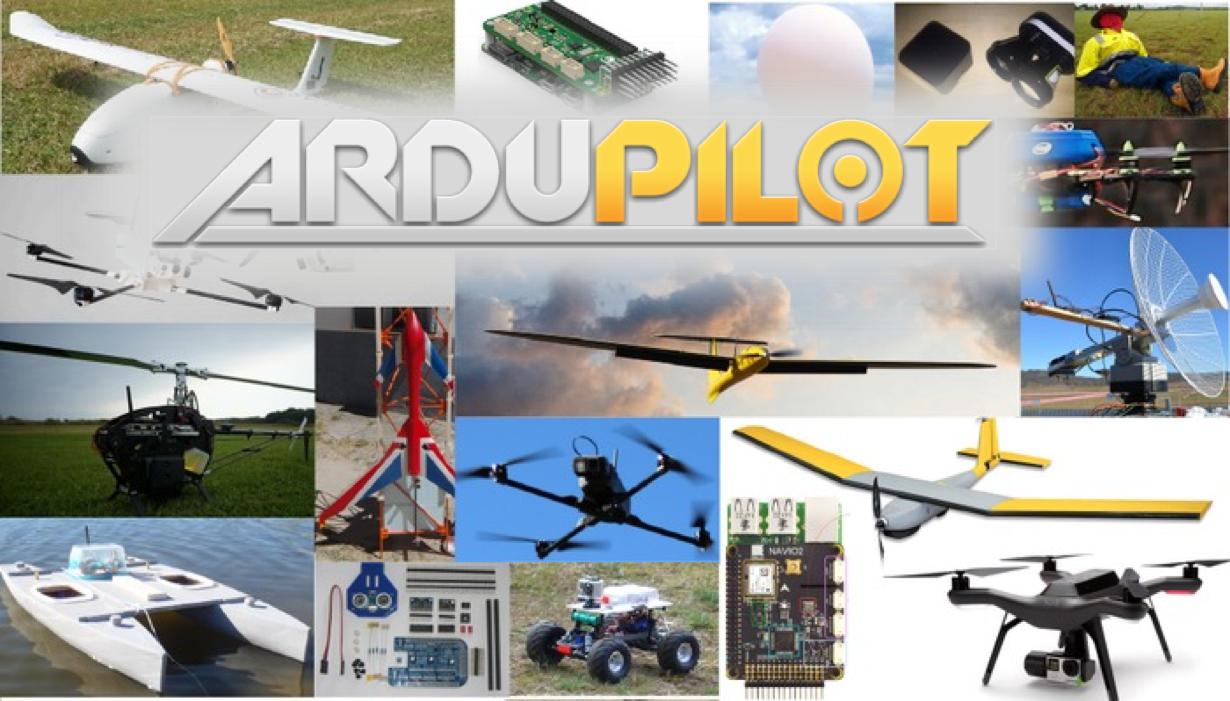
A single codebase covers fixed-wing planes, quad planes, multi-rotors, traditional helicopters, rovers, boats, balance bots, submarines, and antenna trackers. Each vehicle type ships as a dedicated firmware target with its own documentation wiki.
ArduPilot communicates with ground control stations over MAVLink, the standard UAV messaging protocol, enabling integration with mission planning software and telemetry tools across the ecosystem.
Runs on Pixhawk, Pixhawk2, PixRacer, Cube boards, Navigator, NavIO, BBBmini, BeagleBone Blue, PocketPilot, VRBrain, PXF, Erle-Brain 2, and ESP32-based platforms, maintained by named board maintainers.
An onboard scripting subsystem allows custom mission logic and vehicle behavior to be written in Lua without modifying the core firmware, with dedicated maintainers for the scripting subsystem.
Built-in driver support covers GPS, CAN bus, compass, battery monitors, DataFlash logging, FRSky telemetry, Marvelmind positioning, proximity and avoidance sensors, and OSD systems.
The AP_NavEKF2 and AP_NavEKF3 extended Kalman filter subsystems provide robust attitude and position estimation, each with dedicated maintainers listed in the project.
Features
- Multi-vehicle firmware
- MAVLink protocol support
- Broad hardware support
- Lua scripting
- Extended sensor subsystems
- NavEKF state estimation
How to install
git clone --recurse-submodules https://github.com/ArduPilot/ardupilot.git cd ardupilot ./Tools/environment_install/install-prereqs-ubuntu.sh -y . ~/.profile # Build ArduCopter for Pixhawk ./waf configure --board Pixhawk1 ./waf copter
Recommended for this setup
Strengths
- Active development since 2010: With over 74,000 commits and continuous development for more than 14 years, ArduPilot has accumulated deep battle-tested code across its vehicle targets and a large pool of experienced contributors.
- Named maintainer accountability: Every vehicle, board, and major subsystem has a publicly named maintainer responsible for reviewing patches, providing clear ownership and a direct contact for issues in each area of the codebase.
- Large community and ecosystem: Over 21,700 forks and 680 watchers, a dedicated support forum at discuss.ardupilot.org, a Discord server, and financial partners supporting ongoing development create a robust support ecosystem.
- ROS integration: ArduPilot carries ROS among its listed topics, supporting integration with the Robot Operating System for research and advanced robotics applications beyond basic autopilot use.
Trade-offs
- Steep learning curve for new users: The codebase spans multiple vehicle types, hardware abstraction layers, and subsystems built up over 14 years. New users typically need significant time with the wikis and forums before successfully configuring a vehicle.
- Requires compatible autopilot hardware: ArduPilot runs on specific supported boards such as Pixhawk variants, Cube, and Navigator. It cannot be deployed on arbitrary microcontrollers without porting work.
- GPL-3.0 license obligations: The project is licensed under GPL-3.0-or-later. Commercial products that modify and distribute ArduPilot must release their modifications under the same license, which may not suit all commercial use cases.
Tech stack
FAQ
ArduPilot supports conventional airplanes, quad planes, multi-rotors, helicopters, rovers, boats, balance bots, submarines, and antenna trackers through its ArduPlane, ArduCopter, Rover, ArduSub, and AntennaTracker firmware targets.
Supported boards include Pixhawk, Pixhawk2, PixRacer, Cube variants, Navigator, NavIO, BBBmini, BeagleBone Blue, PocketPilot, VRBrain, PXF, Erle-Brain 2, PXFmini, Bebop, Bebop 2, and ESP32-based platforms. Each board has a named maintainer in the project.
ArduPilot is licensed under the GNU General Public License, version 3 or any later version (SPDX: GPL-3.0-or-later). The full license text is in COPYING.txt in the repository.
ArduPilot uses the MAVLink protocol for communication with ground control stations and mission planning software.
The project runs a support forum at discuss.ardupilot.org, a community site at ardupilot.org, and a Discord server. Per-vehicle and per-subsystem wikis are linked from the GitHub repository.