Apache SkyWalking
APM platform covering traces, metrics, logs, and AI agent monitoring.
Replaces Datadog, Dynatrace, New Relic, Ibm Instana
Who it's for
SkyWalking maps service dependencies automatically and provides end-to-end traces without manually correlating logs across services. The Rover eBPF agent adds kernel-level profiling for CPU and network performance without modifying service code, covering the gap between application and infrastructure monitoring.
If your team has no in-house platform engineering capacity to manage a Java-based APM backend, a managed SaaS like Datadog or New Relic will have lower operational overhead, though at higher subscription cost.
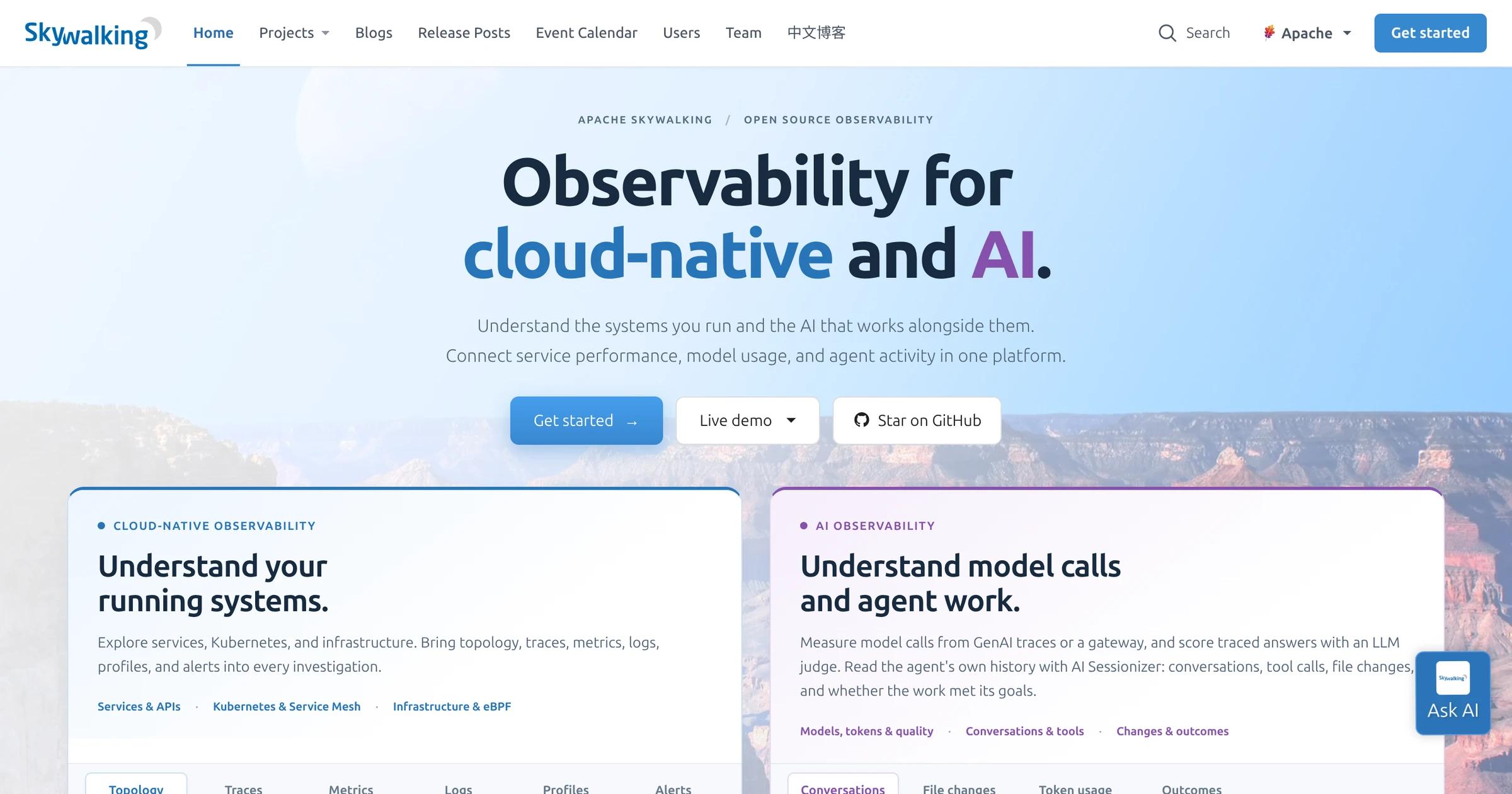
AI Sessionizer replays Claude Code, Kiro, and LangChain agent conversations alongside token usage, tool calls, and file changes. GenAI traces measure per-model-call latency and an LLM judge scores answer quality, all in the same platform as cloud-native infrastructure monitoring.
If you only need model call latency and token counts with no interest in correlating AI activity to infrastructure metrics, a lightweight LLM observability tool focused solely on AI will have a simpler setup.
Services already instrumented with OpenTelemetry SDKs can redirect OTLP data to SkyWalking with minimal changes. SkyWalking converts OTLP traces to service metrics and topology maps, covering the main APM use cases without reinstrumenting every service.
If your team relies on Datadog's integrated security monitoring, synthetic testing, or CI visibility, SkyWalking does not cover those use cases out of the box and a migration would leave those gaps unfilled.
The problem
Running distributed systems on Kubernetes means a single user request can touch dozens of services, pods, and infrastructure components. When something slows down or breaks, finding which hop introduced the latency or the error without purpose-built tooling means manually correlating logs across services, which does not scale. Paid observability platforms solve this but charge per host, per log ingested, or per span indexed, with costs that grow in proportion to the system being monitored. Teams that run large Kubernetes clusters or high-throughput services often face four- to five-figure monthly bills for observability alone. SkyWalking offers the same distributed tracing, topology mapping, and alerting in a system you deploy and run yourself, with no per-unit pricing.
How it works
End-to-end tracing follows requests across every service in a distributed system, building topology maps that show dependencies, call rates, and error rates. Agents cover Java, .NET Core, Node.js, Go, Python, PHP, Lua, Rust, and C++; OpenTelemetry OTLP instrumentation works alongside native agents for the same metrics and topology.
AI Sessionizer replays conversations from Claude Code, Kiro, and LangChain/LangGraph agents alongside their token usage, tool calls, file changes, and outcome judgments. GenAI traces measure individual model calls and an LLM judge scores answer quality, giving teams full visibility from infrastructure to AI outputs.
The Rover agent uses eBPF to profile Kubernetes deployments and diagnose CPU and network performance without modifying application code. It monitors Istio and Envoy service meshes, including Istio Ambient, providing kernel-level observability for teams that cannot or do not want to instrument every service.
SkyWalking accepts data from OpenTelemetry, Prometheus, Zipkin, Zabbix, Fluentd, and Telegraf through the same metrics pipeline, normalizing formats so existing telemetry infrastructure does not need to be replaced. OTLP traces are converted into service metrics and topology maps automatically.
BanyanDB is SkyWalking's purpose-built storage backend for observability data, designed to ingest, analyze, and store telemetry. A single SkyWalking cluster can handle over 100 billion telemetry events, based on published capacity figures from the project. Created in 2022, BanyanDB replaces the need for external storage backends in full-stack deployments.
Machine learning identifies patterns in observability data to automatically calculate metric baselines for intelligent alerting. HTTP URI patterns are recognized automatically, reducing the manual configuration needed to set meaningful alert thresholds as services evolve and traffic patterns shift.
Features
- Distributed Tracing with Service Topology
- AI Agent Monitoring via AI Sessionizer
- eBPF Profiling with Rover Agent
- OpenTelemetry and Multi-Ecosystem Integration
- BanyanDB Native Observability Database
- ML-Based Alerting and Metric Baselines
How to install
Self-hosting Apache SkyWalking uses Docker with the official OAP server and Horizon UI images.
docker run -d --name skywalking-oap -p 11800:11800 -p 12800:12800 apache/skywalking-oap-server:latest
docker run -d --name skywalking-ui -p 8080:8080 --link skywalking-oap -e SW_OAP_ADDRESS=http://skywalking-oap:12800 apache/skywalking-ui:latest
Recommended for this setup
Strengths
- Apache-2.0 License with No Vendor Fees: Apache-2.0 permits commercial use, modification, and distribution without any licensing fees. Teams running large Kubernetes clusters avoid the per-host, per-log, or per-span pricing of Datadog, Dynatrace, or New Relic, where costs scale with the size of the system being monitored.
- Full-Stack Observability Including AI Workloads: SkyWalking covers the same observability pillars as paid APM platforms: distributed tracing, infrastructure metrics, log management, profiling, and alerting. Adding AI agent monitoring in the same system means teams do not need separate tooling for LLM workloads alongside their cloud-native infrastructure.
- Ten-Plus Years in Production, 1,040 Contributors: The project has been in active production use since 2015 and counts over 1,040 contributors. With 25,000 GitHub stars and 22 open issues at the time of writing, the codebase is actively maintained and widely deployed in production environments across hundreds of companies and organizations.
- OpenTelemetry-Native Without Lock-In: Services instrumented with OpenTelemetry SDKs work with SkyWalking without additional changes. Teams migrating off a commercial APM can point existing OTLP collection at a SkyWalking backend rather than a vendor-managed one, keeping instrumentation changes minimal and reversible.
Trade-offs
- Java Backend Requires Operational Investment: SkyWalking runs as a Java-based backend cluster, which introduces JVM tuning, storage management for BanyanDB, and ongoing operational work. Teams without in-house platform engineering capacity may find the initial setup and ongoing tuning more demanding than a managed SaaS APM tool.
- Full-Platform Configuration Has a Learning Curve: SkyWalking has many configurable components: agents, the OAP server, BanyanDB, Horizon UI, and optional Grafana integration. Setting up a production-grade deployment that covers all telemetry types requires reading the official documentation and understanding the data flow between components.
Tech stack
FAQ
Yes. SkyWalking accepts OTLP traces, metrics, and logs natively, so services instrumented with OpenTelemetry SDKs work without additional agents. SkyWalking converts OTLP traces into its topology and service metrics format, giving teams the same dependency maps and dashboards they would get from native agents. Both instrumentation paths produce the same topology and metrics output.
AI Sessionizer is a component that collects conversation history from AI coding agents and replays it alongside token usage, tool calls, file changes, and outcome judgments. It currently supports Claude Code, Kiro, and LangChain/LangGraph agents. Conversations and their metrics reach SkyWalking over OTLP. The outcome judgment feature uses an LLM judge to assess whether the agent's work met its stated goals.
SkyWalking ships with BanyanDB, a purpose-built observability database created by the project in 2022 to ingest, analyze, and store telemetry at scale. The platform also supports Elasticsearch and other compatible backends, giving teams the option to use existing storage infrastructure rather than adopting BanyanDB alongside a new deployment.
Yes. SkyWalking is licensed under Apache-2.0, which permits commercial use, modification, and distribution without licensing fees. There are no per-host, per-log, or per-span charges, and there is no commercial tier that restricts what the open source version can do. The only costs are the infrastructure you choose to run it on.
SkyWalking and Datadog/New Relic cover similar ground: distributed tracing, infrastructure metrics, log management, profiling, and alerting. The main difference is deployment model and cost structure. SkyWalking runs on your infrastructure under Apache-2.0 at no per-unit cost, while Datadog and New Relic are managed platforms with subscription pricing that scales with usage. SkyWalking adds AI agent monitoring that neither managed platform covers fully; Datadog adds integrated security monitoring and synthetic testing that SkyWalking does not.