AI-Infra-Guard
Full-stack AI security scanner for agents, MCP servers, and models.
Replaces Amazon Sagemaker, Google Cloud Vertex Ai, Azure Machine Learning, Databricks, Weights Biases
Who it's for
Point AI-Infra-Guard at the network address of any running AI service: Ollama, vLLM, ComfyUI, or another component in the stack. The scanner fingerprints the version and returns CVE matches with severity and remediation links, giving the security team a structured report without manual version tracking.
If your AI infrastructure runs entirely within a managed cloud platform with its own security compliance attestations (SOC 2, ISO 27001) and no self-managed AI serving components, the CVE scan adds limited value beyond what the platform already provides.
Use the MCP Server and Agent Skills Scan to audit third-party skills from source code or remote URLs before deploying them in your agent environment. The scan detects tool poisoning, credential exfiltration patterns, and command injection risks across 14 risk categories, returning a structured report per skill.
If you build all agent skills in-house and run them in an isolated execution environment with no external network access, the third-party skill audit adds limited incremental value.
Configure the Jailbreak Evaluation module with the target LLM's API endpoint, select from built-in attack datasets, and run multi-turn attack sequences including Many-Shot, PAIR, GOAT, and ActorAttack. The cross-model comparison output shows which models are vulnerable to which attack vectors.
If your LLM deployment uses a managed API where the provider conducts and publishes regular red team evaluations, this module is most useful as a verification layer rather than the primary testing mechanism.
The aig-skill-scan CLI installs via pip and adds to a CI step to scan Agent Skill directories automatically on every push. The SkillTrustBench taxonomy (T01 through T09) provides structured classification of findings that maps cleanly to policy gates in existing security workflows.
If your team is still in early exploration of AI agent tooling and has not committed to a skill framework or agent platform, setting up a CI gate is premature. Run a one-time manual scan first.
The problem
Teams deploying AI agents, MCP servers, and self-hosted inference services face a category of security risk that general-purpose scanners were not designed to handle. Agent skills can carry prompt injection payloads or exfiltrate credentials through tool calls. MCP servers may execute arbitrary commands via tool poisoning. AI framework components like Ollama, vLLM, and ComfyUI ship with known CVEs that go unscanned in most deployment pipelines. LLMs that pass basic safety evaluations can still be jailbroken through multi-turn attack sequences. The result is that AI infrastructure teams are flying blind. Security audits rely on manual review or incomplete scans from frameworks built for traditional web applications. Jailbreak testing is inconsistent or skipped entirely. Vulnerability scanning stops at the OS and network layer and never reaches the AI serving components themselves.
How it works
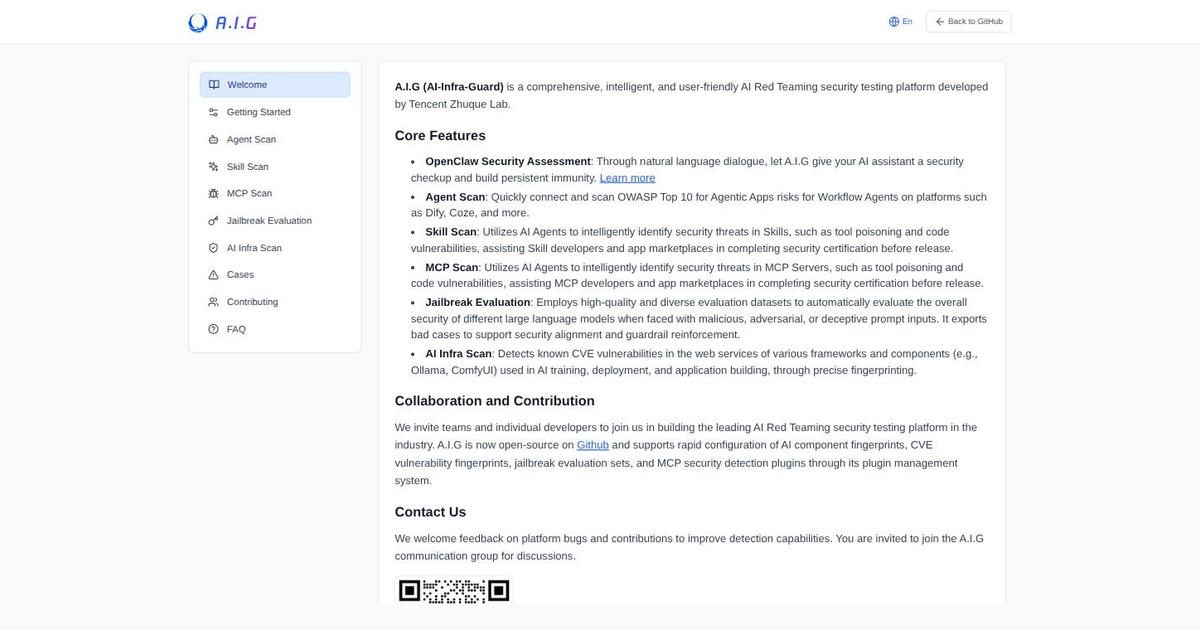
Fingerprints over 100 AI framework components (Ollama, ComfyUI, vLLM, Triton Inference Server, n8n, and more) against a library of 2000+ known CVE rules. Point it at the network address of a running AI service and the scanner detects the version automatically, returning matched vulnerabilities with severity ratings and remediation links.
An independent multi-agent automated scanning framework that evaluates the security posture of AI agent workflows. Supports agents running on Dify and Coze, using 10 OWASP-aligned skills including web-exfiltration detection. Results include a structured risk report per workflow, covering prompt injection and related attack vectors.
Detects 14 categories of security risk in MCP servers and agent skills, scanning from both source code and remote URLs with no running instance required. Covers tool poisoning, credential exfiltration, and command injection. The aig-skill-scan CLI installs via pip and integrates directly into CI/CD pipelines.
Tests LLM robustness against prompt injection and jailbreak attacks using multiple methods: Many-Shot, PAIR, GOAT, and ActorAttack for multi-turn attacks, plus 9 single-turn jailbreak operators. Configure a target LLM's API endpoint, select a dataset, and get a cross-model comparison report with detailed attack outcomes.
Skill security auditing covers 9 risk categories (T01 through T09), spanning instruction hijacking, memory poisoning, code execution, privilege escalation, tool hijacking, and insecure dependencies. The top benchmark score of 0.9848 F1 on SkillTrustBench was achieved using Claude Opus 4.6 as the backing LLM.
Audits AI API relay setups for security issues: model fingerprinting, Claude Signature verification, relay black-box auditing, and vendor quality testing via PAMELA and Ventor QTest. Available as a standalone CLI after Docker deployment, with API documentation at the local Swagger endpoint.
Features
- AI Infrastructure Vulnerability Scan
- Agent Scan for Workflow Security
- MCP Server and Agent Skills Scan
- Jailbreak Evaluation Engine
- SkillTrustBench Benchmark Coverage
- Model and API Relay Checker
How to install
Self-hosting deploys the full stack via Docker Compose with pre-built images; Docker 20.10 or higher, 4GB RAM, and 10GB disk required.
git clone https://github.com/Tencent/AI-Infra-Guard.git
cd AI-Infra-Guard
docker-compose -f docker-compose.images.yml up -d
Recommended for this setup
Strengths
- 2000+ CVE rules targeting AI-specific frameworks: The vulnerability library covers AI framework components specifically, not general web applications. Ollama, vLLM, ComfyUI, n8n, and Triton Inference Server are among 100+ components covered. The library was expanded to 2000+ rules in v4.5.2 (August 2026), keeping pace with new CVE disclosures in the fast-moving AI serving stack.
- Apache 2.0 license with fully open-sourced frontend: Apache 2.0 allows commercial use, modification, and distribution without copyleft requirements. The frontend was fully open-sourced in v4.5.0 (July 2026), meaning teams can fork and customize the web interface alongside the backend rule engine. No licensing fees apply to the self-hosted deployment.
- Active fortnightly release cadence: The project ships updates roughly every two to three weeks, with each release adding new jailbreak attack methods, MCP scan rules, or expanded CVE coverage. The last repository push was August 19, 2026. The changelog traces back to December 2024, with no gaps in the release history visible in the research pack.
- Validated at Black Hat EU 2025 Arsenal: AI-Infra-Guard was selected for the Black Hat EU 2025 Arsenal program, providing external validation from the security research community beyond the project's own benchmarks and documentation.
Trade-offs
- No authentication mechanism; not safe for public networks: The README explicitly states that AI-Infra-Guard currently lacks an authentication mechanism and should not be deployed on public networks. It is positioned for internal use by enterprises or individuals. Exposing the web interface without a VPN or firewall would allow unauthenticated access to scan results and configuration.
- Docker deployment requires 4GB RAM and 10GB disk: The Docker Compose deployment requires Docker 20.10 or higher, at least 4GB RAM, and 10GB of disk space. Lightweight VPS deployments will not run the full stack. Teams on constrained infrastructure need to provision a dedicated server for the scanning service.
- Skill scanner requires an external LLM API key: The aig-skill-scan CLI relies on a backing LLM to classify skill security risks. Scan quality and cost depend on the LLM provider chosen. Teams without an existing API key for a supported model (DeepSeek, Claude, Gemini, GLM, or Kimi) need to obtain one before the skill scanner is operational.
Tech stack
FAQ
Yes. AI-Infra-Guard is Apache 2.0 licensed and free to self-host. The Docker Compose deployment pulls pre-built images from Docker Hub at no cost. A Pro hosted version at aigsec.ai exists with advanced features and requires an invitation code, but the open source self-hosted version is fully functional with no usage fees.
Yes, as long as the service is network-accessible from the machine running AI-Infra-Guard. The AI Infra Scan module takes a URL or IP as input and connects to the live service to fingerprint it. Scanning a private SageMaker endpoint requires running AI-Infra-Guard inside the same VPC or with appropriate network routing in place.
The scan covers over 100 AI framework components, including Ollama, ComfyUI, vLLM, n8n, and Triton Inference Server. The vulnerability rule library contains 2000+ CVE rules as of v4.5.2 (August 2026). New rules are added with each release and the library is community-extensible via YAML fingerprint files submitted as pull requests.
Yes. The Agent Scan module runs automated multi-agent evaluation of agent workflows and includes 10 OWASP-aligned security skills covering prompt injection, web exfiltration detection, and related attack vectors. The MCP Server and Agent Skills Scan separately detects 14 categories of risk in MCP server implementations and agent skills.
The aig-skill-scan CLI requires an external LLM API key configured via the LLM_API_KEY environment variable and the -m flag. It has been tested with Claude Opus 4.6 (F1 0.9848 on SkillTrustBench), GLM 5.1, Gemini 3.5 Flash, Kimi 2.6, and DeepSeek v4 Flash. Any of these can serve as the backing model for skill classification.