
SkillEvaluator
Validation, deduplication, and live sandbox eval for AI agent skills.
Replaces —
Who it's for
Teams maintaining skills for Claude Code, Codex, or similar agents can wire SkillEvaluator into their CI pipeline to gate every pull request. Tier 1 catches security and quality issues before they reach catalog users; Tier 2 flags skill overlap that would put conflicting guidance in front of agents.
Your team publishes a small number of one-off skills and reviews each manually. The CI setup overhead is not worth it for catalogs with fewer than a handful of contributed skills.
Individual developers and teams creating skills for Claude Code, Codex, or other skill-aware agents can run SkillEvaluator locally before submitting. The validate command runs all three tiers and surfaces quality, security, and behavioral issues before catalog review.
You are building a one-off skill for personal use with no plans to contribute it to a shared catalog. Local quality checks add value regardless, but the CI gate setup is not worth the overhead for private, single-skill use.
Tier 1's static security suite scans skill files for secret leaks (Gitleaks) and skill-specific vulnerabilities (SkillSpector) with no API key or internet connection. Semgrep is optional for broader code scanning. Offline operation lets security teams review skills in isolated environments before approving deployment.
Your concern is evaluating LLM response quality in applications, not vetting instruction files. Braintrust or LangSmith are designed for that evaluation target.
The problem
When teams build agent skills for AI coding tools, they face no standard quality bar before publishing. A skill might carry security vulnerabilities, undocumented PII risks, duplicate guidance that conflicts with existing skills, or instructions that don't measurably improve the agent's output on real tasks. Catching these problems after the skill is live means users encounter broken or risky behavior with no warning. The problem deepens at scale. A catalog of dozens of community-contributed skills has no automated deduplication step, so overlapping guidance accumulates. Measuring whether a skill actually helps the agent requires a live sandbox run comparing agent performance with and without it, and no general-purpose eval tool offers this for skill folders.
How it works
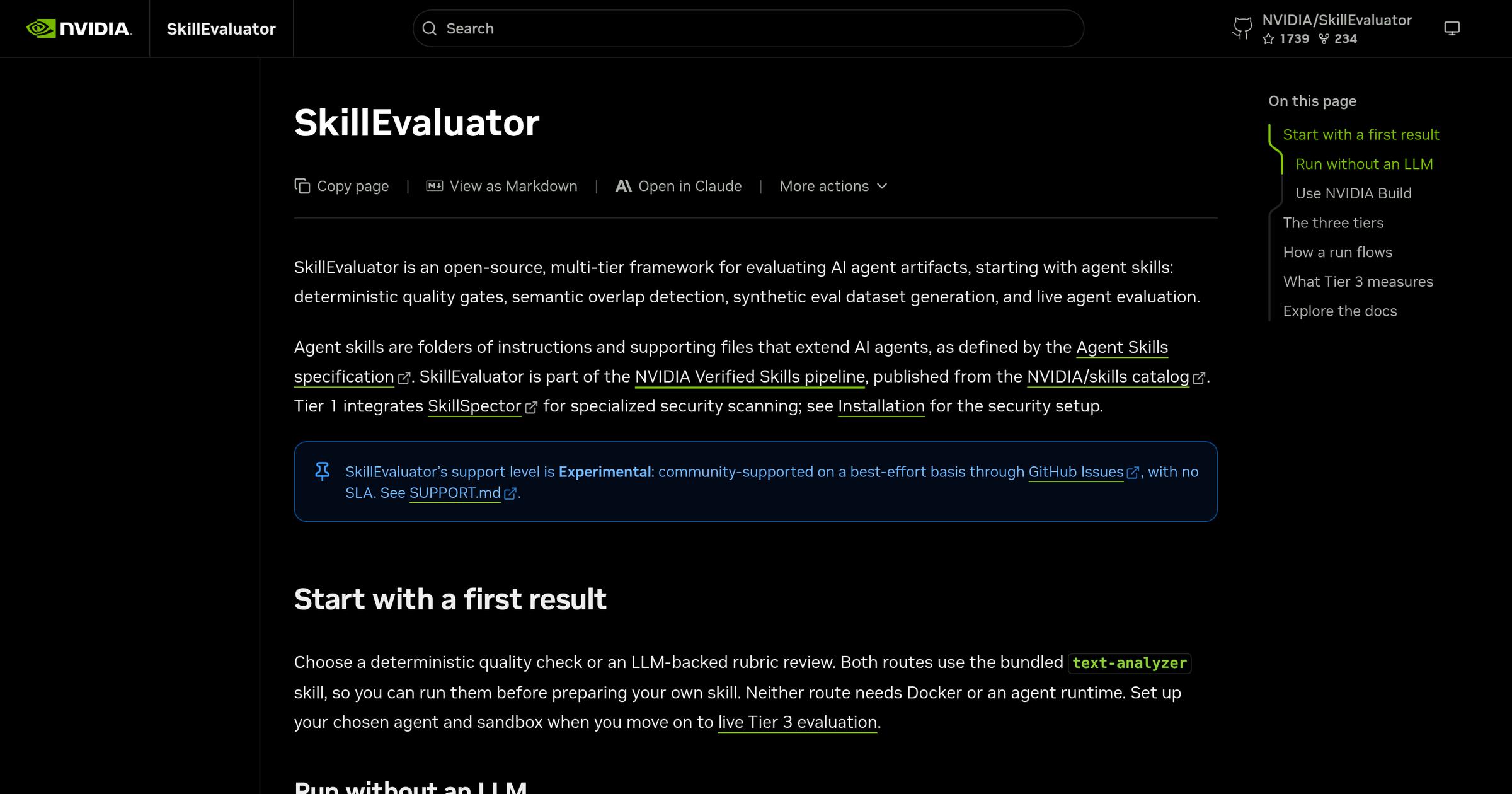
Validates schema, documentation quality, security (SkillSpector and Gitleaks), PII, license, and script integrity offline with no API key. Scores documentation quality out of 100 with a default passing threshold of 70. The bundled text-analyzer skill lets you run a first check before preparing your own skill.
Uses embedding similarity to find repeated guidance inside a single skill and to compare skills across a catalog. Catches conflicts and redundancies before they reach production. Requires an embeddings provider; intra-skill analysis also supports local OpenAI-compatible endpoints.
Runs a real agent inside Docker with and without the skill on generated tasks, then scores the difference across five dimensions: Security, Correctness, Discoverability, Effectiveness, and Efficiency. The Skill Lift metric isolates whether the skill earns its place in the catalog.
Running the CI init command opens a setup pull request on GitHub. A GitLab CI template is included for copy-paste setup. Exit codes map cleanly to pass/fail gates so a failing skill blocks the merge without custom configuration.
Tier 1 includes an optional rubric-eval command that sends skill documentation to a model and returns structured feedback. Works with NVIDIA Build endpoints for free prototyping and with any OpenAI-compatible provider. Useful for catching documentation quality issues that static checks miss.
Features
- Tier 1 deterministic quality gates
- Tier 2 semantic overlap detection
- Tier 3 live sandboxed agent evaluation
- CI integration with GitHub Actions and GitLab
- LLM-backed rubric evaluation
How to install
Installing SkillEvaluator as a Python package gives you the CLI for static quality checks, security scans, and live skill evaluations.
pip install skillevaluatorRecommended for this setup
Strengths
- Offline Tier 1 with no API key: Quality checks, schema validation, security scanning, and documentation scoring all run offline. Teams in security-conscious or air-gapped environments can run the full static suite without any cloud provider setup. The bundled text-analyzer example scores 86.2/100 (grade B) using only the installed package.
- Agent Skills CI integration out of the box: A single CI init command creates a GitHub pull request configuring a workflow to check every changed skill on each pull request. Catching quality and security issues at review time prevents regressions from reaching catalog users. GitLab CI support ships as a ready-to-copy template.
- Apache 2.0 license: Apache 2.0 permits commercial use, modification, and redistribution with no network-use restrictions. Teams building internal skill catalogs or commercial products can ship SkillEvaluator-validated skills without licensing constraints.
- Five-dimension behavioral measurement: Tier 3 scores Security, Correctness, Discoverability, Effectiveness, and Efficiency in live agent runs. The Skill Lift metric gives a single number showing whether the skill improved agent task performance, making it easier to compare skill versions or justify publishing a new skill.
Trade-offs
- Experimental support level, no SLA: NVIDIA classifies SkillEvaluator's support as Experimental: community-supported through GitHub Issues on a best-effort basis, with no SLA or NVIDIA enterprise support entitlement. Teams that need production-grade support agreements should factor this in before adopting it as a CI gate.
- Tier 3 adds agent credential and sandbox overhead: Live evaluation requires a supported agent CLI (Claude Code, Codex, OpenClaw), an API key for LLM generation and grading, and a Docker sandbox. The setup is documented but non-trivial, and sandbox usage for Tier 3 can incur model and managed-sandbox charges.
- Full security scan requires external executables: Complete Tier 1 security coverage depends on SkillSpector and Gitleaks binaries (auto-fetched when missing) and optional Semgrep. When a required scanner cannot run, the check exits nonzero as INCOMPLETE rather than skipping it, which blocks CI until the scanner is installed.
Tech stack
FAQ
An agent skill is a folder of instruction files defined by the Agent Skills specification (agentskills.io) that extends an AI agent like Claude Code or Codex with new capabilities. Without evaluation, a skill may carry security vulnerabilities, low-quality documentation, or instructions that duplicate existing guidance. SkillEvaluator's three tiers check quality and safety statically, then measure whether the skill actually improves agent task performance in live runs.
Yes, for Tier 1 deterministic checks. The base package installed via pip requires only Python 3.12 or later. No GPU, no API key, and no Docker is needed for static quality, schema, PII, and license checks. Full security scanner coverage adds the SkillSpector and Gitleaks binaries, which SkillEvaluator fetches automatically when missing.
The CI init command opens a pull request from your repository root that sets up a GitHub Actions workflow to check every changed skill on each pull request. SkillEvaluator's exit codes serve as the pass/fail gate: a non-zero exit blocks the merge. A GitLab CI YAML template is included for teams not on GitHub.
Tier 3 supports Claude Code, Codex, OpenCode, and OpenClaw, running inside Docker, local OS, or cloud sandboxes. Each agent requires its own credential. Sandbox usage for live Tier 3 evaluation may incur model API and managed-sandbox charges depending on the provider configuration.
No. SkillEvaluator is built specifically for the Agent Skills specification: instruction folders that extend AI coding agents. It evaluates skill quality, security, and behavioral impact on agents, not arbitrary LLM responses or prompt performance. For evaluating LLM application output quality, tools like Braintrust or LangSmith are designed for that purpose.