Pytorch Deep Learning
Hands-on PyTorch deep learning course and free online book
Replaces —
Who it's for
A developer who knows Python and wants to start building neural networks can follow the course from chapter 00, writing real PyTorch code in Colab from day one without needing to install a local environment.
Already has hands-on experience training and deploying ML models.
The three milestone projects covering experiment tracking, paper replication, and model deployment produce concrete artifacts that can be shown to employers as evidence of applied deep learning skills.
Looking for advanced research-level techniques or non-PyTorch frameworks.
All annotated notebooks, slides, and exercises are freely available at learnpytorch.io and on GitHub, making the course fully usable as a self-paced textbook without purchasing any video access.
The problem
Beginners wanting to learn deep learning with PyTorch face a steep ramp: the official documentation is comprehensive but not beginner-sequenced, and most courses teach theory before code. Learners need a structured, code-first path that goes from tensor basics all the way through training, transfer learning, and shipping a model to production.
How it works
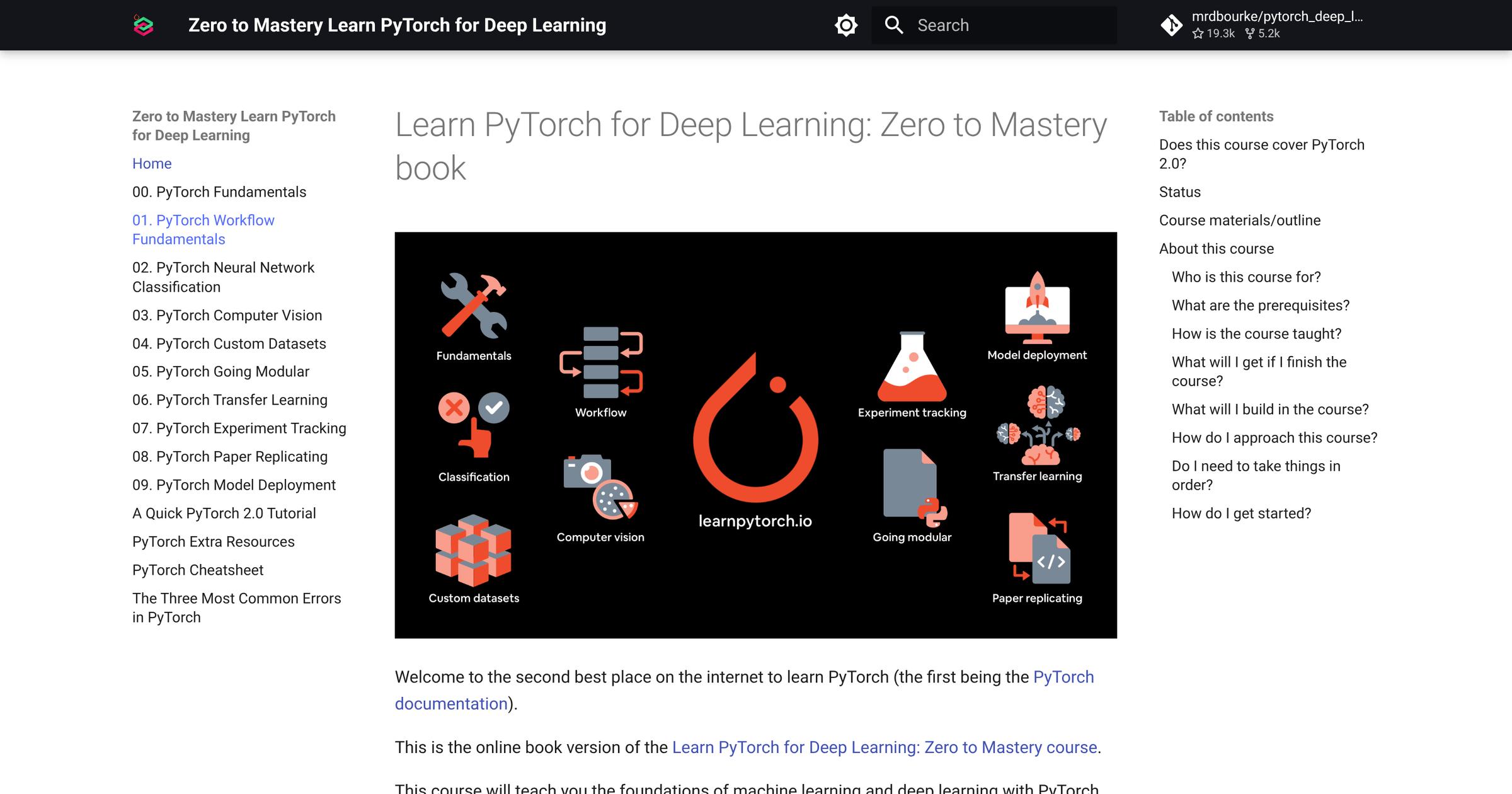
Chapters run from PyTorch fundamentals through neural network classification, computer vision, custom datasets, modular scripts, transfer learning, experiment tracking, paper replication, and model deployment, building on each other sequentially.
All written materials, annotated notebooks, slides, exercises, and solutions are freely accessible at learnpytorch.io with no account required, covering every chapter including PyTorch 2.0.
Every chapter is delivered as a Google Colab notebook so learners can run GPU-backed code in a browser without installing anything locally. Each notebook has an 'Open in Colab' button.
Sections 07, 08, and 09 are milestone projects: experiment tracking across multiple models, replicating a published machine learning paper, and deploying a trained model to the internet as a public demo.
The video course follows an apprenticeship format: the instructor writes PyTorch code and the learner writes along. The first 25 hours covering chapters 00 to 04 are published free on YouTube.
Each of the 10 chapters includes a dedicated exercises section and extra-curriculum links so learners can practice independently and explore deeper resources beyond the core notebooks.
Features
- 10-chapter structured curriculum
- Free online book at learnpytorch.io
- Google Colab notebooks
- Three milestone projects
- 321-video apprenticeship-style course
- Exercises and extra-curriculum per chapter
Recommended for this setup
Strengths
- Fully free written content: The entire online book, all notebooks, slides, and exercises at learnpytorch.io are open source on GitHub and free to read without a paid account, making the written curriculum accessible to anyone.
- Code-first, experiment-driven teaching: The course motto is 'if in doubt, run the code' and 'experiment, experiment, experiment.' Learners write hundreds of lines of PyTorch code across the curriculum rather than following passive lectures.
- Covers the full deployment arc: The curriculum goes from tensor fundamentals all the way to deploying a model to the internet in chapter 09, giving beginners a complete picture of the machine learning workflow rather than stopping at training.
- Compatible with PyTorch 2.0: All course notebooks work with PyTorch 2.0 because it is an additive, backward-compatible release. A dedicated PyTorch 2.0 tutorial added in April 2023 walks through new features on top of the existing content.
Trade-offs
- Designed for beginners, not practitioners: The course is explicitly aimed at people new to machine learning. Learners with one or more years of ML experience may find the pacing and foundational coverage too slow for their level.
- Prerequisites required: The course expects 3 to 6 months of Python experience, at least one introductory ML course, and familiarity with Jupyter or Google Colab notebooks before starting.
- Video content behind a paid platform: The full 321-video course is on Zero to Mastery Academy and Udemy. Only the first 25 hours (chapters 00 to 04) are free on YouTube; the remaining video chapters require a paid enrollment.
Tech stack
FAQ
Yes. PyTorch 2.0 is an additive, backward-compatible release, so all existing course notebooks still work. A dedicated PyTorch 2.0 tutorial was added in April 2023 covering the new features.
No. All notebooks are designed for Google Colab, which provides free GPU access in a browser. No local installation is required.
Yes. The full online book at learnpytorch.io, all notebooks, slides, exercises, and solutions are free and open source on GitHub. The paid enrollment on Zero to Mastery or Udemy unlocks the full 321-video library.
The first 25 hours of material covering chapters 00 through 04 are published as a single video on YouTube. The remaining chapters are part of the paid video course.
Three milestone projects: a multi-model experiment tracking system (chapter 07), a replication of a published machine learning paper (chapter 08), and deploying a neural network food image classifier called FoodVision to the internet (chapter 09).