
nautilus_trader
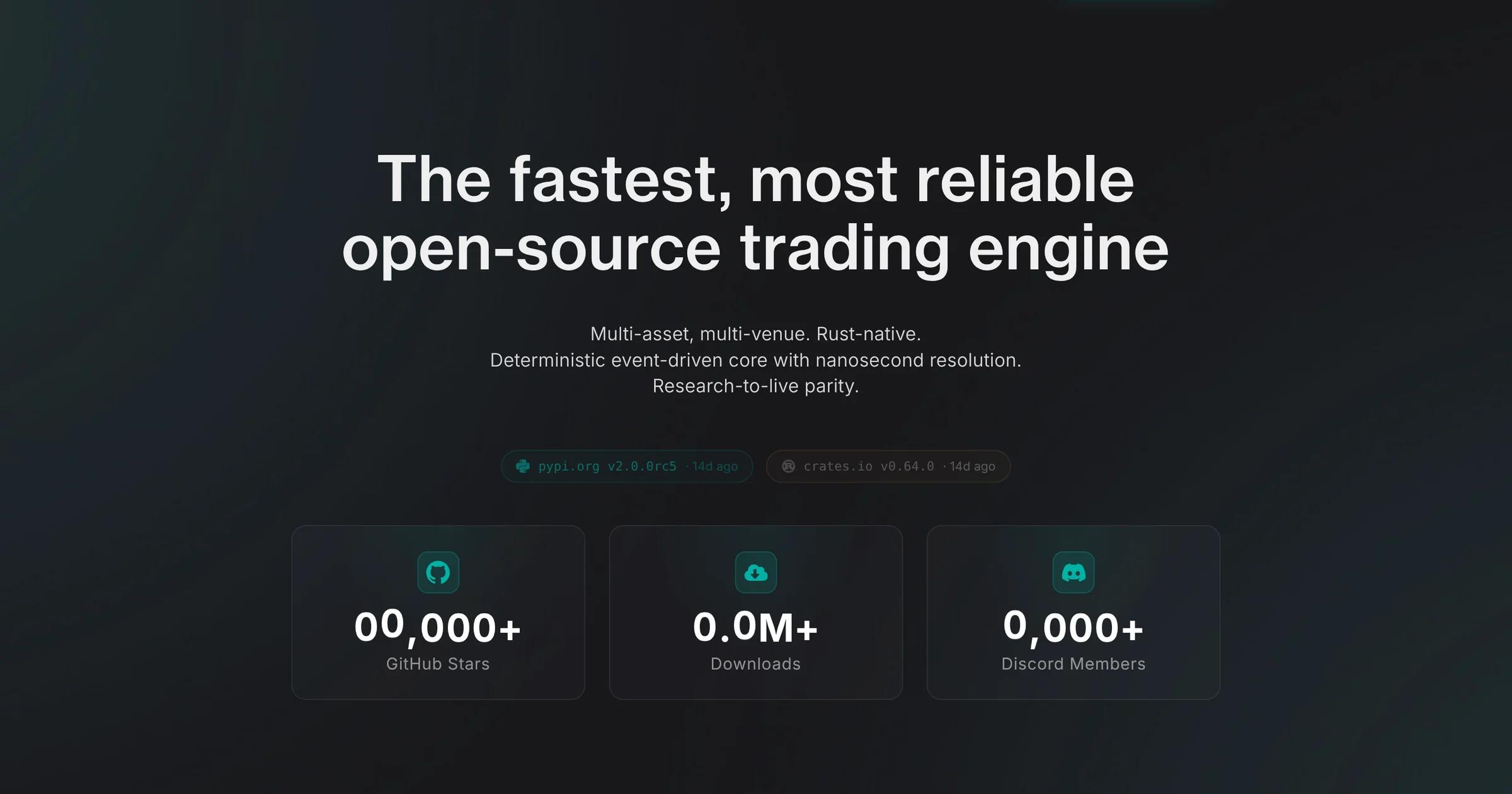
Rust-native trading engine with research-to-live parity
Replaces Quantconnect, Alpaca, Interactive Brokers Api
Who it's for
NautilusTrader provides a unified engine to test and run strategies across equities, FX, crypto, and futures without switching frameworks. The Python API lets researchers express strategy logic while the Rust runtime handles execution at production speed.
You only need a simple single-asset strategy with no backtesting requirements. A lighter broker SDK has less setup overhead and gets you connected faster.
NautilusTrader runs on your own servers with no per-compute billing. You control the data feeds, the execution engine, and the strategy IP. The Python strategy API is familiar to anyone who has written QuantConnect algorithms.
You need a managed cloud environment with built-in data feeds and no infrastructure work. QuantConnect's managed platform is faster to get started with if operating infrastructure is not acceptable.
The engine's throughput is high enough to run reinforcement learning or evolutionary strategy training loops. High-throughput parameter sweeps run without code changes to the strategy, fitting iterative ML workflows that require many backtest iterations.
Your AI workflow needs GPU-accelerated simulation or distributed training across nodes. NautilusTrader is a single-node engine and built-in ML tooling is explicitly out of scope per the project roadmap.
17 stable integrations cover major CEX and DEX venues including Binance, Bybit, Coinbase, Kraken, dYdX, and Hyperliquid. A single strategy can run market-making or cross-venue arbitrage across multiple venues simultaneously using the same event model.
You only trade on a single venue and that venue's native SDK is sufficient. Adding NautilusTrader for a single-venue, non-backtested workflow adds architectural complexity without proportional benefit.
The problem
Most quantitative trading workflows force a hard split between research and production. Researchers build and test strategies in Python using vectorized methods; engineers then reimplement the same logic in compiled languages for the live system. That rewrite introduces subtle behavioral differences: different timing models, different fill semantics, different order book snapshots. When the live system behaves differently from the backtest, it is difficult to tell whether the strategy is wrong or the implementation diverged. Commercial algorithmic trading platforms like QuantConnect address parts of this by providing a managed cloud environment, but they trade infrastructure control for convenience: you cannot inspect the engine internals, your data stays on their servers, and compute costs scale with usage. Proprietary brokerage APIs like the Interactive Brokers API give you connectivity but not a unified event-driven framework, leaving the architecture work entirely to you.
How it works
The core engine is written in Rust for low-latency execution and memory safety, with Python bindings provided via PyO3. Write strategy logic in Python while the Rust runtime handles order matching, message bus throughput, and serialization. Strategies can also be written entirely in Rust for workloads that need maximum throughput.
Run event-driven simulations at nanosecond resolution with configurable fill models, fee schedules, latency parameters, and order book depth. Multiple venues, instruments, and strategies run simultaneously in a single backtest. The event model is deterministic: the same inputs always produce the same outputs, enabling reproducible reruns for research and audit.
The same execution semantics, clock, cache, and message bus operate in both backtesting and live trading. A strategy deployed to production uses the same event model it was tested against, removing the implementation gap that typically introduces deployment risk. No code changes are required to move a strategy from research to live.
A single engine handles equities, futures, options, FX, crypto (spot, perpetuals, derivatives), betting exchanges, prediction markets, and tokenized real-world assets. Run market-making and cross-venue strategies across multiple venues simultaneously. 17 stable integrations include Binance, Bybit, Coinbase, Interactive Brokers, Kraken, dYdX, and Hyperliquid.
Supports IOC, FOK, GTC, GTD, DAY, AT_THE_OPEN, and AT_THE_CLOSE time-in-force values. Execution instructions include post-only, reduce-only, and iceberg orders. Contingency orders include OCO, OUO, and OTO. All order types are available in both backtest and live environments with consistent semantics.
The engine runs fast enough to train AI trading agents using reinforcement learning or evolutionary strategies. High-throughput backtests across large parameter spaces run without altering strategy logic, making iterative ML-based strategy development practical on standard hardware.
Features
- Rust-native core with Python strategy API
- Nanosecond-resolution deterministic backtesting
- Research-to-live parity
- Multi-asset, multi-venue execution
- Advanced order types and execution instructions
- AI trading agent training throughput
How to install
Install NautilusTrader from PyPI; Docker deployment is also supported on Linux, macOS, and Windows.
pip install -U nautilus_traderRecommended for this setup
Strengths
- Single codebase for research and production: NautilusTrader removes the need to reimplement strategy logic in a separate production language. The same event model, clock, and execution flow operate in backtest and live environments. This is enforced by design: the runtime is shared, not emulated.
- LGPL-3.0 license with full infrastructure ownership: LGPL-3.0 lets you run the engine on your own infrastructure, modify internals, and use it commercially without licensing fees. Unlike QuantConnect, your data and execution logic stay on your servers. You are not billed per compute unit or per data feed.
- Production-grade security and supply chain integrity: Releases carry SLSA Build Level 3 provenance, SBOM, and Sigstore attestation. Rust dependencies are audited via cargo-vet, cargo-audit, and cargo-deny. CodeQL runs on all PRs to master. Python artifacts are published via OIDC Trusted Publishing. This level of supply chain rigor is uncommon in open source trading tools.
- Active development with broad integration coverage: The project targets bi-weekly releases and has been actively developed since 2018, with its last commit on 2026-08-18. The repository has over 25,000 GitHub stars and 17 stable venue integrations across crypto CEX, DEX, traditional markets, and betting exchanges, with new integrations accepted through a documented RFC process.
Trade-offs
- API breaking changes between releases: The README explicitly warns that NautilusTrader is still under active development and breaking changes can occur between releases, documented on a best-effort basis. Teams running production systems need to test upgrades carefully. The v2 migration from v1 required a dedicated migration guide; v1 now receives only critical security backports.
- UI dashboards and distributed orchestration are out of scope: The project roadmap explicitly excludes UI dashboards, distributed orchestration, and built-in AI/ML tooling to stay focused on the core single-node engine. Teams that need a monitoring dashboard or multi-node strategy orchestration will need to build those layers themselves.
- LGPL-3.0 distribution requirements: LGPL-3.0 requires that you make the library source available if you distribute a product that links to it. For internal trading systems this rarely applies, but teams building commercial products that ship the engine to external customers should review the license terms before deploying.
Tech stack
FAQ
Yes. NautilusTrader is LGPL-3.0 licensed and free to run on your own infrastructure. There are no per-compute or per-data-feed fees for the open source version. Nautech Systems also offers a Pro tier and a managed Cloud Platform for teams that want additional support or fully managed infrastructure.
Yes. Interactive Brokers is a stable, documented integration with its own INTERACTIVE_BROKERS adapter. It handles brokerage connectivity across the asset classes IBKR supports. See the NautilusTrader integration docs for setup details.
No. Prebuilt Python wheels are available on PyPI and install without a Rust toolchain using pip install -U nautilus_trader. Rust is only required if you want to compile from source or write custom Rust components.
NautilusTrader uses the same event model, clock, cache, and execution flow in both environments. Strategy code written for backtesting deploys to live without modification. This research-to-live parity is a core design goal: the runtime is shared, not emulated.
The engine has been developed since 2018 and is used in production. The README notes that it is still under active development and API breaking changes can occur between releases. The master branch is recommended for production use, and teams should test upgrades carefully before deploying to live environments.