
Mujoco
Physics engine for robotics, biomechanics, and ML research.
Replaces —
Who it's for
MuJoCo is the simulator underlying much of the RL benchmarking literature, with continuous control environments in Gym/Gymnasium built on it. Its throughput-optimized runtime handles the high rollout counts RL training requires without accumulating error over long episodes. The multithreaded rollout module and MJX (JAX backend) add further parallelism for large-scale training runs.
If your research focuses on discrete action spaces, text, or vision tasks without physical simulation, MuJoCo adds a dependency you will not use.
MuJoCo accurately simulates contact forces, joint constraints, and articulated body dynamics, letting engineers validate controllers in simulation before running on physical hardware. The MJCF XML format and converters from CAD formats (Onshape, SDFormat, OBJ) mean existing robot models can often be imported without rebuilding from scratch.
Teams needing a full hardware-in-the-loop setup with real-time control interfaces, sensor models, and built-in ROS integration will need to add those layers on top of MuJoCo or choose a more integrated simulator.
MuJoCo supports the biomechanics use case with MyoConverter for importing OpenSim models, and documentation that explicitly names biomechanics as a primary research target. The LQR tutorial demonstrates balancing a humanoid on one leg, a task drawn from biomechanics control research. The Apache-2.0 license covers publication and institutional use without additional agreements.
If your work relies on OpenSim's musculoskeletal modeling tools and analysis pipelines, MuJoCo is a physics engine layer, not a full replacement for the OpenSim workflow.
MuJoCo is listed by its authors as a tool for graphics and animation research. The WebAssembly viewer and Python bindings lower the barrier for visualization and interactive demos. The MJCF format supports mesh-based collision and rendering, covering animation use cases beyond pure robotics.
Production animation and VFX pipelines need tighter integrations with DCC tools such as Maya, Houdini, or Blender than MuJoCo provides. MuJoCo fits research prototypes better than production animation studios.
The problem
Physics simulation for robotics and machine learning research requires accurate contact dynamics: a robot arm needs to know what happens when fingers press against an object, and an RL training loop needs thousands of rollouts per hour without accumulating simulation error. Proprietary simulation platforms carry institutional licensing costs that limit access for individual researchers, graduate labs, and early-stage startups, while building a custom physics engine from scratch is an engineering project that derails research. The harder problem is integrating a physics engine with modern ML frameworks. Closed-source simulators impose their own Python APIs and versioning cycles, forcing research code to work around proprietary abstractions. Researchers either accept the constraints of a managed environment or spend time on simulator integration instead of their actual experiment.
How it works
MuJoCo's C++ runtime preallocates data structures at model compile time and operates on them directly during simulation, maximizing throughput for the rollout-heavy workloads typical of reinforcement learning. The design avoids dynamic allocation during stepping, keeping simulation tight enough for training loops that need thousands of rollouts per episode.
Native Python bindings are available from PyPI (`pip install mujoco`, requires Python 3.11 or later). The package bundles a compiled copy of the library, so no separate C install is needed. MuJoCo also supports Google Colab notebooks, with tutorial notebooks covering basics, model editing, the multithreaded rollout module, and differentiable physics.
MuJoCo includes a native desktop viewer (MuJoCo Studio) that runs interactively on Linux, Windows, and macOS. A WebAssembly build runs at mujoco.org and live.mujoco.org, where you can inspect models and drag-and-drop your own MJCF files in a browser without installing anything. The browser build runs slower than native C but covers model inspection workflows.
Beyond Python, MuJoCo ships first-party C#/Unity bindings and JavaScript/WebAssembly bindings. Third-party bindings cover MATLAB/Simulink (via the Simulink Blockset), Swift, Java, Julia, and Rust. The dm_control environment stack from Google DeepMind builds on the Python bindings and includes PyMJCF for procedural model manipulation.
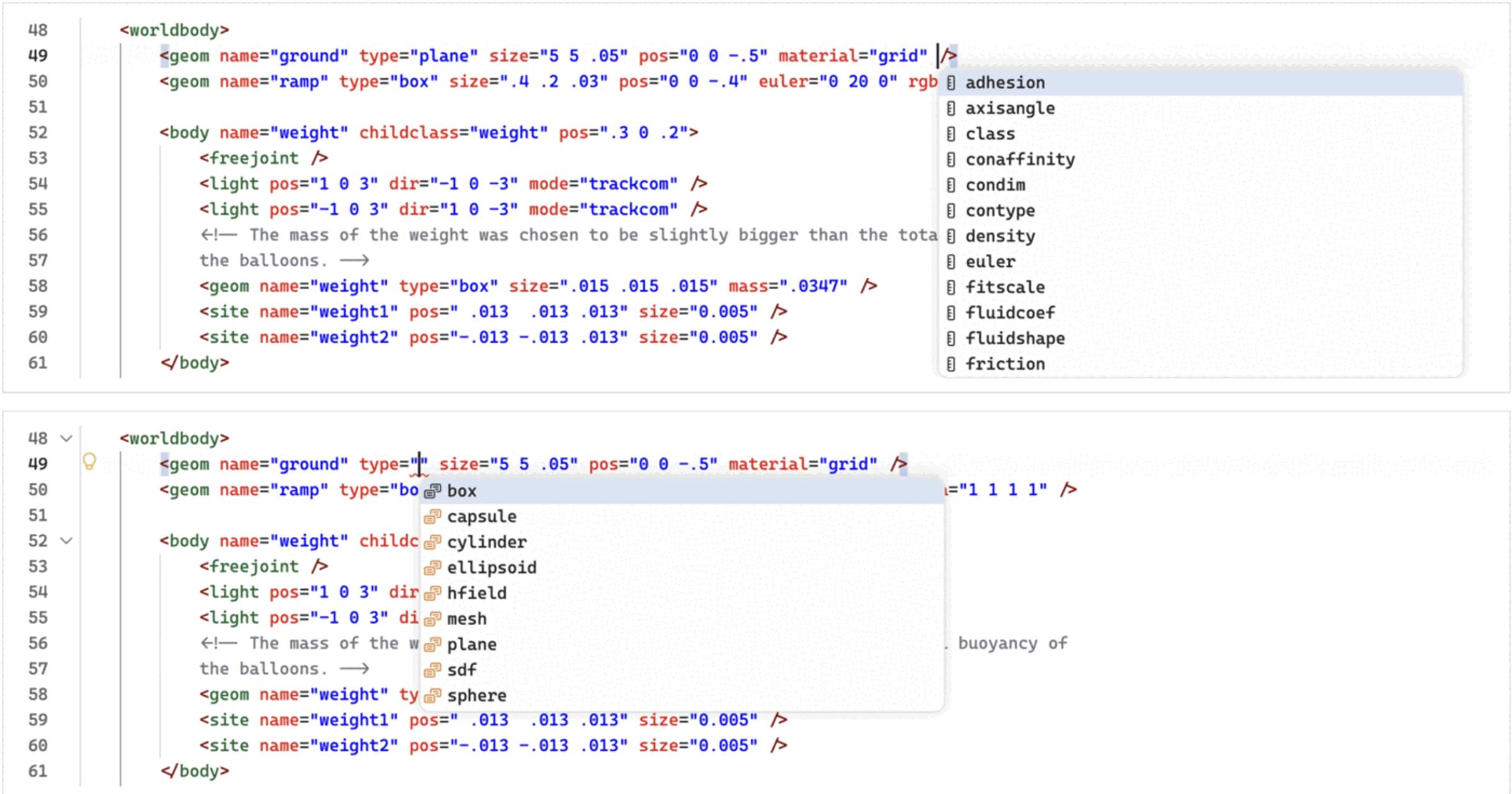
MuJoCo uses an XML-based model format (MJCF) compiled by the built-in compiler into runtime data structures. Converters exist for OpenSim biomechanics models (MyoConverter), SDFormat/Gazebo models (gz-mujoco), OBJ meshes (obj2mjcf), and Onshape CAD assemblies, making it possible to import models from several existing simulation ecosystems.
Features
- High-performance simulation runtime
- Python bindings with bundled library
- Desktop and browser-based visualization
- Multi-language and platform bindings
- MJCF model format with ecosystem converters
How to install
MuJoCo's Python bindings install from PyPI and require Python 3.11 or later.
pip install mujocoRecommended for this setup
Strengths
- Apache-2.0: free for any academic or commercial use: MuJoCo is Apache-2.0 licensed, which means you can use it commercially, fork it, modify it, and redistribute it without paying licensing fees. Unlike MATLAB's Robotics Toolbox, there is no per-seat cost or institutional license negotiation. Research groups, startups, and commercial teams can include it in their pipeline without a procurement step.
- Active monthly releases by Google DeepMind: The repository is maintained by Google DeepMind with a target cadence of one release per month. With 16,933 GitHub stars and 1,992 forks, MuJoCo has broad adoption across academic and industrial ML and robotics groups. The team documents upcoming features in a public changelog on the `latest` branch before each release.
- Throughput-optimized for training-loop workloads: The simulation runtime avoids dynamic memory allocation during stepping and operates on preallocated low-level structures. This design keeps simulation tight enough for reinforcement learning training loops that require thousands of rollouts per episode. The multithreaded `rollout` module exposes parallel simulation for further throughput gains on multi-core machines.
- Wide integration surface across languages and platforms: MuJoCo's C API, Python bindings, C#/Unity plugin, and WebAssembly build give it a wider integration surface than simulators locked to one language or platform. Third-party bindings in Julia, Rust, Swift, Java, and MATLAB extend that reach further. The dm_control environment stack from Google DeepMind layers a gym-style API on top of the Python bindings.
Trade-offs
- Physics engine only, not a full robotics framework: MuJoCo provides physics simulation but no built-in ROS integration, sensor simulation, or deployment pipeline. Research groups building full robot simulation environments typically layer additional tools on top of it or use it through a gym-compatible wrapper like dm_control. Teams wanting an integrated environment with perception, navigation, and actuation in one package will need to build that layer themselves.
- GPU acceleration requires the separate MJX API: MuJoCo's default simulation runs on the CPU. GPU acceleration is available through MJX (MuJoCo XLA), a JAX-based branch that compiles the physics step for hardware accelerators, but MJX is a separate API surface and not a drop-in replacement for the core C runtime. Teams expecting GPU-native simulation out of the box will need to evaluate MJX separately and accept the JAX dependency.
- Browser viewer runs slower than native: The WebAssembly viewer at live.mujoco.org runs in the browser and is noted in the README as slower than native C. It covers model inspection and simple interaction, but is not suitable for performance-sensitive simulation workflows. Rendering large or complex models in the browser may be noticeably slower than running the native MuJoCo Studio desktop application.
Tech stack
FAQ
Yes. MuJoCo is Apache-2.0 licensed, covering both academic and commercial use at no cost. The Python package installs from PyPI and the full source code is on GitHub under google-deepmind/mujoco. There are no per-seat fees, usage caps, or institutional license requirements.
MuJoCo's Python bindings require Python 3.11 or later. The package is available from PyPI (`pip install mujoco`) and comes pre-packaged with a compiled copy of the library, so no separate C build is needed. Pre-built Linux wheels target the manylinux2014 standard; the documentation lists compatible distributions.
Yes. MuJoCo ships JavaScript bindings and a WebAssembly build that runs the full physics engine in the browser. Visit mujoco.org to interact with the MuJoCo 4.0 showcase, or live.mujoco.org to load your own MJCF models and drag-and-drop them interactively. The README notes the browser version runs slower than native C, so it is best suited for model inspection and demos rather than training workloads.
MJX is a JAX-based reimplementation of MuJoCo's physics step that runs on GPUs and TPUs. It follows the same MJCF model format as the core engine but requires JAX as a dependency and is a separate API surface from the core C runtime. MJX targets training workflows that need GPU acceleration for massive parallelism; a tutorial notebook is available on Google Colab.
MuJoCo ships first-party bindings for C (the native API), Python (PyPI), JavaScript/WebAssembly (browser), and C#/Unity (a plugin). Third-party bindings cover MATLAB/Simulink (Simulink Blockset), Swift, Java, Julia, and Rust. The dm_control environment stack from Google DeepMind builds on the Python bindings and adds a gym-style RL environment API on top.