
LibreTranslate
Self-hosted, offline-capable machine translation API.
Replaces Deepl Pro, Google Cloud Translation, Microsoft Azure Ai Translator, Amazon Translate, Modernmt
Who it's for
Teams handling medical, legal, or financial documents who need translation functionality without routing text through third-party APIs. LibreTranslate provides a local endpoint that keeps all content on the application's own infrastructure, meeting data residency requirements that cloud APIs cannot satisfy.
Your app handles general-purpose consumer content and accuracy is the primary concern. Commercial APIs like DeepL or Google Translate produce measurably better output for most language pairs; the data-sovereignty benefit only matters when it is a hard requirement.
Organizations that translate large document volumes regularly and want to avoid per-character fees accumulating at scale. A self-hosted instance converts the variable API cost into a fixed server cost, which becomes favorable above a threshold that depends on your server costs.
Your translation volumes are low and translation quality directly affects user experience. At low volume, the cost savings do not justify the operational overhead, and a managed API delivers better accuracy.
Developers building applications for environments with no or limited internet access, such as local government systems, enterprise intranets, or field tools. LibreTranslate runs fully offline once models are downloaded and starts with a single command.
Your deployment target has reliable internet access and the offline requirement is not a constraint. Offline capability adds setup overhead that managed APIs avoid.
The problem
Machine translation for production use means choosing between accuracy and control. Commercial APIs from Google, Microsoft, Amazon, and DeepL produce high-quality output, but every piece of text you translate leaves your infrastructure, is processed on third-party servers, and may be subject to logging and data retention policies you cannot control. For teams handling medical records, legal documents, internal communications, or any sensitive data, this is a hard constraint. The per-character billing model creates a second problem. A team translating large volumes regularly accumulates API costs with no ceiling unless they negotiate enterprise contracts. Developers who need a translation endpoint for a small app or a one-off data pipeline cannot easily run on managed APIs for free beyond minimal trial tiers.
How it works
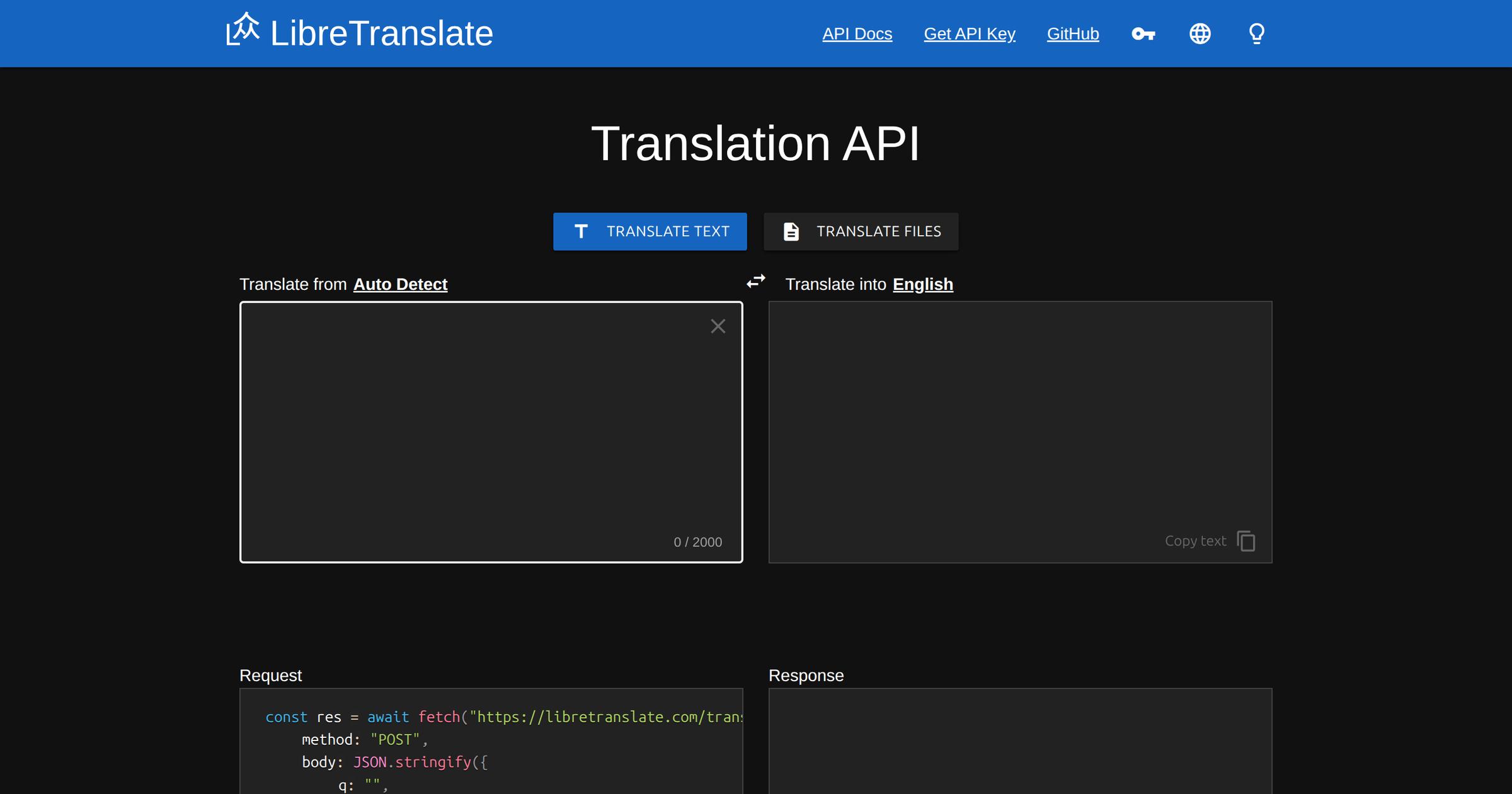
LibreTranslate exposes a standard HTTP REST API for translating both plain text and files across supported language pairs. Requests follow a simple JSON structure compatible with most HTTP clients and can be called from any programming language. File translation is available through a separate endpoint.
Once language model packages are downloaded for the required language pairs, the server translates without any internet connection. This makes it suitable for air-gapped environments, secure networks, and deployments where outbound traffic must be restricted.
The translation models are sourced from Argos Translate, an open source machine translation library. This means the entire stack from API to model weights is open source, with no proprietary dependency at any layer. No vendor lock-in applies to the underlying models.
Language support is modular: install only the language pairs you need rather than loading a monolithic model. Models are downloaded as packages and loaded on demand, keeping server memory usage proportional to the language pairs you actually use.
Running on your own server means no per-character billing, no rate limits from an upstream provider, and no account required. Translation throughput is bounded only by your hardware, making high-volume batch translation economical once the server is running.
Features
- REST API for text and file translation
- Offline-capable operation
- Argos Translate open source engine
- Per-language-pair model installs
- No usage caps or rate limits from upstream
How to install
Install LibreTranslate via pip on your own server.
pip install libretranslateRecommended for this setup
Strengths
- No data leaves your infrastructure: Every translation request stays on your server. Unlike DeepL Pro, Google Cloud Translation, or Amazon Translate, there is no network call to a third-party endpoint. For regulated industries or teams with data residency requirements, this removes a compliance blocker that cloud APIs cannot address.
- 17,000+ stars with active development: The project has over 17,000 GitHub stars and 1,795 forks, with a last push to the repository in October 2026. Active maintenance means bug fixes and language model updates continue; the project is not stagnant or abandoned.
- Zero per-request cost once deployed: Commercial translation APIs charge per character, with costs accumulating quickly at high volumes. LibreTranslate has no per-request cost once deployed: total cost is the server you already operate, making it favorable for high-volume or ongoing translation workloads.
Trade-offs
- Translation quality below commercial leaders: Argos Translate models produce lower accuracy than Google Translate, DeepL, or Microsoft Azure Translator for most language pairs, particularly for less common languages. Teams that need production-grade translation quality for customer-facing content or regulated document workflows will find the gap meaningful.
- 132 open issues: The project carries 132 open GitHub issues. For a critical production API deployment, reviewing the issue tracker before choosing LibreTranslate for specific language pairs or accuracy requirements is advisable, particularly for less common languages that may have fewer available models.
- AGPL-3.0 restricts building a managed service on top: AGPL-3.0 requires that if you run a modified version of LibreTranslate as a service accessible to others over a network, you must publish the source of your modifications. Teams running it internally for their own use are not affected, but those building a managed translation product on top of it need to review this obligation before deploying.
Tech stack
FAQ
Yes. LibreTranslate is AGPL-3.0 licensed and free to run on your own server. There are no API keys, usage limits, or fees when self-hosted. A public demo instance at libretranslate.com is also available, with rate limits applied to prevent abuse. The pip package and source code are available on GitHub.
Commercial APIs like DeepL and Google Translate produce higher accuracy output for most language pairs, particularly for nuanced or less common languages. LibreTranslate's Argos Translate models are competitive for common language pairs but the gap is noticeable for specialized or technical content. The tradeoff is data sovereignty and zero per-request cost versus best-in-class accuracy from managed cloud services.
Yes. Once language model packages are downloaded for the required language pairs, the server translates without any internet connection. This is one of the core advantages over cloud-only commercial APIs and makes LibreTranslate suitable for air-gapped environments or deployments where outbound traffic is restricted.
Internal use is unrestricted: you can run LibreTranslate on your own servers for your team or application without any licensing obligation toward others. The AGPL clause activates only if you modify the source code and make that modified version available to others over a network; in that case you must publish your modifications under the same license.
LibreTranslate supports a range of language pairs through Argos Translate model packages, which are downloaded separately for each language pair. The specific list depends on available Argos Translate models. Check the documentation at docs.libretranslate.com for the current supported language matrix, as the list grows as new Argos Translate models are released.