
languagetool
Self-hosted grammar and style checker for 30+ languages
Replaces Grammarly, Prowritingaid
Who it's for
The HTTP API lets any application send text and receive structured grammar suggestions. Teams building content management systems, document editors, or writing tools can add language checking without depending on a cloud vendor or per-call pricing.
If you need a polished end-user UI with real-time inline suggestions and do not want to maintain a server, the managed API at languagetool.org or a commercial grammar API will be simpler to operate.
Legal, healthcare, and government teams that cannot send documents to external services can run LanguageTool entirely on their own infrastructure. The LGPL-2.1 license permits internal commercial use with no usage fees beyond server costs.
If your team has no data-privacy constraints and prefers a zero-maintenance grammar tool, the free plan on languagetool.org or a cloud-hosted alternative removes all server overhead.
Writers working in German, French, Spanish, Portuguese, Dutch, or Polish get grammar and style checking from one tool. A single LanguageTool server or account covers all supported languages, replacing the need for separate per-language tools.
If your writing is exclusively in English and you need deep AI-powered style analysis, Grammarly Premium or ProWritingAid offer more fine-grained English-specific suggestions in their paid tiers.
LanguageTool has a native LibreOffice extension that brings grammar and style suggestions directly into LibreOffice Writer. It suits users who have moved to an open source office suite and want their grammar checker to match.
If your team works in Microsoft Word or Google Docs, the browser add-on and the Word add-in handle those workflows; no LibreOffice-specific setup is needed.
The problem
Commercial grammar checkers like Grammarly and ProWritingAid send every sentence you write to their cloud servers. For legal teams, healthcare organizations, and companies operating under GDPR or similar regulations, this is a non-starter: confidential documents cannot leave your network just to get a comma corrected. The paid tools also price by subscription, so organizations checking large volumes of text face recurring costs that scale with headcount. Beyond privacy and cost, most proprietary spelling and grammar tools optimize primarily for English. Teams writing in German, French, Portuguese, Spanish, or Dutch often find limited multilingual support, or need separate tools for each language. A single self-hosted grammar server that handles all of them would eliminate both problems at once.
How it works
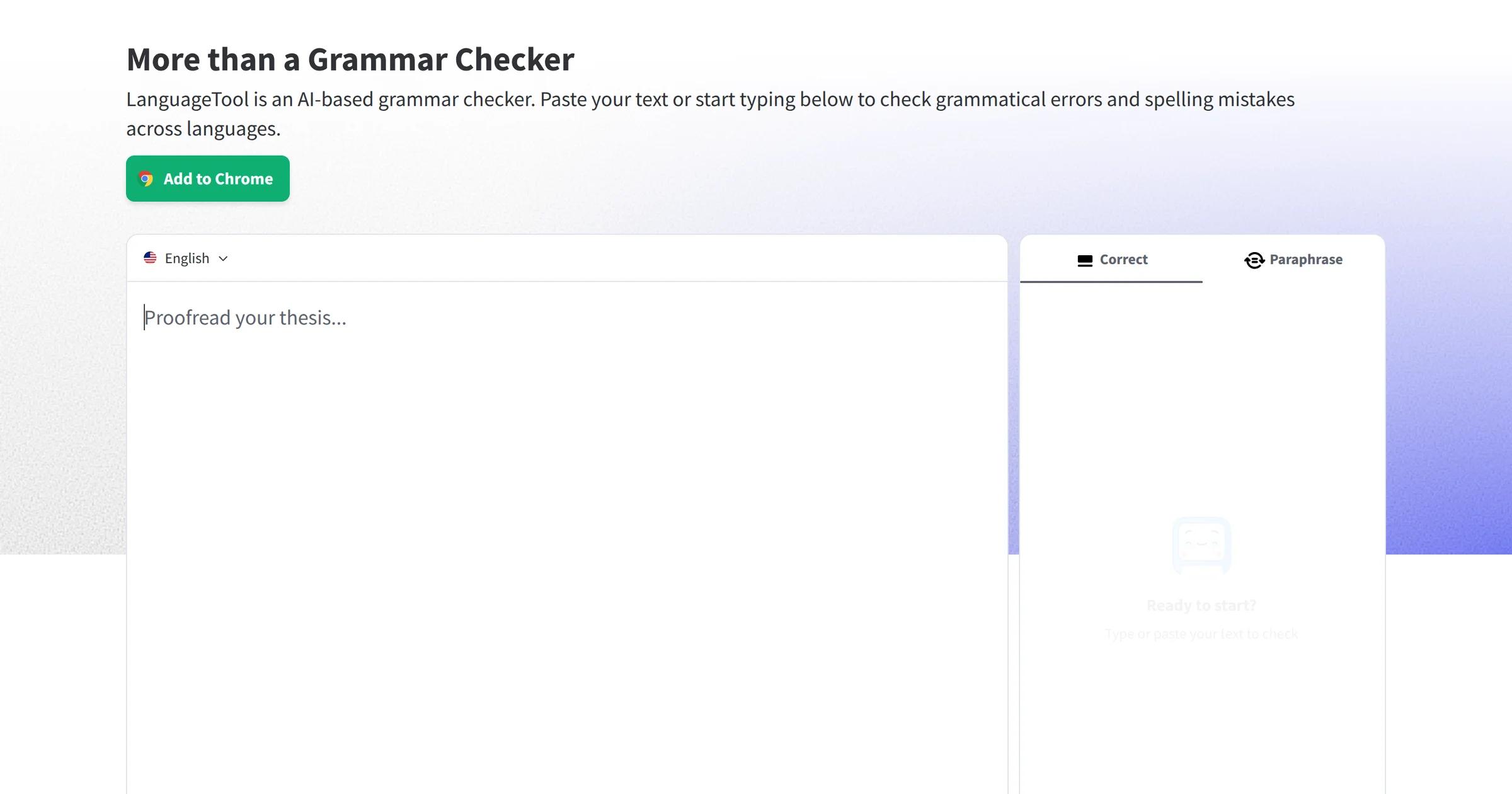
Checks grammar, spelling, punctuation, and style across more than 30 languages and dialects, including six varieties of English: US, UK, Canadian, Australian, New Zealand, and South African. The rule-based NLP engine catches errors that basic spell checkers miss, such as wrong subject-verb agreement, incorrect plural forms, and overused phrases.
Rephrases selected sentences using AI to make them more formal, fluent, simple, or concise. Available in the web editor and via the API, the paraphraser targets word choice and sentence structure rather than just spelling, helping writers improve stylistic clarity without manual rewriting.
Add-ons for all major browsers detect language automatically and provide inline suggestions as you type. Text is not stored by the browser extension itself. The Chrome extension has more than 3 million users and over 10,000 reviews; the Firefox version has more than 1 million users.
Native integrations bring in-document grammar checking directly into writing apps without copying text to a separate tool. The Microsoft Word add-in works on Windows, Mac, and the online version, requiring Word 2016 or later. The Google Docs integration uses the browser add-on. A dedicated LibreOffice extension is available for desktop users.
Runs as an HTTP server exposing a documented REST API. Any application can send text for checking and receive structured grammar suggestions in return. Community-maintained Docker images are available on Docker Hub, and an official shell-script installer is provided in the repository. Useful for teams embedding grammar checking into custom workflows or content management systems.
Features
- Multilingual grammar and style checking
- AI-powered paraphraser
- Browser extensions for Chrome, Firefox, Edge, and Safari
- Integrations for LibreOffice, Google Docs, and Microsoft Word
- Self-hosted HTTP API for custom integrations
How to install
Install LanguageTool using the official shell script; the standalone server requires Java 17.
curl -L https://raw.githubusercontent.com/languagetool-org/languagetool/master/install.sh | sudo bashRecommended for this setup
Strengths
- Only major grammar checker with a self-hosted path: Grammarly and ProWritingAid are cloud-only with no self-hosted option. LanguageTool is the primary open source alternative with a documented server deployment path, letting organizations run grammar checking entirely on their own infrastructure and keep checked text off third-party servers.
- 30+ languages from a single installation: Most proprietary grammar checkers focus primarily on English. LanguageTool covers German, French, Spanish, Portuguese, Dutch, Polish, and more than 20 other languages and dialects from one server installation. For multilingual organizations, this eliminates the need for separate per-language tools or subscriptions.
- Actively maintained since 2013 with recent development: The project has been in continuous development since 2013 and received commits as recently as September 2026. With nearly 15,000 GitHub stars and more than 1,500 forks, the codebase has a strong contributor base. Community language rules are the primary contribution channel, expanding coverage for individual languages over time.
- LGPL-2.1 license: embed in your own applications: The LGPL-2.1 license lets you use LanguageTool in your own software, including commercial applications, without releasing your application's source code. You only need to comply with LGPL terms for modifications to LanguageTool itself. This makes it practical for embedding grammar checking into proprietary products or internal tools.
Trade-offs
- Java runtime and large disk footprint for self-hosters: The server is Java-based and a full clone of the repository requires more than 500 MiB to download and over 1,500 MiB on disk. Running the standalone server requires Java 17 and enough RAM to load language models. Community Docker images simplify deployment but are maintained externally and may lag behind official releases.
- Advanced style features require a Premium subscription: The self-hosted open source build covers grammar and basic style checking. Advanced punctuation, style, and typography suggestions (marketed as Picky Mode) and the full AI suggestion set are part of a paid Premium subscription on languagetool.org. Self-hosters running the open source core do not automatically unlock these features.
- More than 2,100 open GitHub issues: The repository carries more than 2,100 open issues, reflecting both the scale of the project and the breadth of language rules still being developed. Coverage for niche grammar rules or less-common languages may be incomplete, and turnaround on specific bug fixes can be slow given the volunteer-driven contribution model.
Tech stack
FAQ
Yes. The LanguageTool core is LGPL-2.1 licensed and free to run on your own server. Community-maintained Docker images are available on Docker Hub (meyay/languagetool and erikvl87/languagetool). You will need a server with Java 17 and enough RAM to load the language models. The self-hosted build covers grammar and spell checking; some advanced style features require a Premium account on languagetool.org.
More than 30 languages and dialects, with the strongest coverage for English, German, Spanish, French, Dutch, and Portuguese. English support includes six regional varieties: US, UK, Canadian, Australian, New Zealand, and South African English. Coverage depth varies by language; English and German tend to have the most grammar rules.
The browser extension does not store text. When using the public API at languagetool.org, text is processed on their servers; see their privacy policy for retention details. Self-hosters who run their own server control all data handling, and no checked text leaves their infrastructure.
Grammarly is cloud-only with no self-hosted option, and it prices by subscription. LanguageTool is open source, self-hostable, and free to run on your own server, making it the primary alternative for privacy-sensitive or cost-conscious teams. Grammarly's English-language style suggestions are more polished in its free tier; LanguageTool's main advantages are multilingual support and the self-hosting path.
LanguageTool exposes a REST API that accepts plain text and returns grammar and style suggestions in JSON. The public endpoint is documented at languagetool.org/http-api. You can also run the API server locally or via Docker for private use. It is the standard integration path for embedding grammar checking into custom applications or content pipelines.