
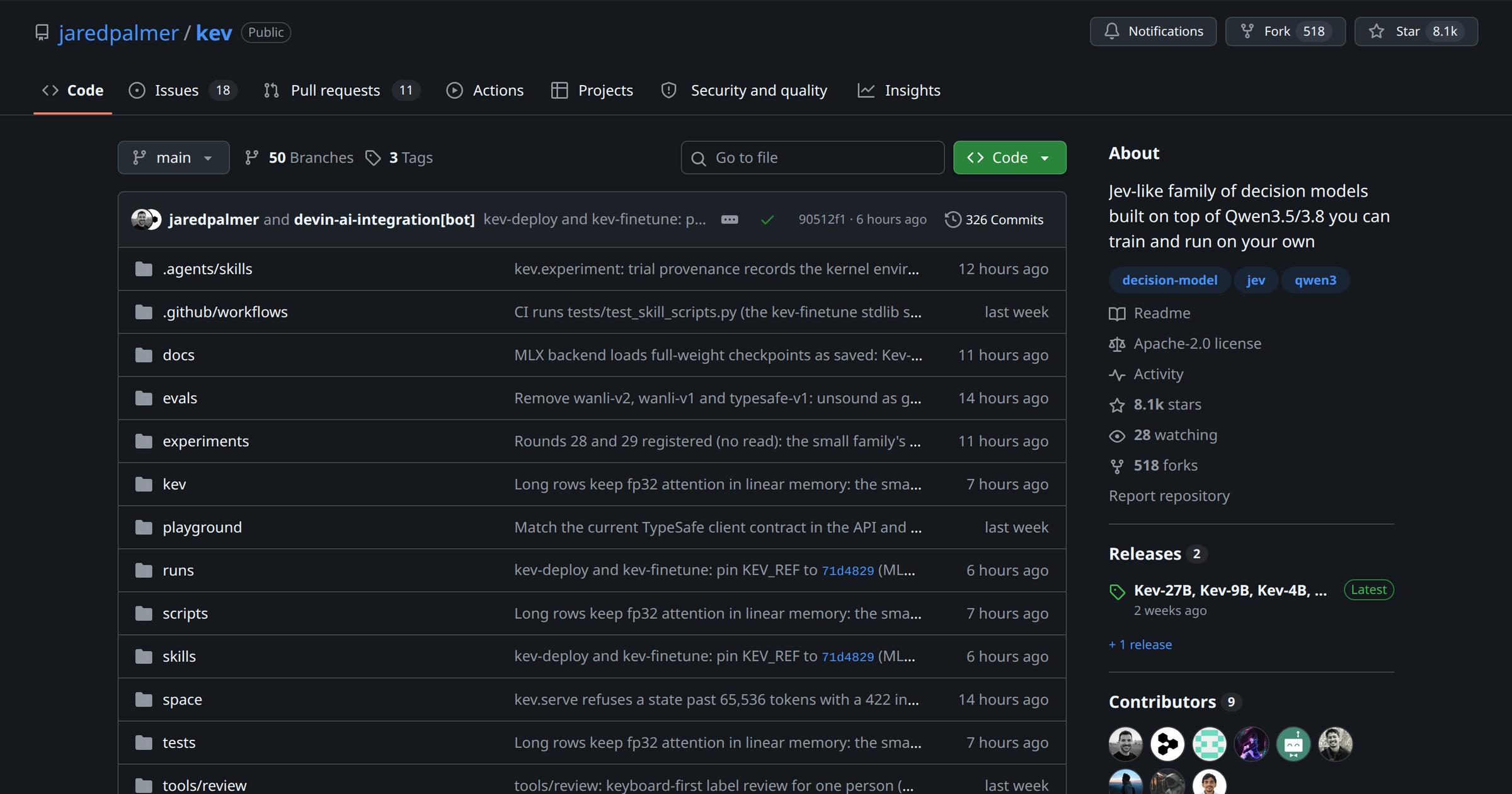
Kev
Train and run Jev-like decision models on your own infrastructure
Replaces Jev
Who it's for
Kev handles department routing, urgency scoring, and escalation flagging in a single API call. Teams currently paying Jev's per-request fee for every incoming ticket can move classification to their own GPU or a Modal endpoint without changing the TypeSafe Python SDK calls in their code.
Your support volume is low enough that Jev's per-request cost is not a concern and you have no data-residency requirements. A hosted API with no infrastructure overhead is simpler at small scale.
Kev's API is a drop-in for TypeSafe's System One endpoint. Replacing Jev is a URL change in the client config. On most classification benchmarks, Kev-27B is within one point of Jev's accuracy, so migration risk is low for routing and entailment tasks.
Your pipeline relies on Jev's performance on hard knowledge questions. Kev-27B trails significantly on MMLU-Pro (0.675 vs 0.840), so knowledge-intensive classification should be tested before migrating.
Kev accepts labeled examples in the same format as the API request, with a label field added to each question. Fine-tuning from a released checkpoint with --init_from takes one or two epochs and costs about $1 on an H100 via Modal. The benchmark script reports accuracy per question type so you know which questions improved.
Your dataset has fewer than a few hundred labeled examples. On a 400-record dataset, accuracy gains were within measurement noise. You need at least around 1,000 examples to see reliable gains.
The problem
Structured classification tasks like ticket routing, escalation flagging, and sentiment scoring are cheap to run when you own the model but expensive when you pay per-request to a hosted API. Teams using Jev send every customer interaction to TypeSafe's servers, which creates data residency concerns for regulated industries and adds per-request costs that compound at scale. The harder part is that hosted-only models cannot be adapted to domain-specific routing rules, your own escalation criteria, or languages not in the training data. When the pretrained model does not fit your categories well, your only option with a hosted API is better prompting; with a model you own, you can fine-tune on labeled examples from your own data and measure the improvement on a held-out set.
How it works
Kev handles yes/no (noul), multiple-choice (choice), and rating (score) questions in a single API call. A ticket can be routed to a department, flagged for escalation, and scored for urgency in one round trip; questions share the input text but cannot read each other's answers.
Each checkpoint ships with a temperature fitted on held-out data, so Kev returns calibrated confidence values. At a 5% error budget on new-source data, Kev-4B, 9B, and 27B automate 0.52 to 0.69 of decisions; that threshold holds because the probabilities are measured on real data, not estimated.
Kev's HTTP server exposes the same /v1/systemone endpoint as TypeSafe's System One API. Any code calling Jev through the TypeSafe Python SDK works against a local Kev server with a single base URL change. No wrapper, no schema migration, no adapter layer needed.
Kev-0.8B runs on any Apple Silicon Mac or a 4 GB GPU; Kev-4B is the recommended starting point for a 32 GB Mac, L40S, or H100; Kev-9B trades a small accuracy gain for more GPU memory; Kev-27B needs an 80 GB H100 or better. Accuracy scales with size: Kev-27B reaches 0.851 on new-source classification while Kev-0.8B reaches 0.648.
A domain fine-tune updates the model to your specific routing categories, escalation rules, and language. On an example support workload, fine-tuning Kev-4B from 1,050 generated records moved accuracy from 67.7% to 73.6% and lifted automated decisions from 34% to 48% at a 5% error budget. A coding-agent skill runs the full loop on Modal for about $1.
A three-command script deploys Kev-4B to Modal and produces an HTTPS endpoint behind an API key. The container scales to zero when idle, so an unused endpoint costs nothing. The first request after idle waits about 35 seconds for a container to start.
Features
- Three question types in one request
- Calibrated probabilities by default
- Drop-in for the TypeSafe Python SDK
- Four model sizes for different hardware
- Fine-tuning on your own labels
- Modal deployment with scale-to-zero
How to install
Deploy a local Kev server with Python 3.12 or 3.13 and the uv package manager.
git clone https://github.com/jaredpalmer/kev.git && cd kev
uv sync --extra serve
uv run --extra serve python -m kev.serve --run jaredpalmer/kev-4b --port 8009
Recommended for this setup
Strengths
- Apache-2.0 with no commercial restrictions: Every Kev checkpoint is Apache-2.0 licensed, which allows commercial self-hosting, fine-tuning, and redistribution without restrictions. Unlike Jev, which is a hosted-only proprietary API, you can run Kev inside your own network and keep all customer data on your infrastructure.
- Accuracy within one point of Jev on routing tasks: Kev-27B scores 0.851 accuracy and 0.156 Brier score on new-source classification, compared to Jev's 0.857 accuracy and 0.211 Brier score. On eight of eleven benchmark categories Kev-27B matches or beats Jev. Kev-4B and 9B are within four points on classification tasks like routing and entailment.
- Fine-tunable on domain data: Released checkpoints accept short domain fine-tunes that improve accuracy on your specific task. On real consumer-finance complaints, one epoch on 5,219 labeled examples took Kev-4B from 0.804 to 0.904 accuracy on held-out data. Using --init_from preserves what the pretrained model knows while adding your domain on top.
- Runs on Apple Silicon for local development: Kev-0.8B and Kev-4B run on Apple Silicon Macs via MLX with no cloud dependency. Kev-4B answers five questions about a short text in 721 ms on an M5, dropping to 136 ms on cache hits. This makes local development and debugging practical without renting GPU time.
Trade-offs
- Kev-27B requires an 80 GB GPU: Kev-27B ships as 51 GB of full weights and needs an 80 GB H100, H200, or B200 to run (or a 96-128 GB Mac, which was not tested at release). Unlike the 0.8B, 4B, and 9B models, it is not available as an adapter; the full checkpoint is Hub-only and too large for a GitHub release.
- Accuracy degrades on long documents for smaller models: Kev-0.8B, 4B, and 9B were trained mostly on inputs up to 384 tokens. They accept up to 65,536 tokens, but accuracy degrades on long documents. Kev-27B handles up to 32,768 training tokens and scores 0.874 on CUAD contracts, but its calibration becomes less reliable at longer lengths; the smaller models have no published long-document results.
- Modal cold start of about 35 seconds: When a Modal-hosted Kev endpoint has been idle, the first request waits around 35 seconds for a container to start. This is acceptable for batch classification jobs or low-traffic workflows, but it rules out synchronous user-facing flows that need sub-second latency.
- Knowledge-question accuracy trails Jev on harder benchmarks: On MMLU-Pro, Kev-27B scores 0.675 against Jev's 0.840, a gap of 16.5 points. The gap is smaller on standard MMLU (0.90 for both) and on classification-shaped tasks. Teams whose workloads depend on general world knowledge or day-precision date arithmetic should test Kev on their own data before committing to a migration.
Tech stack
FAQ
On new-source classification benchmarks, Kev-27B reaches 0.851 accuracy versus Jev's 0.857, a gap of less than one point. Kev-4B and 9B are within four points on routing, entailment, and science questions. The main accuracy gap is on hard knowledge benchmarks like MMLU-Pro, where Kev-27B scores 0.675 against Jev's 0.840. For support routing and structured classification, the gap is small enough that most teams will not notice it in production.
Kev-0.8B runs on any Apple Silicon Mac or a 4 GB GPU. Kev-4B needs a 32 GB Mac, an L40S, or an H100. Kev-9B fits the same GPUs as 4B. Kev-27B requires an 80 GB H100, H200, or B200, or a 96-128 GB Mac (untested at release). If you have no GPU, you can deploy to Modal with one script and pay only for actual inference time.
Yes. Kev accepts labeled examples in the same JSON format as the API, with a label field on each question. A coding-agent skill (npx skills add jaredpalmer/kev@kev-finetune) runs the full loop from labeling to deployment on Modal for about $1. On a real consumer-finance dataset, one epoch of fine-tuning on 5,219 examples took Kev-4B accuracy from 0.804 to 0.904 on held-out data. Gains below roughly 1,000 labeled records are often inside measurement noise.
Yes. Kev's server exposes the same /v1/systemone endpoint as TypeSafe's System One API. Point your TypeSafeClient at http://127.0.0.1:8009 (or your Modal endpoint URL) and keep the rest of your code unchanged. The TypeSafe SDK is included when you run uv sync --extra serve.
Yes. A Hugging Face Space at huggingface.co/spaces/jaredpalmer/kev runs Kev-4B and Kev-0.8B with nothing to install. For local use, Kev-0.8B runs on any Apple Silicon Mac with three commands from the README.