
heretic
Decensor local LLMs automatically with directional ablation
Replaces —
Who it's for
Heretic's interpretability extras let you visualize residual vectors, compute cosine similarities across layers, and generate layer-by-layer animations of how harmful vs. harmless prompts differ in representation. This supports empirical work on where and how safety alignment is encoded in transformers without requiring custom tooling.
Skip if your research focuses on building or improving alignment rather than analyzing it, or if you need a tool with formal academic support and published peer review rather than a community project.
If your application requires a locally hosted LLM that responds to any prompt without content refusals, Heretic automates the process of producing that model from a Hugging Face checkpoint. The entire workflow is a pip install and one command; no knowledge of transformer architecture is needed.
Skip if your deployment targets a cloud API (commercial providers will not run user-modified model weights), or if your use case is already served by an existing heretic-tagged model on Hugging Face.
Heretic's Hugging Face integration and interactive chat session after each run make it practical for comparing how different base models respond once safety filters are removed. The built-in benchmark runner (MMLU, GSM8K) provides a consistent quality signal across abliteration runs on different model families.
Skip if you prefer pre-built model images rather than running a 20-to-30-minute abliteration job locally. The Hugging Face model hub already has over 5,000 heretic-tagged models ready to download.
Security and red-teaming engineers can use Heretic to produce controlled uncensored variants of frontier open models, providing a baseline comparison point for evaluating how effectively safety alignment prevents undesired outputs before and after abliteration.
Skip if your organization prohibits running uncensored models internally, or if you need commercial support and liability coverage for the tooling used in security evaluations.
The problem
Running a local language model with no content restrictions has historically required deep expertise in transformer internals. Manual abliteration involves identifying residual directions across layers, selecting ablation weight kernels, and tuning parameters by hand: work accessible only to ML researchers with specialized background. At the same time, commercial API services enforce content policies that block entire categories of queries outright. Teams that need unrestricted outputs from a locally hosted model had no automated path: they either engaged expert ML contractors or accepted the restrictions of closed platforms with per-token pricing and no self-hosting option.
How it works
Heretic uses a TPE-based optimizer (Optuna) to find ablation parameters without manual tuning. It co-minimizes refusal rate and KL divergence from the original model simultaneously, so the decensored output retains as much original intelligence as possible. On a gemma-3-12b-it benchmark, Heretic reached the same refusal suppression as expert-made abliterations at a KL divergence of 0.16, compared to 0.45 and 1.04 for two competing manually tuned alternatives.
Unlike fixed-weight abliteration approaches, Heretic applies a shape-optimizable weight kernel over transformer layers, with separate ablation parameters for attention out-projection and MLP down-projection. The residual direction index is a float rather than an integer, enabling interpolated directions that extend beyond what difference-of-means computation alone identifies, unlocking a larger optimization space.
Supports most dense transformer models, many multimodal models, several MoE architectures, and hybrid models like Qwen3.5. Load a model from Hugging Face by name and Heretic handles the rest. Pure state-space models and certain research architectures are not yet supported out of the box.
Set the quantization option to bnb_4bit to run Heretic on models that would otherwise exceed available VRAM. Quantization is applied during the decensoring process itself, making it practical to abliterate large models on consumer-grade GPUs without needing a separate quantization step.
After decensoring, Heretic offers to save the model locally, upload it directly to Hugging Face, launch an interactive chat session to evaluate quality, or run standard benchmarks (MMLU, GSM8K). All options are available in any combination from a single menu prompt at the end of each run.
The optional research extra adds tools for studying model internals: PaCMAP-based visualizations of residual vectors across transformer layers, animated GIFs showing how residuals evolve layer by layer, and a quantitative table of residual geometry metrics including cosine similarity, L2 norms, and silhouette coefficients per layer.
Features
- Automatic ablation parameter optimization
- Flexible ablation weight kernel with float direction index
- Broad model architecture support
- Built-in quantization via bitsandbytes
- Post-run evaluation, benchmarking, and upload
- Research interpretability extras
How to install
Install Heretic via pip into a Python 3.10+ environment with PyTorch 2.2+ configured for your hardware.
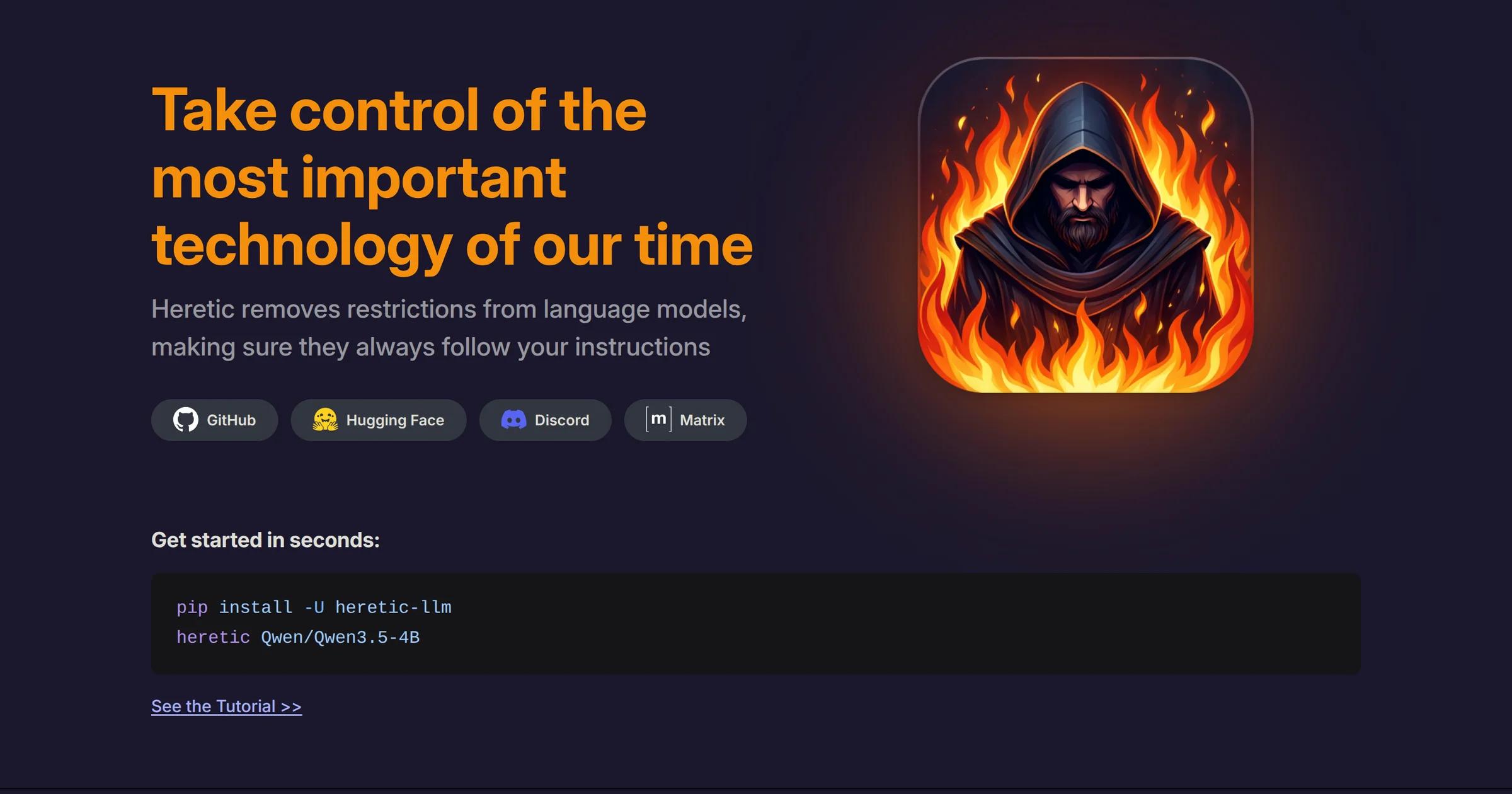
pip install -U heretic-llm
heretic Qwen/Qwen3-4B-Instruct-2507
Recommended for this setup
Strengths
- Fully automatic: no ML expertise required: Anyone who can run a command-line program can use Heretic. The optimization loop finds high-quality ablation parameters without human guidance. This is the core differentiator from prior art tools like abliterator.py and AutoAbliteration, which require manual parameter selection and iterative evaluation by someone who understands transformer internals.
- Lower capability damage than manual abliterations: Benchmarks on gemma-3-12b-it showed Heretic's automatically generated abliteration achieved 3/100 refusals (matching expert hand-tuned results) at a KL divergence of 0.16, compared to 0.45 and 1.04 for two competing manually produced abliterations. Lower KL divergence means less damage to the model's reasoning and generation quality.
- Over 5,000 community-published models on Hugging Face: The Heretic community has published more than 5,000 models to Hugging Face tagged with the heretic topic. This provides an immediately accessible library of pre-abliterated models for common architectures, so users who cannot run Heretic locally can still access its output without running the tool themselves.
- Written from scratch with a research orientation: Heretic does not reuse code from any prior abliteration project. Its research extras provide quantitative metrics (residual geometry tables, PaCMAP projections) that support interpretability work, making it useful beyond censorship removal for researchers studying how safety alignment is encoded in transformer layers.
Trade-offs
- Requires consumer GPU hardware with significant VRAM: Abliterating a 4B model on an RTX 3090 takes 20 to 30 minutes. Larger models need substantially more VRAM. While bitsandbytes quantization reduces requirements, very large models are impractical on anything below a high-end GPU setup. CPU-only runs are not documented in the current README.
- AGPL-3.0 requires source disclosure for hosted services: AGPL-3.0 is a copyleft license. If you run a modified version of Heretic as a network service (for example, an API endpoint that accepts models and returns decensored versions), you must release your modifications under the same license. Teams wanting to build a proprietary service on top of Heretic need to evaluate this constraint carefully before integrating it.
- Pure state-space models and some architectures not yet supported: Heretic explicitly states that pure state-space models and certain other research architectures are not supported out of the box. If your target model falls into this category, you will need a different abliteration approach or wait for future Heretic support.
Tech stack
FAQ
Abliteration is a post-training intervention that modifies a model's weight matrices to suppress a specific direction in residual space, without any gradient updates or new training data. Fine-tuning requires labeled examples and a full training run; abliteration operates directly on the saved model weights in a single forward-pass analysis step. Heretic automates the abliteration process using parameter optimization, making it faster and less expertise-dependent than either manual abliteration or fine-tuning.
Heretic requires a CUDA-capable GPU with enough VRAM to hold the target model. On an RTX 3090 (24GB VRAM), a 4B-parameter model takes 20 to 30 minutes to process. Larger models require proportionally more VRAM, but bitsandbytes 4-bit quantization is supported and reduces requirements significantly. Some model configurations may require PyTorch 2.6+ for features like MXFP4 quantization. CPU-only execution is not documented in the current README.
Yes. The heretic CLI accepts any model path that the underlying transformers library can load, including local directories in the standard Hugging Face safetensors format. You do not need a Hugging Face account to abliterate a local model checkpoint; an account is only needed if you want to upload the result to the Hugging Face hub.
AGPL-3.0 is a copyleft license. Running Heretic locally for personal or internal research is unrestricted. If you modify Heretic and run it as a network service accessible to others (such as an API endpoint), you must release your modifications under AGPL-3.0 as well. The license applies to Heretic itself, not to the models you produce with it; the decensored model output is governed by the license of the base model you started from.
Heretic's main advantage is automatic parameter optimization via Optuna's TPE algorithm, which selects ablation weights without manual tuning. In benchmarks on gemma-3-12b-it, Heretic produced the same refusal suppression as manually tuned alternatives (3/100 refusals) at significantly lower KL divergence (0.16 vs 0.45 to 1.04), indicating less damage to the model's capabilities. Heretic was also written from scratch and does not share code with any prior abliteration project. The tradeoff is that Heretic's optimizer makes choices automatically, which may not suit researchers who need precise manual control over which layers and directions are modified.