
Ente
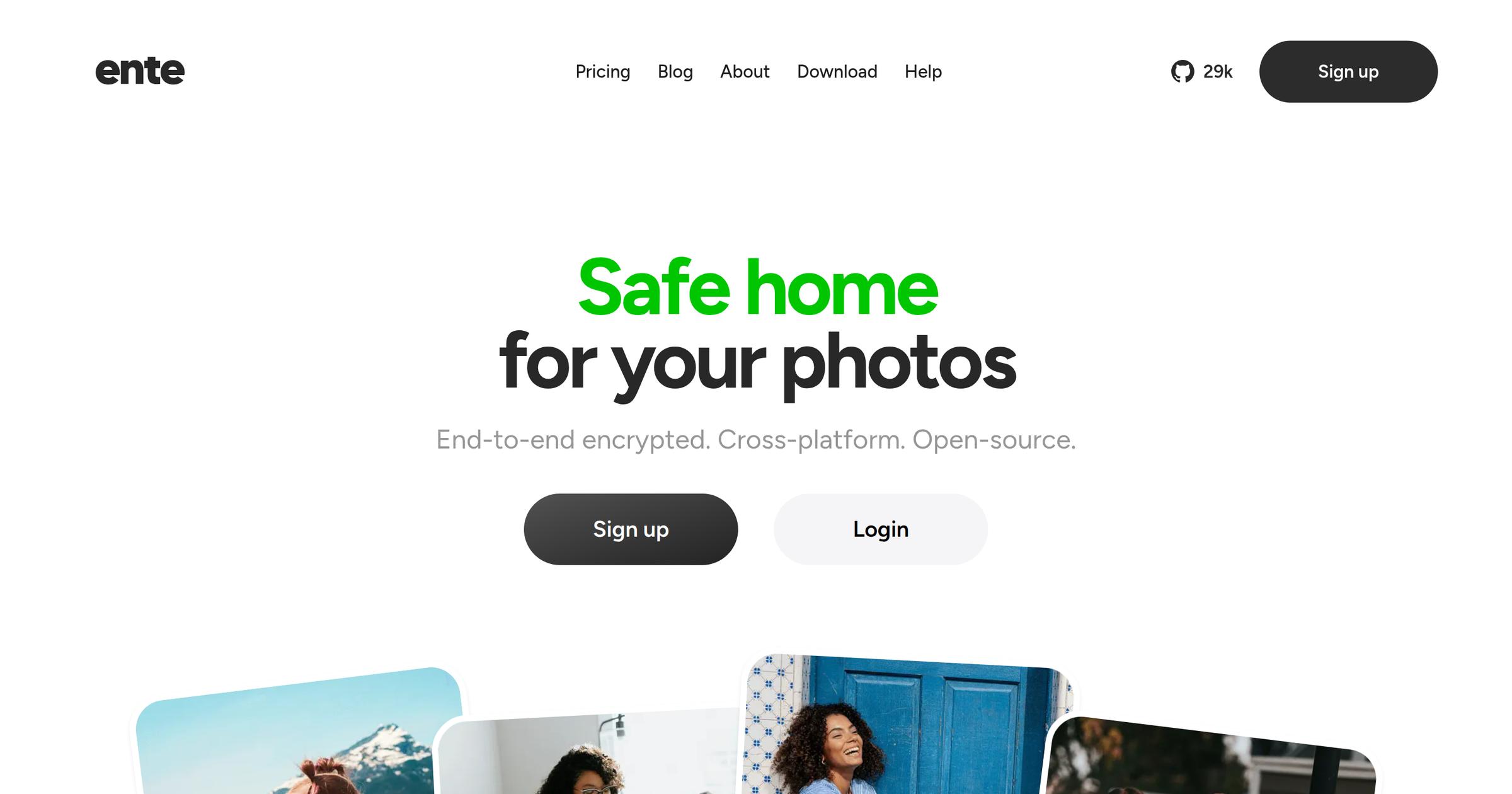
E2EE photo backup with face recognition, AI search, and family plans
Replaces Google Photos, Apple Icloud Photos, Amazon Photos
Who it's for
If you want to stop Google from scanning your personal photos for ad targeting, Ente replaces Google Photos with end-to-end encryption, on-device face recognition, and zero-knowledge AI search. The migration path includes an import tool for moving existing libraries.
You rely on Google Photos features that require server-side analysis, such as Google Lens integration or Google Assistant queries over your library. Those capabilities cannot be replicated with client-side encryption.
Family plans let multiple people share a subscription and collaborate in shared albums while keeping individual libraries private and encrypted. Because Ente runs on iOS, Android, and web, families with both iPhone and Android devices can all participate without switching platforms.
Your entire family uses Apple devices and already has iCloud Family Sharing with no cross-platform needs. iCloud is more tightly integrated in that specific scenario and requires no additional subscription.
The full server and client source code is in a public monorepo under AGPL-3.0. You can deploy your own Ente instance, modify the code, and audit every data flow through your storage infrastructure. This is the option for developers who want full control over their photo backup stack.
You need a fully managed service with no server maintenance responsibilities. Self-hosting Ente requires ongoing infrastructure work; the managed cloud tier removes that burden if owning the server is not a requirement.
Ente Photos and Ente Auth, the platform's 2FA app, share the same encryption model and account. If you want both your photo library and your authentication codes encrypted without trusting a commercial provider, Ente provides both under one account. Ente Auth is free with no storage cap.
You already have a separate 2FA setup you are satisfied with. Ente Auth and Ente Photos are independent products; you do not need to use both.
The problem
Cloud photo services from Google, Apple, and Amazon offer convenient storage but access your photo library in ways most users do not examine closely. Google Photos scans photos for content classification and ad targeting. Apple's iCloud Photos does not encrypt files end-to-end by default, which means Apple can respond to legal requests with your original photos. Amazon Photos is tied to a Prime subscription and is a fully proprietary service with no self-hosting option. For privacy-conscious users, the alternative has historically been self-hosted tools that require significant server work and offer poor mobile experiences, or encrypted storage that lacks features like face recognition and AI search. There has not been an encrypted photo service that matched the convenience of commercial tools while also providing a credible self-hosting path and third-party audited cryptography.
How it works
Every photo and video is encrypted on your device before it is sent to the server. The server stores only ciphertext, so neither Ente employees nor any third party can see your photos. The cryptography has been independently audited by Cure53, Symbolic Software, and Fallible, and the audit results are public.
Face detection and grouping runs entirely on your device, not on Ente's servers. Your biometric data stays local. You can label faces and browse photos by person without sending any facial data to the cloud, which is the key difference from Google Photos face grouping.
Natural-language search lets you find photos by describing scenes, people, or moments. The AI processing runs locally, so your search queries and photo contents are never transmitted to a server. You can search for 'beach trip' or 'birthday party' without exposing your library contents.
Each uploaded file is stored in three geographically separate locations. If one datacenter has an outage, your photos remain accessible from the other two copies. This replication is built into the service tier and does not require a separate add-on or higher plan.
Official clients exist for iOS, Android, F-Droid, web, Linux, macOS, and Windows. All platforms share the same encryption model, so you are not forced to use a specific operating system to access your library. The breadth of platform coverage is wider than Apple iCloud Photos or Amazon Photos.
A single Ente Photos subscription can be shared with family members at no added charge per person. Shared albums let family members collaborate and collect photos together, while each person's private library remains end-to-end encrypted and inaccessible to other family members.
Features
- End-to-End Encryption Before Upload
- On-Device Face Recognition
- Zero-Knowledge AI Search
- 3x Geographic Data Replication
- Cross-Platform Client Apps
- Family Plans with No Extra Per-Member Cost
How to install
Self-hosting Ente starts by cloning the monorepo, which contains both server and client app source code.
git clone https://github.com/ente/enteRecommended for this setup
Strengths
- Third-Party Audited Cryptography: The source code and cryptography have been audited by three independent firms: Cure53 (a German cybersecurity firm), Symbolic Software (French cryptography experts), and Fallible (an Indian penetration testing firm). Public audit results mean you can verify the security claims, not just accept the marketing.
- Fully Open Source Monorepo: The server, iOS app, Android app, and web client are all published in a single public repository under AGPL-3.0. You can read every line of code that handles your photos, fork it, or run the entire stack yourself. Google Photos and Apple iCloud Photos are both fully proprietary with no equivalent transparency.
- No Ads, No Training, No Data Selling: Ente does not run ads, does not train AI models on your photos, and does not sell usage data. The business model is subscription-based: you pay for storage and that is the entire product. Client-side encryption makes these claims enforceable: even if policies changed, the server cannot read your files.
- Cross-Platform Without Ecosystem Lock-In: Unlike Apple iCloud Photos, which requires Apple devices for the best experience, Ente provides a consistent experience on iOS, Android, web, Linux, macOS, and Windows. Switching from Apple to Android or vice versa does not affect access to your library or require migrating to a different service.
Trade-offs
- Self-Hosting Requires Server Configuration: The self-hosted path is not a one-click install. Cloning the monorepo and running the server requires configuring a backend, database, and object storage. The repository documentation covers the setup, but it is not suitable for users without server administration experience. Ente's managed cloud service avoids this entirely.
- No Automated Video Compression Previews: Ente Photos does not automatically generate compressed video previews for fast in-app playback. Full-resolution videos are stored and served, which means previewing long videos requires downloading the full file. A user review from 2026 named this as the most requested missing feature at that time.
- AGPL-3.0 Restricts Offering the Service Commercially: AGPL-3.0 means you can run Ente for yourself, your family, or your organization's internal use at no cost. You cannot take the code, modify it, and sell it as a hosted photo service to others without sharing your source changes. Offering Ente as a managed service for paying customers requires a commercial license arrangement.
Tech stack
FAQ
Ente Photos offers 10 GB of free storage with no time limit. Paid plans add more storage capacity. The self-hosted version is free to run on your own server under the AGPL-3.0 license, though you are responsible for your own hosting costs. Ente Auth, the platform's 2FA app, is fully free with no storage cap.
Files are encrypted on your device before upload using keys that never leave your device. The server receives only encrypted ciphertext and cannot decrypt your photos even with full server access. This client-side encryption model has been independently audited by Cure53, Symbolic Software, and Fallible, all of whom published their findings publicly.
Yes. The complete server and all client app source code is in a public GitHub repository under AGPL-3.0. You can clone the repository and run your own instance. The setup requires configuring a server, database, and object storage, so it is not a one-click install and assumes some server administration experience.
Google Photos processes your photos on Google's servers, enabling Google Lens and Assistant features but giving Google access to your unencrypted images for content classification and ad targeting. Ente encrypts every file on your device before upload, so the server stores only ciphertext. Neither Ente nor any third party can read your photos regardless of legal requests or policy changes.
Ente is licensed under AGPL-3.0. You can run it for personal use, family use, or internal organizational use at no cost, including self-hosting. The AGPL-3.0 copyleft restriction applies if you want to offer a modified version as a hosted service to paying customers: you would need to share your source changes or arrange a separate commercial license.