colibri
Run models bigger than your machine
Replaces —
Who it's for
The Brain and Atlas pages give real-time visibility into expert activation patterns across 13,260 characterized experts. The engine validates token-exact against a reference transformers implementation, so researchers can modify routing logic and measure the effect on output with precision. Community A/B contribution is built into the project model, with open hypothesis tables tracking what still needs controlled measurement.
You need stable APIs and reproducible benchmarks across versions. colibrì is evolving rapidly and several optimization behaviors are labeled as open hypotheses rather than settled policy.
colibrì serves an OpenAI-compatible API locally, so existing clients written against OpenAI endpoints redirect to localhost without code changes. Data never leaves the machine, there are no rate limits, and there is no per-token cost. The learning cache improves decode speed on repeated workload patterns over time.
Your application needs 50 or more tokens per second for interactive latency. Consumer hardware without near-full expert residency in VRAM cannot match cloud inference throughput.
Cloud API pricing for heavy research use can exceed equivalent hardware costs within months. colibrì's zero per-token model means the cost is electricity and a one-time hardware investment. Eight model families cover reasoning, vision, audio, and tool calling at parameter counts from 7B to 2.8T, all under the same Apache-2.0 license.
Your team runs short, infrequent queries. Cloud APIs are faster and cheaper for low-volume use where the hardware investment does not amortize over enough inference volume to pay off.
The problem
Large language models fail to run locally when they exceed available VRAM and RAM. Loading a 744B-parameter model at int4 requires more fast memory than most hardware has, so frontier-scale model access has meant paying per-token cloud API bills. For research workloads that iterate across configurations, those costs accumulate fast. Every query also leaves the local network, which rules out cloud APIs for proprietary code, medical records, and legal documents where data cannot touch an external server. Cloud APIs also treat the model as a black box, making it impossible to observe routing behavior, modify inference logic, or study how a query is processed internally. Local inference tools have historically required fitting the whole model in fast memory, which excludes every frontier MoE model for anyone without a rack of high-memory GPUs. Researchers and engineers who want to run a 744B or 2.8T model on hardware they already own have had no practical path until streaming-based placement changed what fitting a model means.
How it works
colibrì treats VRAM, RAM, and NVMe storage as a single placement hierarchy for the same model weights. Dense attention weights stay resident; the 19,456 routed experts stream from the fastest available tier on demand. A router lookahead thread prefetches the next layer's experts one layer ahead, where routing is 71.6% predictable, so most reads arrive before they are needed.
Every forward pass is validated against a reference transformers oracle using teacher-forcing, typically matching 30 to 32 out of 32 positions. The design rule is that placement decisions change speed only, never model output or router semantics. Speed optimizations that introduce output drift are rejected before shipping. Insufficient fast memory reduces decode speed; it never silently changes model precision.
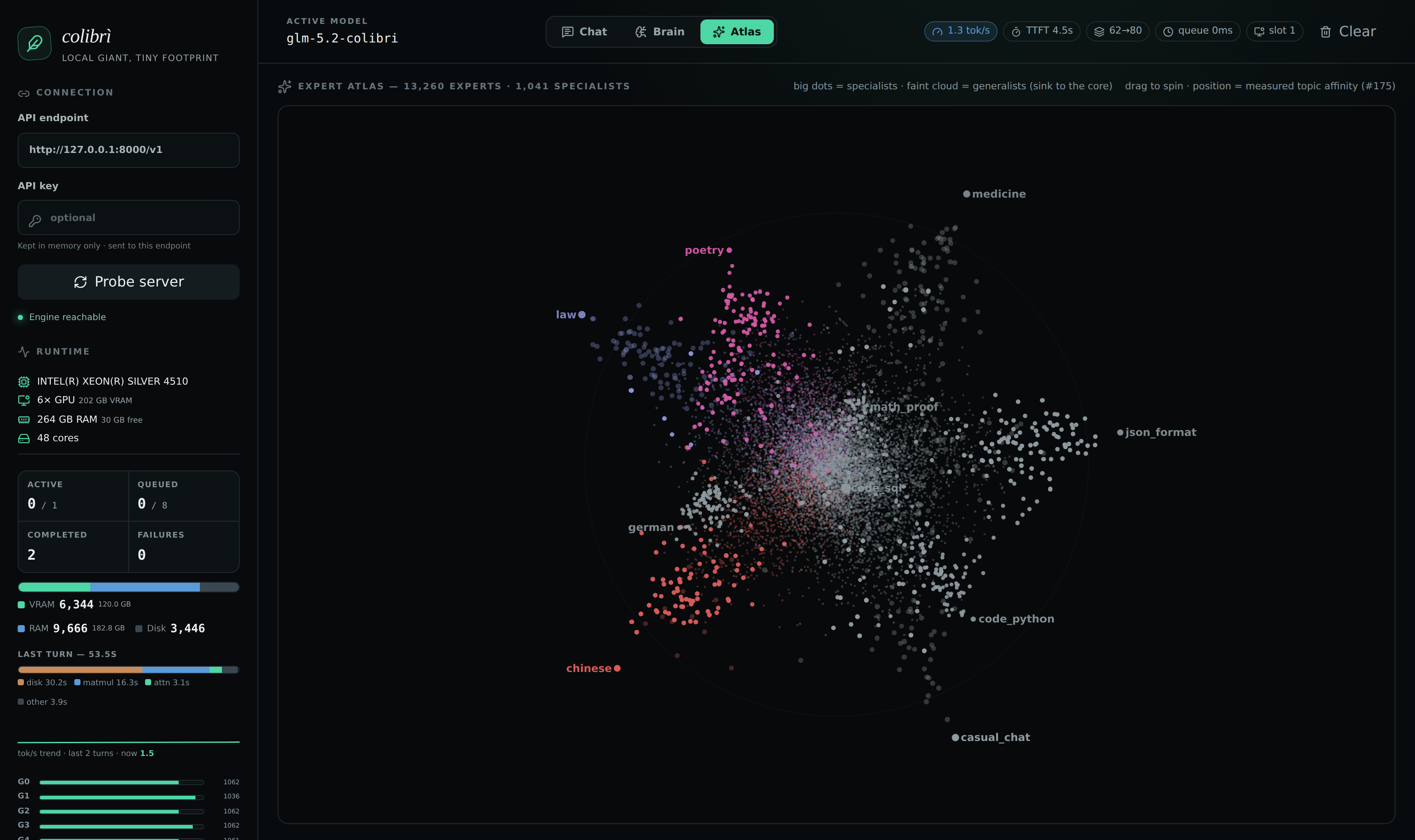
Running `./coli web` starts an HTTP server with an OpenAI-compatible endpoint, so any client already pointing at an OpenAI base URL redirects to localhost without code changes. The web dashboard shows live token metrics, per-turn timing, VRAM and RAM and disk tier allocation, and a real-time visualization of expert routing activity.
When a second SSD holds a copy of the model, colibrì routes expert reads across both drives simultaneously using a deterministic hash weighted by each drive's measured bandwidth. A 9 GB/s plus 3 GB/s pair reads experts roughly 33% faster than the faster drive alone. A partial mirror covering only some model shards still contributes, and a read error on the mirror falls back to the primary without crashing.
A coordinator process keeps token generation, routing, and KV state local while worker processes on other machines handle routed expert FFN computation over persistent TCP connections. A layer's routed batch is sent as one request per layer rather than one round trip per expert, so token latency scales with layer count, not expert count. Workers require a local copy of the converted model checkpoint.
The Brain page renders all 19,456 experts as a live cortex where color indicates storage tier, brightness shows routing heat, and every expert activated in a turn flashes white. The Atlas page shows 13,260 characterized experts as a 3-D map where position reflects measured routing affinity, not a learned embedding. Both pages are available in the web dashboard at no additional setup.
Features
- Expert weight streaming across VRAM, RAM, and NVMe
- Token-exact correctness guarantee
- OpenAI-compatible API server and web dashboard
- Dual-SSD read striping for higher decode bandwidth
- Local cluster mode for multi-machine inference
- Live expert visualization and routing atlas
How to install
Setup requires a git clone and a single make command; no external dependencies or package managers are needed.
git clone https://github.com/JustVugg/colibri
make -C colibri/c
./coli chat --model /path/to/glm-5.2
Recommended for this setup
Strengths
- Single C file, zero external dependencies: The engine is one C file and small headers. Building is `make -C colibri/c`, which requires only a C compiler. The CUDA, Metal, and Vulkan backends are optional; the engine runs on CPU without any GPU, without BLAS, and without a Python runtime at inference time. There is nothing to install beyond cloning the repo and running make.
- Correctness prioritized over speed: colibrì's stated policy is that placement decisions change speed only, never model answers. The MLA KV state is compressed 57x (576 floats per token instead of 32,768) and validated to produce byte-identical output across restarts. Speculative decoding defaults enforce findings from issue forensics: the MTP head must be int8 because int4 collapses acceptance to 0 to 4%, and draft and verify must compute the same function.
- Apache-2.0 permissive license: Apache-2.0 is an OSI-approved permissive license. You can run colibrì for personal or commercial use, modify it, distribute it, and include it in proprietary products without making your own source available. Attribution is required when distributing binary copies. There are no usage fees, server restrictions, or managed-service clauses.
- Learning cache that improves with use: The engine records which experts each workload routes to across sessions in a `.coli_usage` file and automatically pins the hottest ones on the next run. On machines where fast memory is scarce, repeated prompts in the same domain progressively reduce disk reads as hot experts migrate into RAM or VRAM. Speed improves without any manual tuning.
Trade-offs
- Slow decode on disk-bound hardware: On a 25 GB laptop streaming everything from NVMe, colibrì reports 0.05 to 0.1 tokens per second for the 744B model. That is human-readable but not practical for interactive use. Meaningful decode speed requires at least partial expert residency in RAM, which means 32 GB or more for the smaller model families. Cloud inference APIs deliver 50 or more tok/s with no hardware investment.
- Enormous model checkpoint size: A 744B int4 model checkpoint is approximately 370 GB. Downloading, storing, and converting weights requires significant disk space and time before inference can begin. The 2.8T Kimi K3 family requires at least 32 GB of fast memory and a proportionally larger checkpoint. Users on metered connections or with limited local storage cannot run the larger model families.
- Research-grade stability without a production SLA: colibrì explicitly carries no SLA on speed; the guarantee covers output correctness only. With 114 open issues and first release in July 2026, several optimizations including dual-SSD striping and CPU/GPU overlap are described as open hypotheses requiring broader community validation rather than settled behavior. APIs and defaults may change between versions during rapid development.
Tech stack
FAQ
The minimum is a 25 GB machine with NVMe storage, which can run the 744B GLM-5.2 at 0.05 to 0.1 tokens per second streaming from disk. For practical interactive speeds, 32 to 64 GB of RAM allows most expert weight pinning and delivers 1 to 5 tok/s on mid-range hardware. The 2.8T Kimi K3 requires at least 32 GB of fast memory. Community benchmarks from machines ranging from an M4 Pro Mac Mini to a 430 GB EPYC server are documented in the project's benchmark tables.
Yes. colibrì supports CUDA for NVIDIA GPUs, Metal for Apple Silicon, and Vulkan for any GPU with a Vulkan 1.2 driver, including AMD cards via Mesa/RADV. GPU acceleration is optional; the engine runs on CPU-only hardware. On a machine with VRAM, colibrì places the hottest experts in VRAM and falls back to RAM and NVMe for the rest.
Every forward pass is validated against a reference transformers oracle using teacher-forcing, typically matching 30 to 32 out of 32 positions. The design rule is that placement decisions (which storage tier an expert lives on) change speed only, never model output. The MLA KV state is compressed 57x but validated to produce byte-identical output to an uninterrupted session. Speed optimizations that introduce output drift are rejected before shipping.
Yes. Running `./coli web --model /path/to/model` starts an OpenAI-compatible HTTP server. Any client library or application already pointing at an OpenAI base URL can redirect to localhost without code changes. The same port also serves the web dashboard with live metrics and expert visualization.
colibrì is a research-grade inference engine first released in July 2026 and under rapid development. The project carries no SLA on speed, though it guarantees output correctness. With 114 open issues and several optimization behaviors described as open hypotheses, it is best suited for research, private applications, and exploratory development rather than customer-facing systems that require stable throughput guarantees.