
Bifrost
Open-source AI gateway with 23+ providers, failover, and MCP support.
Replaces Portkey
Who it's for
Bifrost gives platform teams a single control plane for all LLM traffic, with virtual keys per team, per-team budgets, and a unified dashboard. Instead of each team managing their own API keys and billing, costs are tracked and governed centrally.
If your organization uses a single team's LLM account with no cross-team billing or governance requirements, the control-plane layer is overhead. A direct SDK call is simpler.
Automatic failover means an agent workflow does not fail when a single provider goes down or hits a rate limit. Load balancing across multiple API keys raises the effective throughput ceiling without rewriting the agent's LLM calls.
If you're running a single-provider proof of concept or a low-volume project where downtime is acceptable, the gateway is unnecessary infrastructure.
Bifrost is a drop-in OpenAI-compatible alternative to LiteLLM's proxy mode. The benchmark data (54x lower P99 latency, 68% less memory at 500 RPS) is directly relevant to teams running LiteLLM at volume and hitting performance or memory issues.
If your existing LiteLLM deployment is stable and you have no performance complaints, migration adds risk with limited benefit.
The built-in MCP gateway centralizes tool connections for AI agents. Instead of each agent maintaining its own MCP client configuration, tools are registered once in Bifrost and available to all models passing through the gateway.
If you're building a single-agent app with a few tools and no multi-agent coordination, configuring Bifrost adds infrastructure with little payoff compared to a direct MCP client.
The problem
Building production AI systems on a single LLM provider is fragile. Provider outages, rate limits, and sudden pricing changes leave teams with no fallback, and adding provider redundancy manually means writing bespoke routing logic per provider API. That code becomes a maintenance burden as providers update their SDKs. Governance adds a second layer of work. When multiple teams or agents share API keys, costs accumulate invisibly until the bill arrives. Setting per-team budgets and audit logs requires custom instrumentation that most teams build slowly and inconsistently, if at all. Adding Model Context Protocol tool access across a fleet of agents adds a third coordination problem with no standard answer in the provider SDKs.
How it works
Routes requests across 23+ providers (OpenAI, Anthropic, AWS Bedrock, Google Vertex, Azure, and more) through a single OpenAI-compatible endpoint. Switching models or providers requires changing only the model string in the request body, not any SDK configuration.
Automatically reroutes to a backup provider when one goes down, with intelligent load distribution across multiple API keys for the same provider. In benchmarks, the gateway sustained 5,000 RPS with a 100% success rate on a t3.xlarge instance.
Caches LLM responses based on semantic similarity rather than exact string matches. Functionally equivalent questions return the cached answer, cutting redundant provider calls and reducing costs across a team's shared AI requests without changes to application code.
Acts as a centralized Model Context Protocol gateway, giving AI models access to external tools (filesystems, web search, databases) with centralized policy enforcement. All MCP tool connections route through one managed layer rather than being configured per agent.
Issues separate virtual API keys per team, project, or use case, each with independent spending limits and access controls. Usage costs are tracked at key granularity, making it possible to attribute costs to specific teams or stop a runaway model before it hits the monthly limit.
Includes native OpenTelemetry support and a built-in dashboard for monitoring request volumes, latency, and error rates without additional setup. Prometheus metrics are available for teams already running a monitoring stack.
Features
- Multi-Provider Routing
- Automatic Failover and Load Balancing
- Semantic Caching
- MCP Gateway
- Virtual Keys and Budget Management
- Built-in Observability
How to install
Deploy Bifrost as a local server using Docker or NPX.
npx -y @maximhq/bifrost

docker run -p 8080:8080 maximhq/bifrost

docker run -p 8080:8080 -v $(pwd)/data:/app/data maximhq/bifrost
Recommended for this setup
Strengths
- Go-native performance with verified benchmarks: The Go implementation adds 11µs of overhead per request at 5,000 RPS on a t3.xlarge, with a 100% success rate. Benchmarks against LiteLLM at 500 RPS show 54x lower P99 latency and 68% lower memory usage, making Bifrost viable for latency-sensitive workloads.
- Drop-in replacement requiring one URL change: Replacing an existing OpenAI, Anthropic, or Google GenAI SDK requires changing one line, the base_url value. No SDK rewrites, no new client libraries. Works with LangChain, LangGraph, Vercel AI SDK, LiteLLM, and most major AI frameworks.
- Apache-2.0 license with in-VPC deployment: The Apache-2.0 license permits commercial use, modification, and redistribution with no restrictions. The in-VPC deployment model means no API traffic routes through Bifrost or Maxim servers, which meets data residency requirements for financial, healthcare, and government workloads.
- Active project with a clear enterprise path: Created in March 2025, the repo reached 8,800+ stars in its first year. An enterprise tier adds clustering, adaptive load balancing, and guardrails for teams that outgrow the open-source feature set, with the Apache-2.0 core remaining free.
Trade-offs
- High open issue count for a young project: The GitHub tracker shows 1,225 open issues for a project launched in March 2025. While this partly reflects rapid adoption, teams evaluating Bifrost for production use should review the open issue list for blockers in their specific provider combination or deployment target before committing.
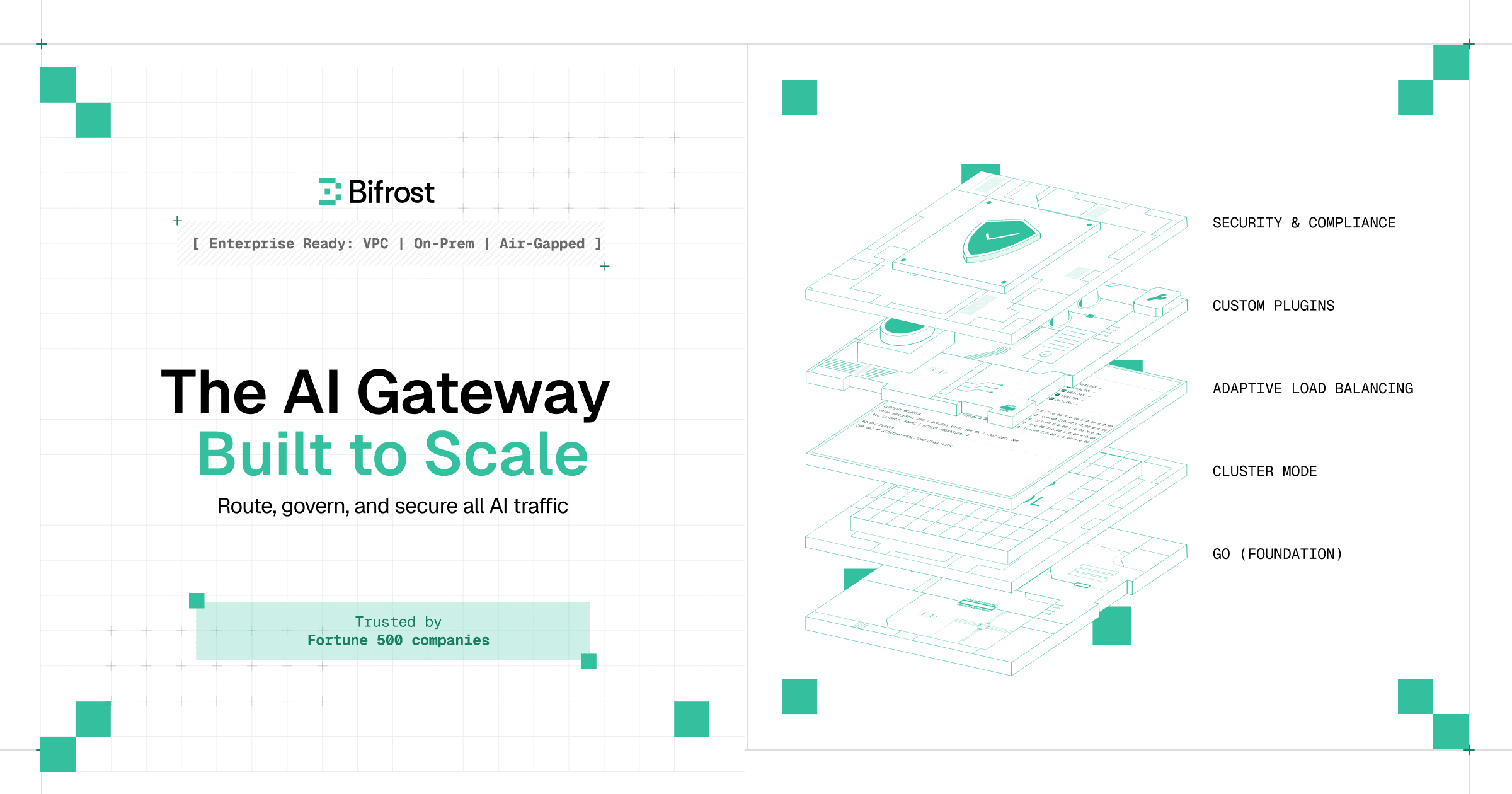
- Enterprise features require a Maxim commercial license: The OSS tier covers multi-provider routing, load balancing, failover, semantic caching, virtual keys, basic budget management, and OpenTelemetry observability. Clustering, adaptive load balancing, guardrails, and advanced MCP gateway features require a commercial license from Maxim.
- Shorter production track record than established gateways: Bifrost launched in March 2025. While performance benchmarks are strong and the project is actively maintained, its production track record is shorter than established alternatives. Teams running mission-critical workloads should evaluate stability through a pilot deployment first.
Tech stack
FAQ
Yes. The open-source version is Apache-2.0 licensed and free to self-host. Enterprise features (clustering, adaptive load balancing, guardrails, and advanced MCP gateway options) require a commercial license from Maxim; contact them for pricing.
Bifrost covers the same core use case as LiteLLM's proxy: a self-hosted gateway that provides a unified OpenAI-compatible API across multiple LLM providers. Benchmark comparisons at 500 RPS show 54x lower P99 latency and 68% less memory usage. Migration requires changing one base_url line in your existing SDK.
Not in a self-hosted deployment. Bifrost can be deployed entirely within your own VPC; no request data passes through Maxim or Bifrost servers. The built-in telemetry and observability data stay within your own monitoring stack.
The open-source version supports 23+ providers, including OpenAI, Anthropic, AWS Bedrock, Google Vertex, Azure, Cerebras, Cohere, Mistral, Ollama, and Groq. The repo description references support for 10,000+ models across these providers.
The open-source tier includes multi-provider routing, load balancing, failover, semantic caching, virtual keys, budget management, and OpenTelemetry observability. Enterprise adds clustering for multi-node deployments, adaptive load balancing, guardrails for content policy enforcement, and advanced MCP gateway features.